
用于金属材料超声辅助电弧焊的旋转超声焊极设计
Rotating Sonotrode Design for Ultrasonic-Assisted Arc Welding of Metal Materials.
作者信息
Mao Xinyu, Yang Zhidong, Chen Qihao, Hu Mingzhu, Gan Tian
机构信息
Provincial Key Laboratory of Advanced Welding Technology, Jiangsu University of Science and Technology, Zhenjiang 212003, China.
Nanjing KathMatic Technology Co., Ltd., Nanjing 211100, China.
出版信息
Materials (Basel). 2024 Mar 31;17(7):1599. doi: 10.3390/ma17071599.
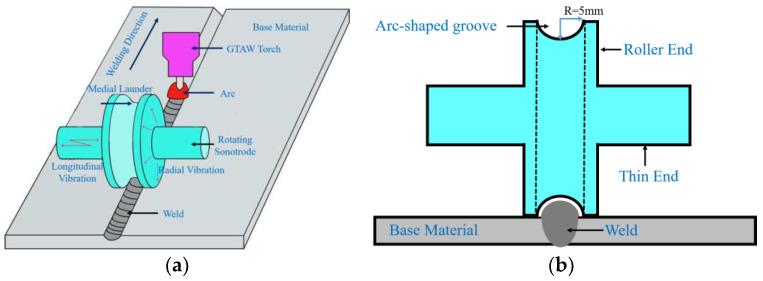
In the process of the ultrasonic-assisted arc welding of metal materials, traditional ultrasonic application methods, such as the low-frequency impact of ultrasonic horns on a base material, can easily cause the non-fusion defect. In order to solve this problem, a rotating sonotrode with a groove and double thin ends was designed in this study. The ultrasonic vibration is transmitted into the weld pool by the rolling of the sonotrode on both sides of the weld. The resonant frequency was set at 50 kHz. Firstly, based on the Mindlin theory, a rotating sonotrode without a groove was designed by solving the frequency equation and by conducting a finite element simulation. Secondly, the effects of the groove, perforation, and transition mode on the resonant frequency, stress distribution, and amplification factor were investigated by finite element simulation. Finally, the optimum rotating sonotrode with a groove was obtained. The results show that the size of a rotating sonotrode that has a small frequency error can be obtained by using the discrete interval solver method combined with finite element simulation. The groove can significantly reduce the resonant frequency. The stress concentration can be effectively reduced by using the elliptical transition mode. The resonant frequency and amplification factor of a rotating sonotrode with a groove could be effectively adjusted by a method of double-position joint perforation. The final resonant frequency was 49.721 kHz and the amplification factor was 3.02. This study provides an effective design method for a sonotrode with double thin ends and a groove structure.
在金属材料的超声辅助电弧焊接过程中,传统的超声应用方法,如超声变幅杆对母材的低频冲击,容易导致未熔合缺陷。为了解决这个问题,本研究设计了一种带有凹槽和双细端的旋转超声焊极。超声振动通过超声焊极在焊缝两侧的滚动传递到熔池中。共振频率设定为50kHz。首先,基于Mindlin理论,通过求解频率方程并进行有限元模拟,设计了一种无凹槽的旋转超声焊极。其次,通过有限元模拟研究了凹槽、穿孔和过渡方式对共振频率、应力分布和放大系数的影响。最后,得到了最佳的带凹槽旋转超声焊极。结果表明,采用离散区间求解器方法结合有限元模拟,可以得到频率误差较小的旋转超声焊极尺寸。凹槽可以显著降低共振频率。采用椭圆形过渡方式可以有效降低应力集中。采用双位接头穿孔方法可以有效调节带凹槽旋转超声焊极的共振频率和放大系数。最终共振频率为49.721kHz,放大系数为3.02。本研究为具有双细端和凹槽结构的超声焊极提供了一种有效的设计方法。



 Zotero 插件