
膳食二十二碳六烯酸(DHA)通过抑制二十碳五烯酸的延伸来下调肝脏 DHA 的合成。
Dietary docosahexaenoic acid (DHA) downregulates liver DHA synthesis by inhibiting eicosapentaenoic acid elongation.
机构信息
Department of Nutritional Sciences, University of Toronto, Toronto, ON, Canada.
Department of Nutrition, University of Chile, Santiago, Chile.
出版信息
J Lipid Res. 2024 Jun;65(6):100548. doi: 10.1016/j.jlr.2024.100548. Epub 2024 Apr 20.
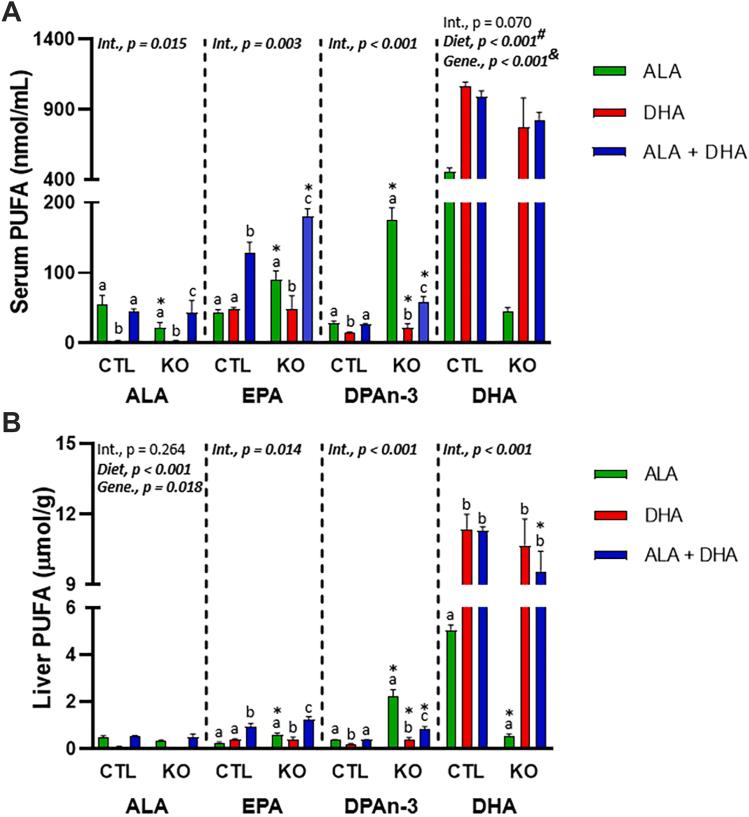
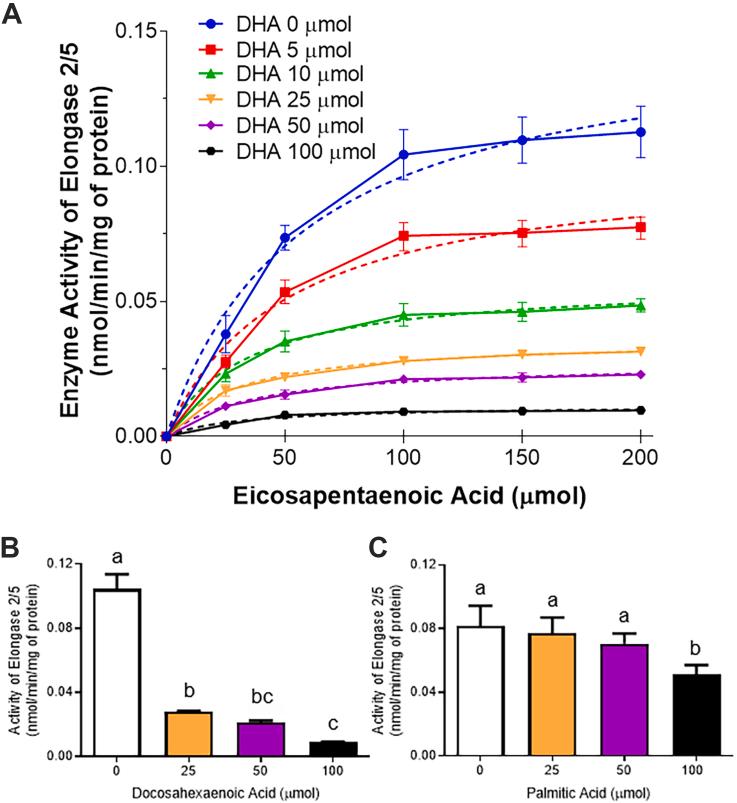
DHA is abundant in the brain where it regulates cell survival, neurogenesis, and neuroinflammation. DHA can be obtained from the diet or synthesized from alpha-linolenic acid (ALA; 18:3n-3) via a series of desaturation and elongation reactions occurring in the liver. Tracer studies suggest that dietary DHA can downregulate its own synthesis, but the mechanism remains undetermined and is the primary objective of this manuscript. First, we show by tracing C content (δC) of DHA via compound-specific isotope analysis, that following low dietary DHA, the brain receives DHA synthesized from ALA. We then show that dietary DHA increases mouse liver and serum EPA, which is dependant on ALA. Furthermore, by compound-specific isotope analysis we demonstrate that the source of increased EPA is slowed EPA metabolism, not increased DHA retroconversion as previously assumed. DHA feeding alone or with ALA lowered liver elongation of very long chain (ELOVL2, EPA elongation) enzyme activity despite no change in protein content. To further evaluate the role of ELOVL2, a liver-specific Elovl2 KO was generated showing that DHA feeding in the presence or absence of a functional liver ELOVL2 yields similar results. An enzyme competition assay for EPA elongation suggests both uncompetitive and noncompetitive inhibition by DHA depending on DHA levels. To translate our findings, we show that DHA supplementation in men and women increases EPA levels in a manner dependent on a SNP (rs953413) in the ELOVL2 gene. In conclusion, we identify a novel feedback inhibition pathway where dietary DHA downregulates its liver synthesis by inhibiting EPA elongation.
二十二碳六烯酸(DHA)在大脑中含量丰富,可调节细胞存活、神经发生和神经炎症。DHA 可从饮食中获得,也可通过一系列发生在肝脏中的去饱和和延伸反应,由 α-亚麻酸(ALA;18:3n-3)合成。示踪研究表明,膳食 DHA 可下调自身合成,但机制尚未确定,这是本手稿的主要目标。首先,我们通过对 DHA 的碳含量(δC)进行化合物特异性同位素分析,表明在低膳食 DHA 后,大脑会接收由 ALA 合成的 DHA。然后我们发现,膳食 DHA 增加了小鼠肝脏和血清中的 EPA,这依赖于 ALA。此外,通过化合物特异性同位素分析,我们证明增加的 EPA 来源于 EPA 代谢减缓,而不是以前假设的 DHA 逆向转化增加。单独或与 ALA 一起喂养 DHA 会降低肝脏中非常长链延伸(ELOVL2,EPA 延伸)酶的活性,尽管其蛋白含量没有变化。为了进一步评估 ELOVL2 的作用,生成了肝脏特异性 Elovl2 KO 小鼠,表明在存在或不存在功能性肝脏 ELOVL2 的情况下,DHA 喂养会产生类似的结果。EPA 延伸的酶竞争测定表明,DHA 对 EPA 延伸具有依赖于 DHA 水平的非竞争性和反竞争性抑制。为了转化我们的发现,我们表明 DHA 补充在男性和女性中以依赖于 ELOVL2 基因中 SNP(rs953413)的方式增加 EPA 水平。总之,我们确定了一种新的反馈抑制途径,其中膳食 DHA 通过抑制 EPA 延伸来下调其肝脏合成。



 Zotero 插件