
韩国社区居住老年人自评口腔健康与跌倒之间的时间趋势及关联:调查数据的二次分析
Temporal trends and the association between self-rated oral health and falls in community-dwelling older adults in South Korea: a secondary analysis of survey data.
作者信息
Seo Hyun-Ju, Ahn Soon-Ki, Choi Min-Jung
机构信息
College of Nursing, Chungnam National University, Daejeon, Republic of Korea.
Department of Preventive Medicine, Chungnam National University Hospital, Daejeon, Republic of Korea.
出版信息
BMJ Open. 2024 Apr 23;14(4):e081549. doi: 10.1136/bmjopen-2023-081549.
OBJECTIVE
This study aims to examine temporal trends and the association between falls and self-rated oral health (SROH) status in community-dwelling older Korean adults.
DESIGN
Secondary analysis of a serial cross-sectional study.
METHODS
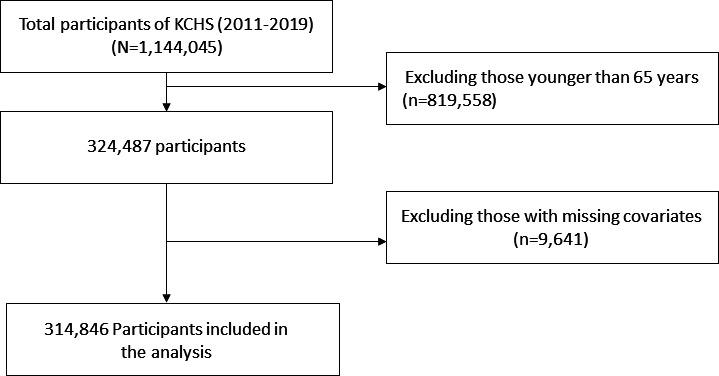
We analysed biennial data from 314 846 older adults in South Korea from 2011 to 2019 using data from the Korea Community Health Survey. Self-reported fall experience data came from the injury questionnaire question, 'Have you fallen in the past year (slipping, tripping, stumbling and falling)?'. For SROH, the participants were asked, 'How do you feel about your oral health, such as teeth and gums, in your own opinion?'. The association between SROH and falls was examined using a weighted multivariable logistic regression model adjusted for sociodemographic characteristics, health status and behaviours, and psychological factors.
RESULTS
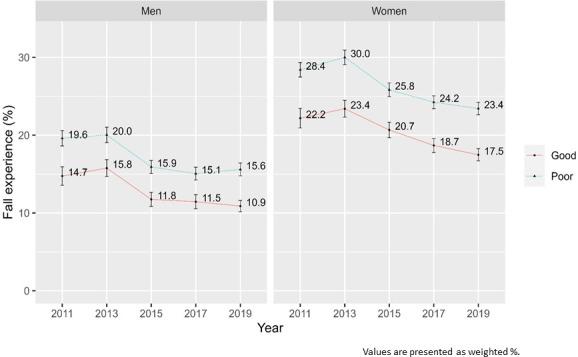
Those who reported poor SROH had a lower declining slope than the other groups, although all groups showed a significantly decreasing trend in both men and women from 2011 to 2019 (p for trend<0.001). Older adults who reported having poor SROH had a more significant history of fall accidents than the good SROH groups, controlling for potential confounding variables (adjusted OR 1.16 (95% CI 1.10 to 1.21) in men; adjusted OR 1.17 (95% CI 1.13 to 1.21) in women).
CONCLUSIONS
Older adults with poor SROH, especially women, had more fall accidents, making them a priority target for fall prevention strategies. This study suggests considering SROH status when identifying fall risk factors in community-dwelling older adults.
目的
本研究旨在探讨韩国社区居住的老年成年人跌倒的时间趋势以及跌倒与自评口腔健康(SROH)状况之间的关联。
设计
系列横断面研究的二次分析。
方法
我们使用韩国社区健康调查的数据,分析了2011年至2019年韩国314846名老年人的两年期数据。自我报告的跌倒经历数据来自伤害调查问卷中的问题:“您在过去一年中是否跌倒过(滑倒、绊倒、绊跌和摔倒)?”。对于SROH,参与者被问及:“您自己认为您的口腔健康,如牙齿和牙龈,感觉如何?”。使用调整了社会人口学特征、健康状况和行为以及心理因素的加权多变量逻辑回归模型,研究SROH与跌倒之间的关联。
结果
报告SROH较差的人群下降斜率低于其他组,尽管从2011年到2019年,所有组在男性和女性中均呈现出显著下降趋势(趋势p<0.001)。在控制潜在混杂变量后,报告SROH较差的老年人跌倒事故史比SROH良好的组更显著(男性调整后的OR为1.16(95%CI为1.10至1.21);女性调整后的OR为1.17(95%CI为1.13至1.21))。
结论
SROH较差的老年人,尤其是女性,跌倒事故更多,这使他们成为预防跌倒策略中的优先目标。本研究建议在识别社区居住老年成年人的跌倒风险因素时考虑SROH状况。
 Zotero 插件