
用于Ti6Al4V的冷金属过渡增材制造与激光金属沉积的混合制造:微观结构与动态/静态力学性能
Hybrid Fabrication of Cold Metal Transfer Additive Manufacturing and Laser Metal Deposition for Ti6Al4V: The Microstructure and Dynamic/Static Mechanical Properties.
作者信息
Chen Zhenwen, Liang Yanning, Li Cong, Zhang Xiaoyong, Kong Jian, Fan Jikang, Wang Kehong, Peng Yong
机构信息
School of Materials Science and Engineering, Nanjing University of Science and Technology, Nanjing 210094, China.
Key Laboratory of Controlled Arc Intelligent Additive Manufacturing Technology, Nanjing University of Science and Technology, Nanjing 210094, China.
出版信息
Materials (Basel). 2024 Apr 18;17(8):1862. doi: 10.3390/ma17081862.
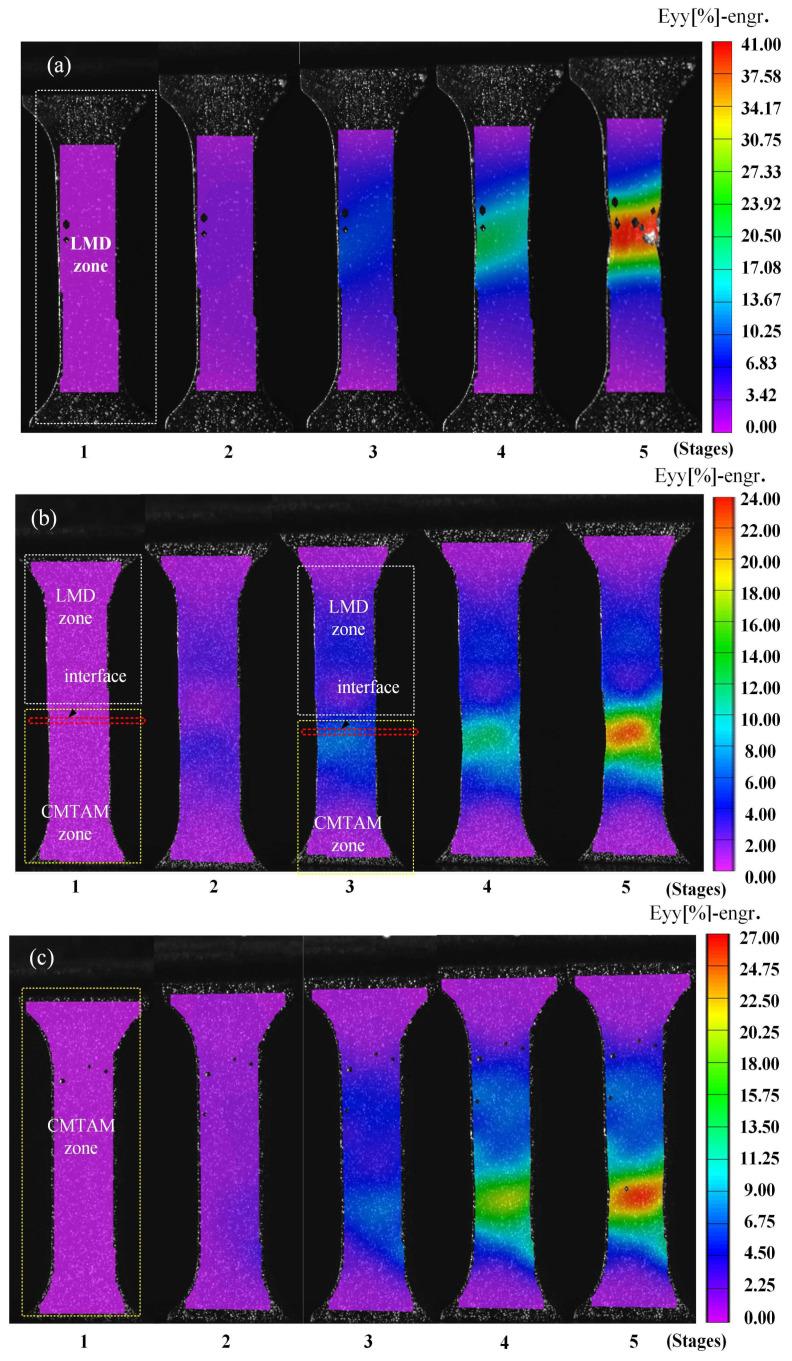
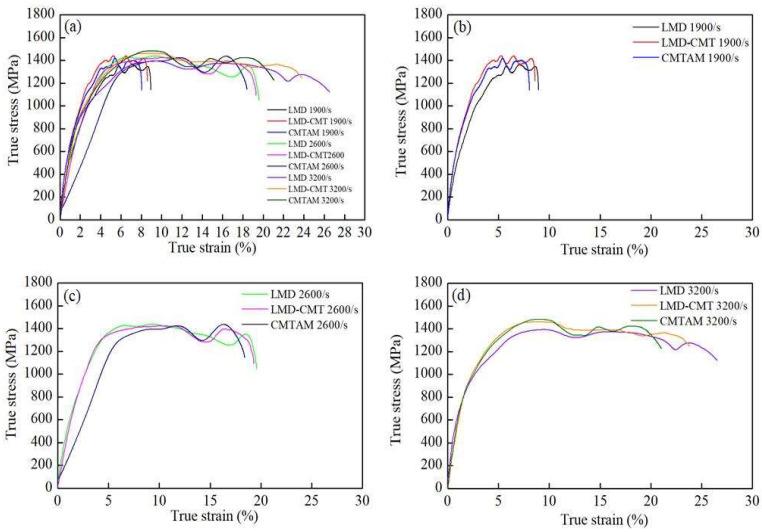
The titanium alloy components utilized in the aviation field are typically large in size and possess complex structures. By utilizing multiple additive manufacturing processes, the precision and efficiency requirements of production can be met. We investigated the hybrid additive manufacturing of Ti-6Al-4V using a combination of cold metal transfer additive manufacturing (CMTAM) and laser metal deposition (LMD), as well as the feasibility of using the CMT-LMD hybrid additive manufacturing process for fabricating Ti-6Al-4V components. Microstructural examinations, tensile testing coupled with digital image correlation and dynamic compressive experiments (by the split Hopkinson pressure bar (SHPB) system) were employed to assess the parts. The results indicate that the interface of the LMD and CMTAM zone formed a compact metallurgical bonding. In the CMTAM and LMD zone, the prior-β grains exhibit epitaxial growth, forming columnar prior-β grains. Due to laser remelting, the CMT-LMD hybrid additive zone experiences grain refinement, resulting in equiaxed prior-β grains at the interface with an average grain size smaller than that of the CMTAM and LMD regions. The microstructures reveal significant differences in grain orientation and morphology among the zones, with distinct textures forming in each zone. In the CMT-LMD hybrid zone, due to interfacial strengthening, strain concentration occurs in the arc additive zone during tensile testing, leading to fracture on the CMTAM zone. Under high-strain-rate dynamic impact conditions, the LMD region exhibits ductile fracture, while the CMTAM zone demonstrates brittle fracture. The hybrid zone combines ductile and brittle fracture modes, and the CMT-LMD hybrid material exhibits superior dynamic impact performance compared to the single deposition zone.
航空领域使用的钛合金部件通常尺寸较大且结构复杂。通过采用多种增材制造工艺,可以满足生产的精度和效率要求。我们研究了使用冷金属过渡增材制造(CMTAM)和激光金属沉积(LMD)相结合的方法对Ti-6Al-4V进行混合增材制造,以及使用CMT-LMD混合增材制造工艺制造Ti-6Al-4V部件的可行性。采用微观结构检查、结合数字图像相关的拉伸试验和动态压缩试验(通过分离式霍普金森压杆(SHPB)系统)来评估部件。结果表明,LMD和CMTAM区域的界面形成了紧密的冶金结合。在CMTAM和LMD区域,原始β晶粒呈现外延生长,形成柱状原始β晶粒。由于激光重熔,CMT-LMD混合增材区域经历了晶粒细化,在界面处形成等轴原始β晶粒,其平均晶粒尺寸小于CMTAM和LMD区域。微观结构显示各区域之间在晶粒取向和形态上存在显著差异,每个区域都形成了独特的织构。在CMT-LMD混合区域,由于界面强化,拉伸试验期间电弧增材区域会出现应变集中,导致在CMTAM区域发生断裂。在高应变率动态冲击条件下,LMD区域呈现韧性断裂,而CMTAM区域表现为脆性断裂。混合区域结合了韧性和脆性断裂模式,与单一沉积区域相比,CMT-LMD混合材料表现出优异的动态冲击性能。




 Zotero 插件