
真空中激光加速材料碎片在玻璃板上造成的相连微米级高频损伤的分离与分析。
Separation and Analysis of Connected, Micrometer-Sized, High-Frequency Damage on Glass Plates due to Laser-Accelerated Material Fragments in Vacuum.
作者信息
Pietzsch Sabrina, Wollny Sebastian, Grimm Paul
机构信息
Faculty of Media, Darmstadt University of Applied Sciences, Schöfferstraße 3, 64295 Darmstadt, Germany.
Information Center for Education, DIPF|Leibniz Institute for Research and Information in Education, Rostocker Straße 6, 60323 Frankfurt am Main, Germany.
出版信息
J Imaging. 2024 Apr 26;10(5):101. doi: 10.3390/jimaging10050101.
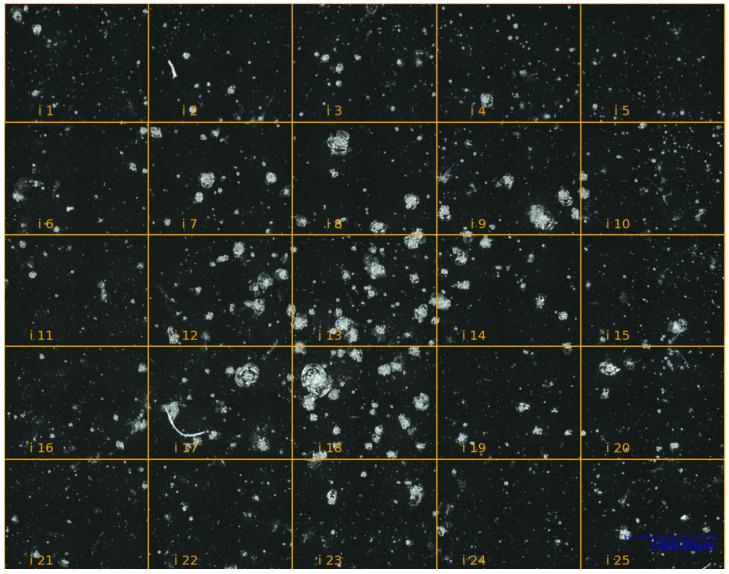
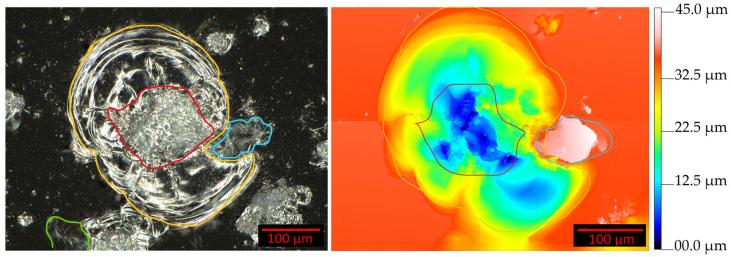
In this paper, we present a new processing method, called MOSES-Impacts, for the detection of micrometer-sized damage on glass plate surfaces. It extends existing methods by a separation of damaged areas, called impacts, to support state-of-the-art recycling systems in optimizing their parameters. These recycling systems are used to repair process-related damages on glass plate surfaces, caused by accelerated material fragments, which arise during a laser-matter interaction in a vacuum. Due to a high number of impacts, the presented MOSES-Impacts algorithm focuses on the separation of connected impacts in two-dimensional images. This separation is crucial for the extraction of relevant features such as centers of gravity and radii of impacts, which are used as recycling parameters. The results show that the MOSES-Impacts algorithm effectively separates impacts, achieves a mean agreement with human users of (82.0 ± 2.0)%, and improves the recycling of glass plate surfaces by identifying around 7% of glass plate surface area as being not in need of repair compared to existing methods.
在本文中,我们提出了一种名为MOSES-Impacts的新处理方法,用于检测玻璃板表面微米级的损伤。它通过分离称为撞击的受损区域对现有方法进行了扩展,以支持最先进的回收系统优化其参数。这些回收系统用于修复玻璃板表面与工艺相关的损伤,这些损伤是由真空中激光与物质相互作用期间产生的加速材料碎片造成的。由于撞击数量众多,所提出的MOSES-Impacts算法专注于二维图像中相连撞击的分离。这种分离对于提取诸如撞击重心和半径等相关特征至关重要,这些特征被用作回收参数。结果表明,MOSES-Impacts算法有效地分离了撞击,与人工用户的平均一致性达到(82.0 ± 2.0)%,并且与现有方法相比,通过识别出约7%的玻璃板表面积无需修复,提高了玻璃板表面的回收利用率。





 Zotero 插件