
用于液晶弹性体活性响应的液晶取向与形状优化
Liquid Crystal Orientation and Shape Optimization for the Active Response of Liquid Crystal Elastomers.
作者信息
Barrera Jorge Luis, Cook Caitlyn, Lee Elaine, Swartz Kenneth, Tortorelli Daniel
机构信息
Lawrence Livermore National Laboratory, 7000 East Ave, Livermore, CA 94550, USA.
出版信息
Polymers (Basel). 2024 May 17;16(10):1425. doi: 10.3390/polym16101425.
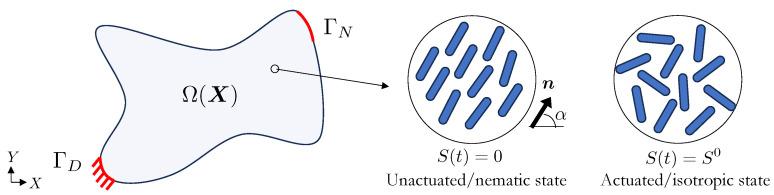
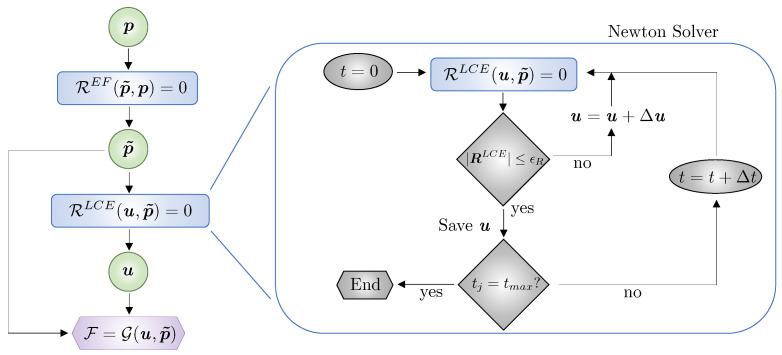
Liquid crystal elastomers (LCEs) are responsive materials that can undergo large reversible deformations upon exposure to external stimuli, such as electrical and thermal fields. Controlling the alignment of their liquid crystals mesogens to achieve desired shape changes unlocks a new design paradigm that is unavailable when using traditional materials. While experimental measurements can provide valuable insights into their behavior, computational analysis is essential to exploit their full potential. Accurate simulation is not, however, the end goal; rather, it is the means to achieve their optimal design. Such design optimization problems are best solved with algorithms that require gradients, i.e., sensitivities, of the cost and constraint functions with respect to the design parameters, to efficiently traverse the design space. In this work, a nonlinear LCE model and adjoint sensitivity analysis are implemented in a scalable and flexible finite element-based open source framework and integrated into a gradient-based design optimization tool. To display the versatility of the computational framework, LCE design problems that optimize both the material, i.e., liquid crystal orientation, and structural shape to reach a target actuated shapes or maximize energy absorption are solved. Multiple parameterizations, customized to address fabrication limitations, are investigated in both 2D and 3D. The case studies are followed by a discussion on the simulation and design optimization hurdles, as well as potential avenues for improving the robustness of similar computational frameworks for applications of interest.
液晶弹性体(LCEs)是一种响应性材料,在受到外部刺激(如电场和热场)时会发生大的可逆变形。控制其液晶介晶的排列以实现所需的形状变化,开启了一种使用传统材料时无法实现的新设计范式。虽然实验测量可以为它们的行为提供有价值的见解,但计算分析对于充分发挥其潜力至关重要。然而,精确模拟并非最终目标;相反,它是实现其优化设计的手段。此类设计优化问题最好用需要成本和约束函数相对于设计参数的梯度(即灵敏度)的算法来解决,以便有效地遍历设计空间。在这项工作中,一个非线性LCE模型和伴随灵敏度分析在一个基于有限元的可扩展且灵活的开源框架中实现,并集成到一个基于梯度的设计优化工具中。为了展示计算框架的通用性,解决了LCE设计问题,这些问题同时优化材料(即液晶取向)和结构形状,以达到目标驱动形状或最大化能量吸收。在二维和三维中研究了多种针对制造限制定制的参数化方法。案例研究之后讨论了模拟和设计优化的障碍,以及改进类似计算框架对感兴趣应用的鲁棒性的潜在途径。



 Zotero 插件