
严重内翻畸形全踝关节置换术中内踝截骨术后骨不连:3例报告
Nonunion after medial malleolar osteotomy in total ankle arthroplasties for severe varus deformity: a report of 3 cases.
作者信息
Okamura Gensuke, Hirao Makoto, Noguchi Takaaki, Etani Yuki, Ebina Kosuke, Miura Taihei, Tsuboi Hideki, Goshima Atsushi, Okada Seiji, Hashimoto Jun
机构信息
Department of Orthopaedic Surgery, National Hospital Organization, Osaka Minami Medical Center, Osaka 586-8621, Japan.
Department of Orthopaedic Surgery, Osaka University Graduate School of Medicine, Osaka 565-0871, Japan.
出版信息
J Surg Case Rep. 2024 May 30;2024(5):rjae358. doi: 10.1093/jscr/rjae358. eCollection 2024 May.
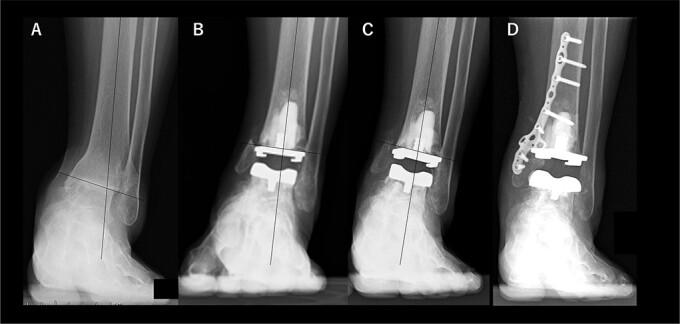
Of the three ankles after total ankle arthroplasty (TAA) with medial malleolar osteotomy for severe varus deformity (talar varus tilt >10°), two failed in varus migration of the tibial component. In these two cases, tibial osteotomy was performed with varus alignment of 5°and 2°, and with medially shifted placement of tibial component, while one ankle showed no migratoin of prostheses after 5 years, even with nonunion. In this case, tibial osteotomy was performed with a valgus alignment of 4°. Internal fixation after medial malleolar osteotomy should be done for severe varus cases. Medially shifted placement of tibial component should be avoided. Fortunately, the failure did not occur in a case of valgus of the distal tibia. Valgus tibial osteotomy might help to reduce the collision of the talus against the medial malleolus.
在因严重内翻畸形(距骨内翻倾斜>10°)行内踝截骨的全踝关节置换术(TAA)后的三个踝关节中,有两个出现胫骨部件内翻移位失败。在这两个病例中,胫骨截骨时分别采用了5°和2°的内翻对线,且胫骨部件向内侧移位放置,而另一个踝关节在5年后假体未出现移位,即使存在骨不连。在这个病例中,胫骨截骨采用了4°的外翻对线。对于严重内翻病例,内踝截骨后应进行内固定。应避免胫骨部件向内侧移位放置。幸运的是,胫骨远端外翻的病例未出现失败情况。胫骨外翻截骨可能有助于减少距骨与内踝的碰撞。


 Zotero 插件