
在盐碱湿地中,添加生物炭改变土壤性质时,可能会对植物群落表现产生负面影响。
Biochar addition can negatively affect plant community performance when altering soil properties in saline-alkali wetlands.
作者信息
Wang Ziyi, He Mengxuan, Lu Xueqiang, Meng Zirui, Liu Jie, Mo Xunqiang
机构信息
School of Geographic and Environmental Science, Tianjin Normal University, Tianjin, China.
College of Environment Science and Engineering, Nankai University, Tianjin, China.
出版信息
Front Plant Sci. 2024 May 16;15:1347658. doi: 10.3389/fpls.2024.1347658. eCollection 2024.
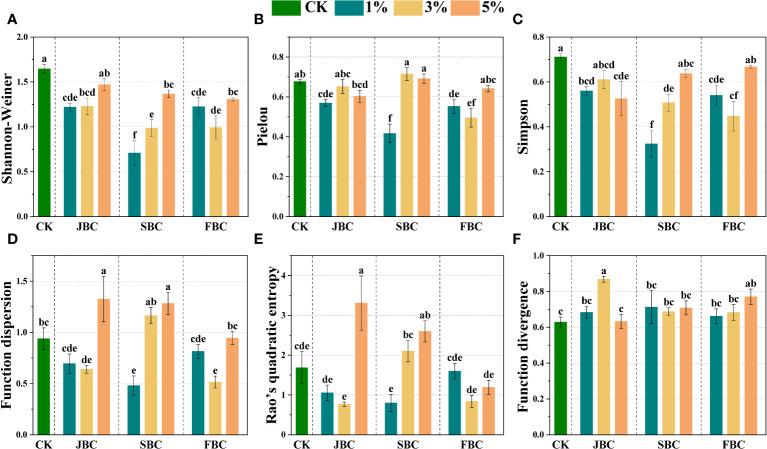
Biochar is a widely proposed solution for improving degraded soil in coastal wetland ecosystems. However, the impacts of biochar addition on the soil and plant communities in the wetland remains largely unknown. In this study, we conducted a greenhouse experiment using soil seed bank from a coastal saline-alkaline wetland. Three types of biochar, including biochar (JBC), biochar (SBC) and biochar (FBC), were added to the saline-alkaline soil at ratios of 1%, 3% and 5% (w/w). Our findings revealed that biochar addition significantly increased soil pH, and increased available potassium (AK) by 3.74% - 170.91%, while reduced soil salinity (expect for 3% SBC and 5%SBC) by 28.08% - 46.93%. Among the different biochar types, the application of 5% FBC was found to be the most effective in increasing nutrients and reducing salinity. Furthermore, biochar addition generally resulted in a decrease of 7.27% - 90.94% in species abundance, 17.26% - 61.21% in community height, 12.28% - 56.42% in stem diameter, 55.34% - 90.11% in total biomass and 29.22% - 78.55% in root tissue density (RTD). In particular, such negative effects was the worst in the SBC samples. However, 3% and 5% SBC increased specific root length (SRL) by 177.89% and 265.65%, and specific root surface area (SRSA) by 477.02% and 286.57%, respectively. The findings suggested that the plant community performance was primarily affected by soil pH, salinity and nutrients levels. Furthermore, biochar addition also influenced species diversity and functional diversity, ultimately affecting ecosystem stability. Therefore, it is important to consider the negative findings indirectly indicate the ecological risks associated with biochar addition in coastal salt-alkaline soils. Furthermore, was needed to desalt before carbonization to prevent soil salinization when using biochar, as it is a halophyte.
生物炭是一种被广泛提议用于改善沿海湿地生态系统退化土壤的解决方案。然而,添加生物炭对湿地土壤和植物群落的影响在很大程度上仍然未知。在本研究中,我们使用来自沿海盐碱湿地的土壤种子库进行了一项温室实验。将三种类型的生物炭,包括生物炭(JBC)、生物炭(SBC)和生物炭(FBC),以1%、3%和5%(w/w)的比例添加到盐碱土中。我们的研究结果表明,添加生物炭显著提高了土壤pH值,使有效钾(AK)增加了3.74% - 170.91%,同时使土壤盐分(除3% SBC和5% SBC外)降低了28.08% - 46.93%。在不同类型的生物炭中,发现施用5% FBC在增加养分和降低盐分方面最为有效。此外,添加生物炭通常导致物种丰富度下降7.27% - 90.94%,群落高度下降17.26% - 61.21%,茎直径下降12.28% - 56.42%,总生物量下降55.34% - 90.11%,根组织密度(RTD)下降29.22% - 78.55%。特别是,这种负面影响在SBC样本中最为严重。然而,3%和5%的SBC分别使比根长(SRL)增加了177.89%和265.




 Zotero 插件