
容积分析表明,胸主动脉腔内修复术后真腔和假腔重塑持续12个月。
Volumetric analysis demonstrates that true and false lumen remodeling persists for 12 months after thoracic endovascular aortic repair.
作者信息
Suh Ga-Young, Hirotsu Kelsey, Beygui Ramin E, Dake Michael D, Fleischmann Dominik, Cheng Christopher P
机构信息
Department of Surgery, Stanford University, Stanford, Calif.
School of Medicine, Stanford University, Stanford, Calif.
出版信息
J Vasc Surg Cases Innov Tech. 2016 Aug 24;2(3):101-104. doi: 10.1016/j.jvscit.2016.05.001. eCollection 2016 Sep.
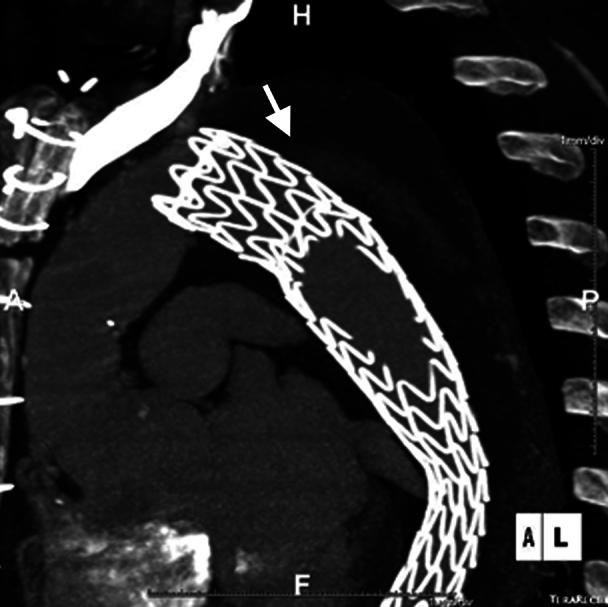
A 62-year-old man underwent an elephant trunk procedure followed by thoracic endovascular aortic repair (TEVAR). Computed tomography angiography-based models were built to quantify volume of the whole aorta and true and false lumens preoperatively, before TEVAR, after TEVAR, and at follow-up at 3, 6, and 12 months. With TEVAR, descending aortic true lumen volume increased by 54%, then increased additionally by 60% during 12 months. The descending aortic false lumen volume regressed continuously for 12 months following TEVAR, with the most rapid rate from 6 to 12 months at 16 cm/month. TEVAR immediately increased true lumen volume and continued to remodel the true and false lumens throughout the following 12 months.
一名62岁男性接受了象鼻手术,随后进行了胸主动脉腔内修复术(TEVAR)。基于计算机断层扫描血管造影术建立模型,以术前、TEVAR术前、TEVAR术后以及3个月、6个月和12个月随访时对整个主动脉以及真腔和假腔的容积进行量化。通过TEVAR,降主动脉真腔容积增加了54%,然后在12个月内又额外增加了60%。TEVAR术后,降主动脉假腔容积在12个月内持续缩小,在6至12个月时缩小速度最快,为每月16厘米。TEVAR立即增加了真腔容积,并在接下来的12个月内持续重塑真腔和假腔。


 Zotero 插件