
对ASTM G32 - 16(固定试样)标准空蚀试验提出质疑。
Questioning the ASTM G32-16 (stationary specimen) standard cavitation erosion test.
作者信息
Dular Matevž, Montalvo Guillermo Enrique Barragan, Hočevar Marko, Novak Lovrenc, Ohl Claus Dieter, Petkovsek Martin
机构信息
Faculty of Mechanical Engineering, University of Ljubljana, Askerceva 6, 1000 Ljubljana, SI, Slovenia; Institute for Physics, Otto von Guerricke University, Universitätsplatz 2, 39106 Magdeburg, DE, Germany.
Escuela Politécnica Nacional, Av. Ladrón de Guevara E11-253, Quito 170525, Ecuador.
出版信息
Ultrason Sonochem. 2024 Jul;107:106930. doi: 10.1016/j.ultsonch.2024.106930. Epub 2024 May 31.
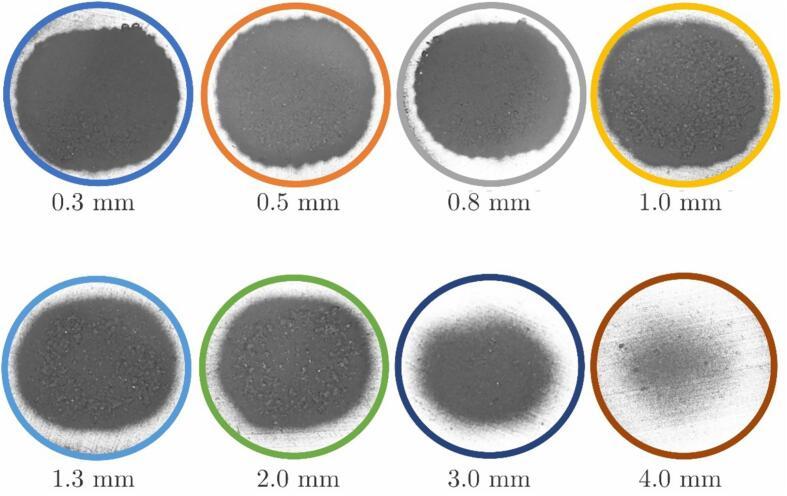
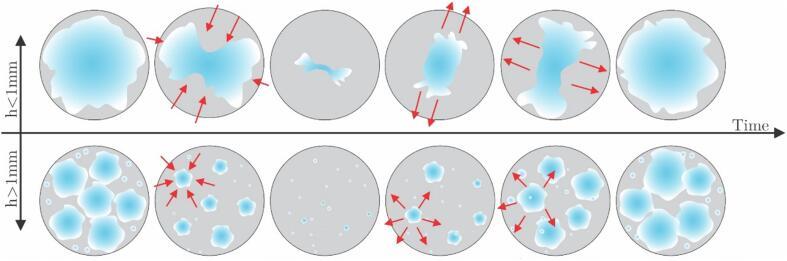
Cavitation erosion is one of the most severe problems encountered in hydraulic turbomachinery. When testing the materials, the engineers usually rely on standardized procedures. The most common one being the vibratory ASTM G-32 test, which offers two possibilities of performing the test - the direct, where the specimen is attached to the ultrasonic device and the indirect, where the specimen is stationary and exposed to the ultrasonic horn, positioned just 0.5 mm from it. The erosion rates from the two are significantly different and a question may be asked if they are at all comparable and further on are they comparable to the "real-life" hydrodynamic cavitation which occurs in turbomachinery. In this study we performed erosion tests on a stationary specimen where the gap between the specimen and the horn was varied from 0.3 to 4 mm. In addition, we used high speed visualization to observe the cavitation in the gap. We observed that the cavitation erosion rate strongly depends on the gap. From visualization we see that the cavitation dynamics significantly changes in a small gap, leading to a large, but 2-dimensional cavitation bubbles which collapse very slowly, compared to the small spherical ones in a larger gap. We investigated the probability of shock wave occurrence and derived a very simple model, which gives accurate qualitative predictions of experimental data. Finally, the study puts into question the validity of ASTM G32 test - the most common approach used in engineering today.
空化侵蚀是水力涡轮机械中遇到的最严重问题之一。在测试材料时,工程师通常依赖标准化程序。最常见的是振动式ASTM G - 32测试,它提供了两种进行测试的方式——直接方式,即把试样附着在超声设备上;间接方式,即试样静止不动,暴露于距其仅0.5毫米的超声变幅杆下。这两种方式的侵蚀速率显著不同,人们可能会问它们是否具有可比性,进而它们是否与涡轮机械中发生的“实际”流体动力空化具有可比性。在本研究中,我们对一个静止试样进行了侵蚀测试,试样与变幅杆之间的间隙在0.3至4毫米之间变化。此外,我们使用高速可视化技术来观察间隙中的空化现象。我们观察到空化侵蚀速率强烈依赖于间隙。从可视化结果可以看出,在小间隙中,空化动力学显著变化,会产生大的二维空化气泡,与大间隙中的小球形气泡相比,其坍塌非常缓慢。我们研究了冲击波出现的概率,并推导了一个非常简单的模型,该模型对实验数据给出了准确的定性预测。最后,该研究对ASTM G32测试(当今工程中最常用的方法)的有效性提出了质疑。






 Zotero 插件