National & Regional United Engineering Lab of Tissue Engineering, Department of Orthopedics, Southwest Hospital, Third Military Medical University (Army Medical University), Chongqing, 400038, China.
Department of Neurosurgery, National Clinical Research Center for Child Health and Disorders, Ministry of Education Key Laboratory of Child Development and Disorders, Chongqing Key Laboratory of Pediatrics, Children's Hospital of Chongqing Medical University, Chongqing, 400014, China.
BMC Public Health. 2024 Jun 9;24(1):1550. doi: 10.1186/s12889-024-19070-z.
Obesity is characterized by excessive fat accumulation in the body. Physical activity (PA) is an effective intervention to combat obesity, but the effectiveness of different PA patterns on controlling obesity is unclear. Lipid accumulation product (LAP), derived from waist circumference and triglycerides, is a novel indicator for obesity evaluation. However, the association between PA patterns (i.e., weekend warriors and regularly active) and LAP remains unexplored. This study aims to elucidate the relationship between PA patterns and LAP in US adult population.
Adult individuals with complete data on LAP, PA patterns, and other covariates from the National Health and Nutrition Examination Survey (NHANES) database (2007-2018) were included in this study. Multivariate linear regression models were utilized to explore the association between PA patterns and LAP. Subgroup analyses, interaction tests, restricted cubic spline (RCS) regression analyses, and threshold and saturation effect analyses were also performed to investigate the stability and nonlinearity of PA-LAP association, respectively.
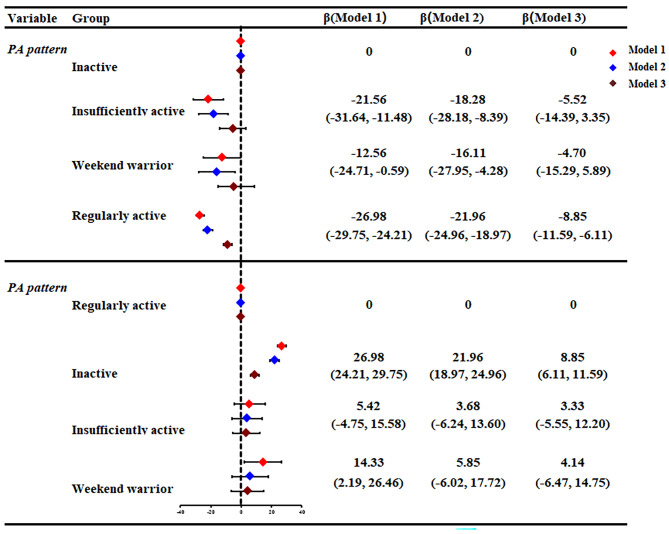
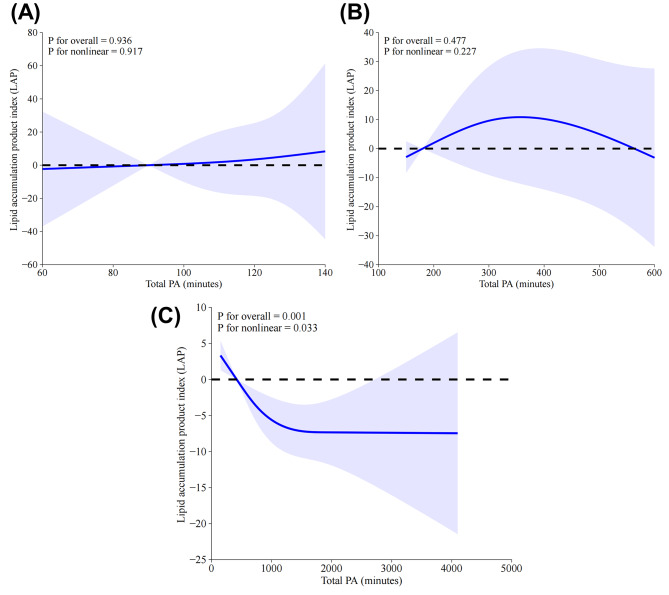
A total of 11,212 participants were included in this study. After adjusting for all potential covariates, being regularly active (RA) (β=-8.85, P < 0.05) obtained significantly higher LAP reduction as opposed to being weekend warriors (WWs) (β=-4.70, P = 0.3841). Furthermore, subgroup analyses and interaction tests indicated that the PA-LAP association was more pronounced in individuals with higher education levels (P interaction = 0.0084) and diabetes (P interaction = 0.0062). Additionally, a significant, non-linear, and negative correlation between weekly total PA and LAP in non-inactive individuals was identified by RCS analysis (P for overall < 0.001, P for nonlinearity = 0.009). A threshold of 440 min in weekly total PA was found to arouse favorable LAP reduction.
Being regularly active obtained better LAP reduction as opposed to being WWs. For non-inactive adults, engaging in more than 440 min of PA per week helps to reduce LAP effectively.
肥胖的特征是体内脂肪过度积累。身体活动(PA)是对抗肥胖的有效干预措施,但不同 PA 模式对控制肥胖的有效性尚不清楚。脂质蓄积产物(LAP)源自腰围和甘油三酯,是一种新的肥胖评估指标。然而,PA 模式(即周末战士和经常活跃者)与 LAP 之间的关联尚未得到探索。本研究旨在阐明美国成年人中 PA 模式与 LAP 之间的关系。
本研究纳入了来自国家健康和营养检查调查(NHANES)数据库(2007-2018 年)中具有完整 LAP、PA 模式和其他协变量数据的成年个体。采用多元线性回归模型探讨 PA 模式与 LAP 的关系。还进行了亚组分析、交互检验、限制立方样条(RCS)回归分析以及阈值和饱和效应分析,分别以探究 PA-LAP 关联的稳定性和非线性。
本研究共纳入 11212 名参与者。在校正所有潜在协变量后,与周末战士(WWs)相比,经常活跃(RA)(β=-8.85,P<0.05)显著降低了 LAP(β=-4.70,P=0.3841)。此外,亚组分析和交互检验表明,在具有较高教育水平(P 交互=0.0084)和糖尿病(P 交互=0.0062)的个体中,PA-LAP 关联更为明显。此外,通过 RCS 分析发现,在非活跃个体中,每周总 PA 与 LAP 之间存在显著、非线性和负相关(P 总<0.001,P 非线性=0.009)。发现每周总 PA 达到 440 分钟是引起 LAP 降低的一个阈值。
与 WWs 相比,RA 可以更好地降低 LAP。对于非活跃的成年人,每周进行超过 440 分钟的 PA 有助于有效降低 LAP。