
神经解剖学证据以及与人类功能磁共振成像数据相符的小鼠降钙素基因相关肽模型支持肽能性动眼神经副核参与偏头痛。
Neuroanatomical evidence and a mouse calcitonin gene-related peptide model in line with human functional magnetic resonance imaging data support the involvement of peptidergic Edinger-Westphal nucleus in migraine.
作者信息
Al-Omari Ammar, Gaszner Balázs, Zelena Dóra, Gecse Kinga, Berta Gergely, Biró-Sütő Tünde, Szocsics Péter, Maglóczky Zsófia, Gombás Péter, Pintér Erika, Juhász Gabriella, Kormos Viktória
机构信息
Department of Pharmacology and Pharmacotherapy, Medical School, University of Pécs, Pécs, Hungary.
Department of Anatomy, Medical School and Research Group for Mood Disorders, Centre for Neuroscience, University of Pécs, Pécs, Hungary.
出版信息
Pain. 2024 Dec 1;165(12):2774-2793. doi: 10.1097/j.pain.0000000000003294. Epub 2024 Jun 14.
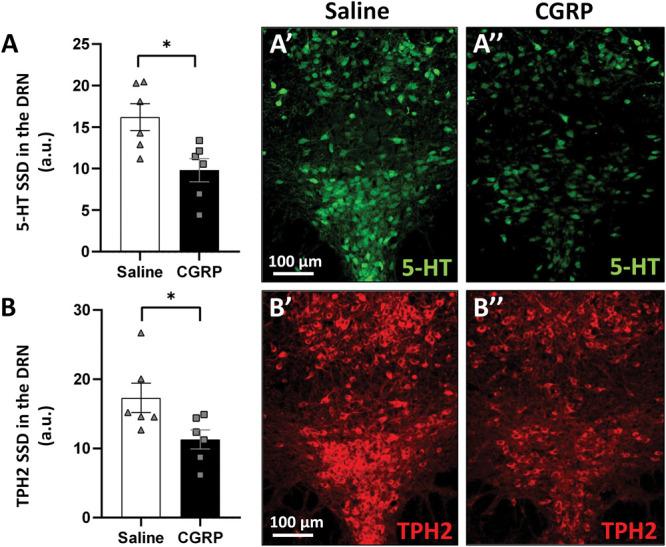
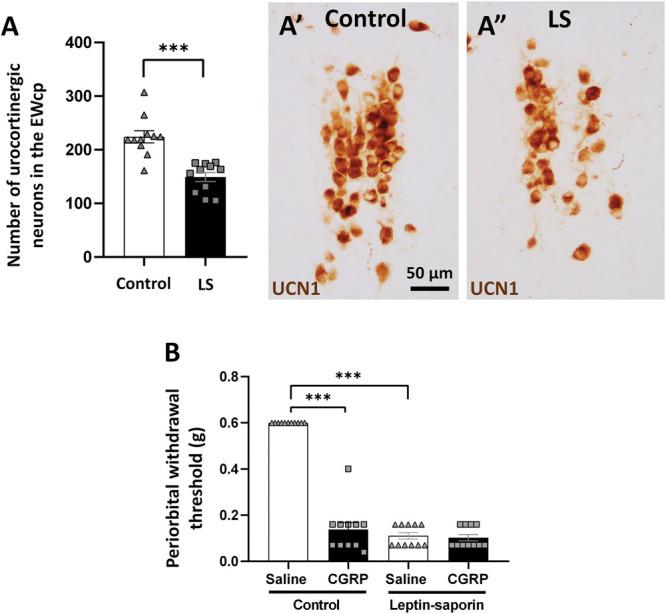
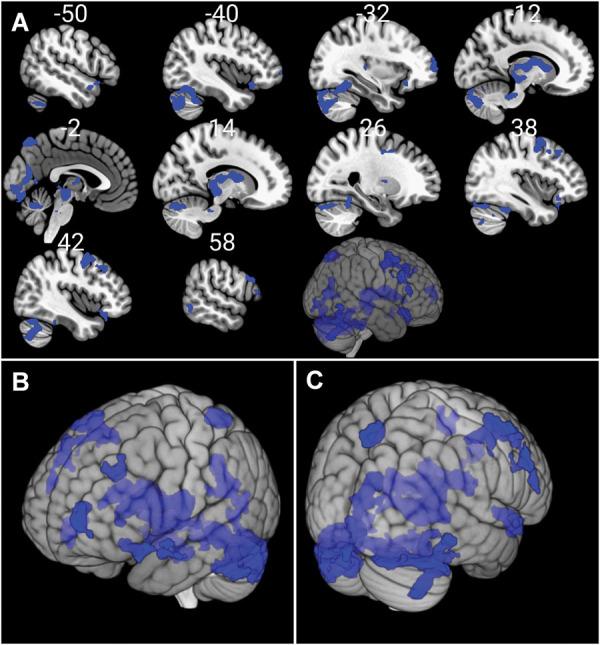
The urocortin 1 (UCN1)-expressing centrally projecting Edinger-Westphal (EWcp) nucleus is influenced by circadian rhythms, hormones, stress, and pain, all known migraine triggers. Our study investigated EWcp's potential involvement in migraine. Using RNAscope in situ hybridization and immunostaining, we examined the expression of calcitonin gene-related peptide (CGRP) receptor components in both mouse and human EWcp and dorsal raphe nucleus (DRN). Tracing study examined connection between EWcp and the spinal trigeminal nucleus (STN). The intraperitoneal CGRP injection model of migraine was applied and validated by light-dark box, and von Frey assays in mice, in situ hybridization combined with immunostaining, were used to assess the functional-morphological changes. The functional connectivity matrix of EW was examined using functional magnetic resonance imaging in control humans and interictal migraineurs. We proved the expression of CGRP receptor components in both murine and human DRN and EWcp. We identified a direct urocortinergic projection from EWcp to the STN. Photophobic behavior, periorbital hyperalgesia, increased c-fos gene-encoded protein immunoreactivity in the lateral periaqueductal gray matter and trigeminal ganglia, and phosphorylated c-AMP-responsive element binding protein in the STN supported the efficacy of CGRP-induced migraine-like state. Calcitonin gene-related peptide administration also increased c-fos gene-encoded protein expression, Ucn1 mRNA, and peptide content in EWcp/UCN1 neurons while reducing serotonin and tryptophan hydroxylase-2 levels in the DRN. Targeted ablation of EWcp/UCN1 neurons induced hyperalgesia. A positive functional connectivity between EW and STN as well as DRN has been identified by functional magnetic resonance imaging. The presented data strongly suggest the regulatory role of EWcp/UCN1 neurons in migraine through the STN and DRN with high translational value.
表达尿皮质素1(UCN1)的中枢投射动眼神经副核(EWcp)受昼夜节律、激素、压力和疼痛影响,而这些都是已知的偏头痛触发因素。我们的研究调查了EWcp在偏头痛中的潜在作用。使用RNAscope原位杂交和免疫染色,我们检测了小鼠和人类EWcp以及中缝背核(DRN)中降钙素基因相关肽(CGRP)受体成分的表达。追踪研究检测了EWcp与三叉神经脊束核(STN)之间的联系。应用偏头痛的腹腔注射CGRP模型,并通过明暗箱和小鼠的von Frey试验进行验证,采用原位杂交结合免疫染色来评估功能形态学变化。在对照人群和发作间期偏头痛患者中,使用功能磁共振成像检查EW的功能连接矩阵。我们证实了CGRP受体成分在小鼠和人类DRN以及EWcp中的表达。我们确定了从EWcp到STN的直接促尿皮质素能投射。畏光行为、眶周痛觉过敏、导水管周围灰质外侧和三叉神经节中c-fos基因编码蛋白免疫反应性增加,以及STN中磷酸化的c-AMP反应元件结合蛋白,支持了CGRP诱导的偏头痛样状态的有效性。给予降钙素基因相关肽也增加了EWcp/UCN1神经元中c-fos基因编码蛋白的表达、Ucn1 mRNA和肽含量,同时降低了DRN中的5-羟色胺和色氨酸羟化酶-2水平。靶向消融EWcp/UCN1神经元会诱发痛觉过敏。通过功能磁共振成像确定了EW与STN以及DRN之间的正性功能连接。所呈现的数据强烈表明EWcp/UCN1神经元通过STN和DRN在偏头痛中发挥调节作用,具有很高的转化价值。


 Zotero 插件