
纳米孔揭示了 III 型 CRISPR-Cas 产生的单聚腺苷酸的化学计量。
Nanopores Reveal the Stoichiometry of Single Oligoadenylates Produced by Type III CRISPR-Cas.
机构信息
Laboratory of Biophysics, Wageningen University and Research, Stippeneng 4, 6708WE Wageningen, The Netherlands.
Laboratory of Microbiology, Wageningen University and Research, Stippeneng 4, 6708WE Wageningen, The Netherlands.
出版信息
ACS Nano. 2024 Jul 2;18(26):16505-16515. doi: 10.1021/acsnano.3c11769. Epub 2024 Jun 14.
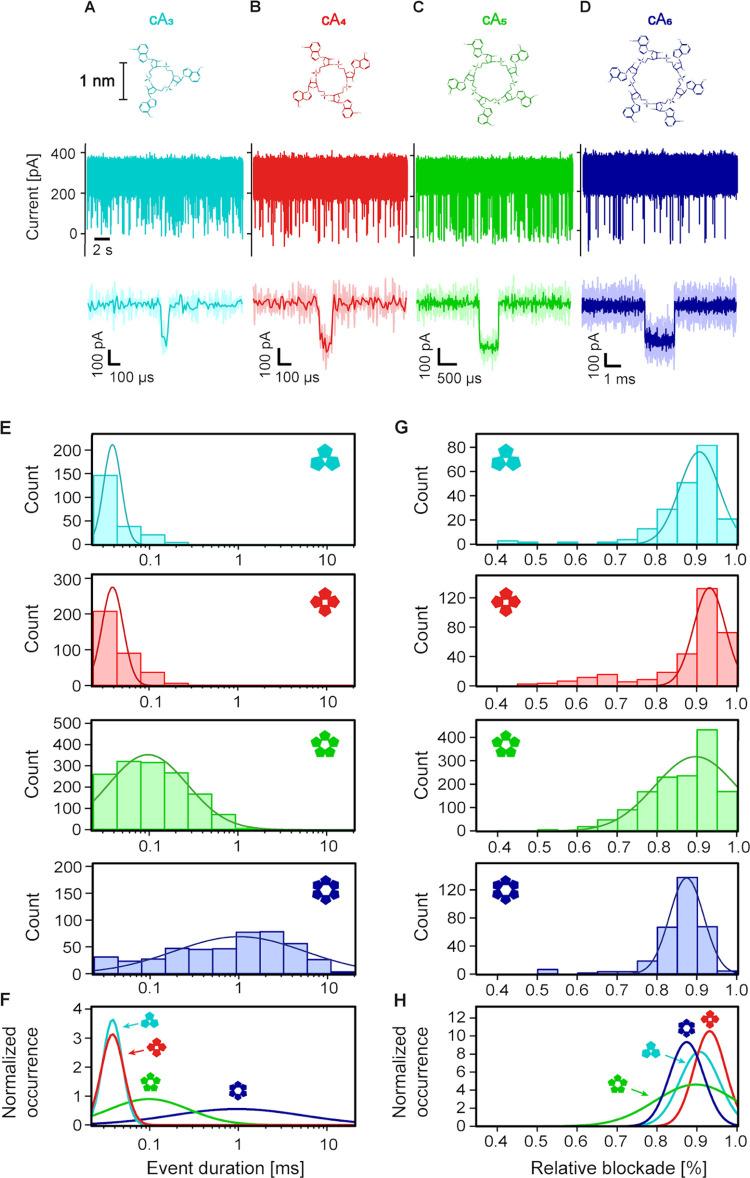
Cyclic oligoadenylates (cOAs) are small second messenger molecules produced by the type III CRISPR-Cas system as part of the prokaryotic immune response. The role of cOAs is to allosterically activate downstream effector proteins that induce dormancy or cell death, and thus abort viral spread through the population. Interestingly, different type III systems have been reported to utilize different cOA stoichiometries (with 3 to 6 adenylate monophosphates). However, so far, their characterization has only been possible in bulk and with sophisticated equipment, while a portable assay with single-molecule resolution has been lacking. Here, we demonstrate the label-free detection of single cOA molecules using a simple protein nanopore assay. It sensitively identifies the stoichiometry of individual cOA molecules and their mixtures from synthetic and enzymatic origin. To achieve this, we trained a convolutional neural network (CNN) and validated it with a series of experiments on mono- and polydisperse cOA samples. Ultimately, we determined the stoichiometric composition of cOAs produced enzymatically by the CRISPR type III-A and III-B variants of and confirmed the results by liquid chromatography-mass spectroscopy (LC-MS). Interestingly, both variants produce cOAs of nearly identical composition (within experimental uncertainties), and we discuss the biological implications of this finding. The presented nanopore-CNN workflow with single cOA resolution can be adapted to many other signaling molecules (including eukaryotic ones), and it may be integrated into portable handheld devices with potential point-of-care applications.
环化寡腺苷酸 (cOAs) 是由 III 型 CRISPR-Cas 系统产生的小分子第二信使,作为原核免疫反应的一部分。cOAs 的作用是别构激活下游效应蛋白,诱导休眠或细胞死亡,从而阻止病毒在种群中的传播。有趣的是,不同的 III 型系统被报道利用不同的 cOA 化学计量比(3 到 6 个腺苷酸单磷酸)。然而,到目前为止,它们的特征只能在大量和使用复杂设备的情况下进行,而缺乏具有单分子分辨率的便携式测定。在这里,我们使用简单的蛋白质纳米孔测定法证明了单个 cOA 分子的无标记检测。它灵敏地识别了来自合成和酶源的单个 cOA 分子及其混合物的化学计量比。为了实现这一点,我们训练了一个卷积神经网络(CNN),并通过一系列单分散和多分散 cOA 样品的实验对其进行了验证。最终,我们确定了由 CRISPR III-A 和 III-B 变体产生的 cOAs 的化学计量组成,并通过液相色谱-质谱联用 (LC-MS) 验证了结果。有趣的是,两种变体产生的 cOAs 的组成几乎相同(在实验误差范围内),我们讨论了这一发现的生物学意义。具有单 cOA 分辨率的纳米孔-CNN 工作流程可以适应许多其他信号分子(包括真核生物),并且可以集成到具有潜在即时护理应用的便携式手持设备中。




 Zotero 插件