
根治性胃切除术后急性肾损伤:发病率、危险因素及对预后的影响。
Acute kidney injury after radical gastrectomy: incidence, risk factors, and impact on prognosis.
作者信息
Zhang Benlong, Li Li, Gao Yunhe, Wang Zijian, Lu Yixun, Chen Lin, Zhang Kecheng
机构信息
Department of General Surgery, The First Medical Center of Chinese PLA General Hospital, Beijing, P. R. China.
出版信息
Gastroenterol Rep (Oxf). 2024 Jun 17;12:goae061. doi: 10.1093/gastro/goae061. eCollection 2024.
BACKGROUND
Acute kidney injury (AKI) is a serious adverse event often overlooked following major abdominal surgery. While radical gastrectomy stands as the primary curative method for treating gastric cancer patients, little information exists regarding AKI post-surgery. Hence, this study aimed to ascertain the incidence rate, risk factors, and consequences of AKI among patients undergoing radical gastrectomy.
METHODS
This was a population-based, retrospective cohort study. The incidence of AKI was calculated. Multivariate logistic regression was used to identify independent predictors of AKI. Survival curves were plotted by using the Kaplan-Meier method and differences in survival rates between groups were analyzed by using the log-rank test.
RESULTS
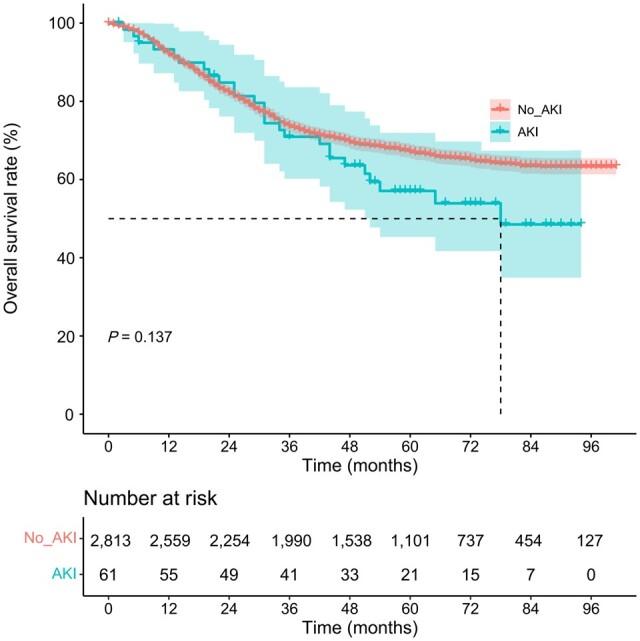
Of the 2,875 patients enrolled in this study, 61 (2.1%) developed postoperative AKI, with AKI Network 1, 2, and 3 in 50 (82.0%), 6 (9.8%), and 5 (8.2%), respectively. Of these, 49 patients had fully recovered by discharge. Risk factors for AKI after radical gastrectomy were preoperative hypertension (odds ratio [OR], 1.877; 95% CI, 1.064-3.311; =0.030), intraoperative blood loss (OR, 1.001; 95% CI, 1.000-1.002; =0.023), operation time (OR, 1.303; 95% CI, 1.030-1.649; =0.027), and postoperative intensive care unit (ICU) admission (OR, 4.303; 95% CI, 2.301-8.045; <0.001). The probability of postoperative complications, mortality during hospitalization, and length of stay in patients with AKI after surgery were significantly higher than those in patients without AKI. There was no statistical difference in overall survival (OS) rates between patients with AKI and without AKI (1-year, 3-year, 5-year overall survival rates of patients with AKI and without AKI were 93.3% vs 92.0%, 70.9% vs 73.6%, and 57.1% vs 67.1%, respectively, =0.137).
CONCLUSIONS
AKI following radical gastrectomy is relatively rare and typically self-limited. AKI is linked with preoperative hypertension, intraoperative blood loss, operation time, and postoperative ICU admission. While AKI raises the likelihood of postoperative complications, it does not affect OS.
背景
急性肾损伤(AKI)是腹部大手术后常被忽视的严重不良事件。根治性胃切除术是治疗胃癌患者的主要治愈方法,但关于术后急性肾损伤的信息较少。因此,本研究旨在确定根治性胃切除术后患者急性肾损伤的发生率、危险因素及后果。
方法
这是一项基于人群的回顾性队列研究。计算急性肾损伤的发生率。采用多因素logistic回归分析确定急性肾损伤的独立预测因素。采用Kaplan-Meier法绘制生存曲线,并用log-rank检验分析组间生存率差异。
结果
本研究纳入的2875例患者中,61例(2.1%)发生术后急性肾损伤,其中急性肾损伤网络分级1、2、3级分别为50例(82.0%)、6例(9.8%)和5例(8.2%)。其中,49例患者出院时已完全康复。根治性胃切除术后急性肾损伤的危险因素包括术前高血压(比值比[OR],1.877;95%可信区间[CI],1.064 - 3.311;P = 0.030)、术中失血(OR,1.001;95%CI,1.000 - 1.002;P = 0.023)、手术时间(OR,1.303;95%CI,1.030 - 1.649;P = 0.027)和术后入住重症监护病房(ICU)(OR,4.303;95%CI,2.301 - 8.045;P < 0.001)。急性肾损伤患者术后并发症发生概率、住院期间死亡率及住院时间均显著高于无急性肾损伤患者。急性肾损伤患者与无急性肾损伤患者的总生存率(OS)无统计学差异(急性肾损伤患者与无急性肾损伤患者的1年、3年、5年总生存率分别为93.3%对92.0%、70.9%对73.6%、57.1%对67.1%,P = 0.137)。
结论
根治性胃切除术后急性肾损伤相对少见,通常为自限性。急性肾损伤与术前高血压、术中失血、手术时间及术后入住ICU有关。虽然急性肾损伤增加了术后并发症的发生可能性,但不影响总生存率。
 Zotero 插件