G Nithish, H Samanvitha, Sajjan Shantkumar S, T Harsha M, S Monika
Department of Diagnostic Radiology, Bangalore Medical College and Research Institute, Bengaluru, IND.
Department of Interventional Radiology, All India Institute of Medical Sciences, Rishikesh, Rishikesh, IND.
Cureus. 2024 May 30;16(5):e61393. doi: 10.7759/cureus.61393. eCollection 2024 May.
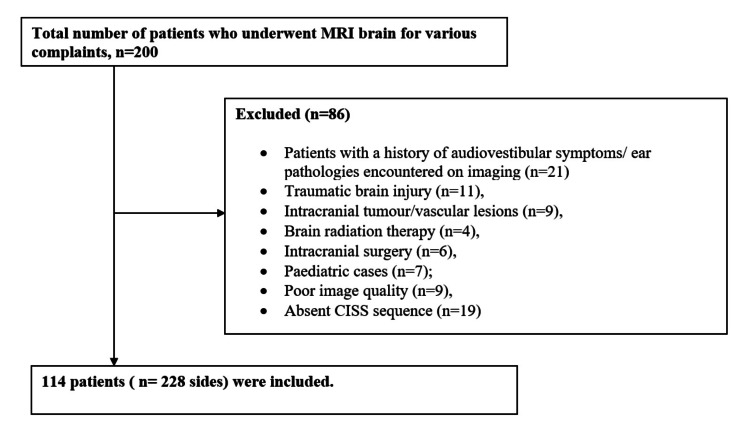
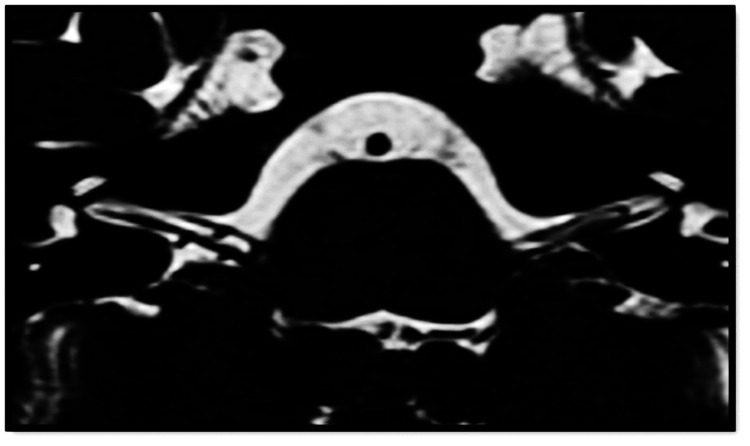
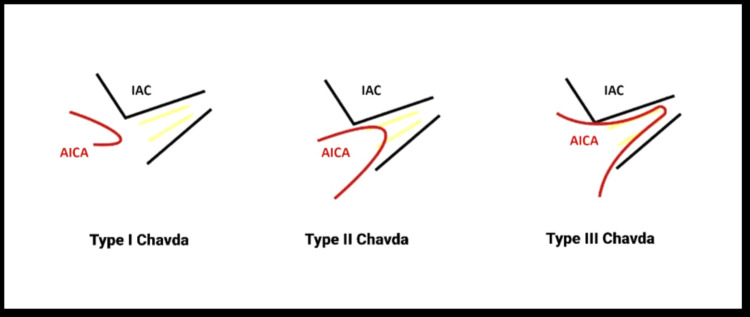
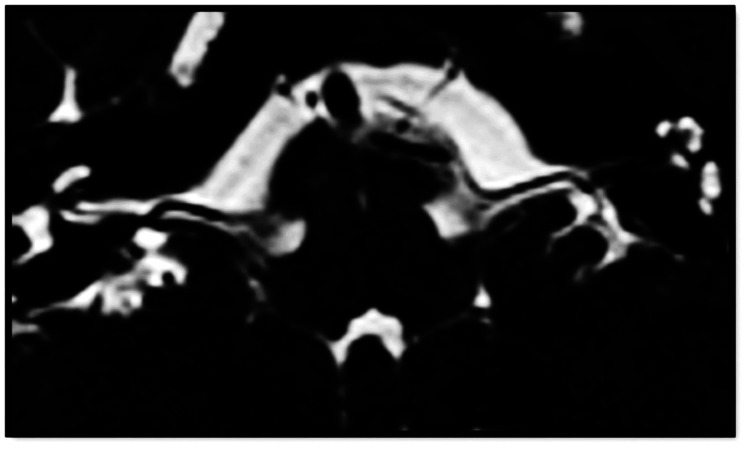
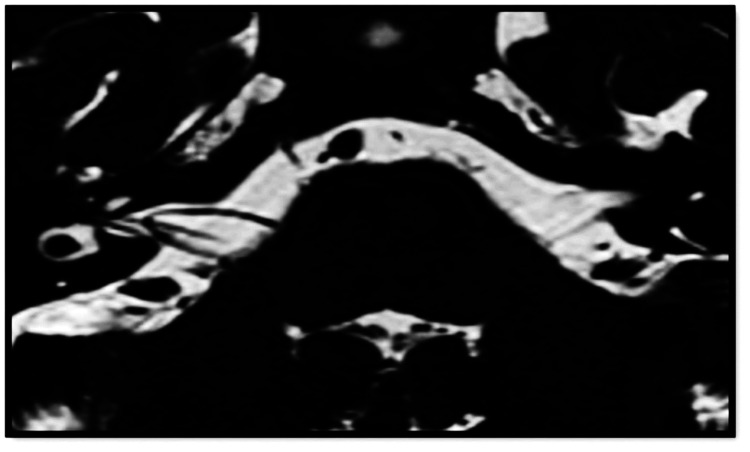
Background The cerebellopontine angle (CPA) cistern houses vital neurovascular structures such as cranial nerves V, VII, and VIII and the anterior inferior cerebellar artery (AICA), often leading to neurovascular compression syndromes due to its complex anatomy. Although vascular compression is a recognized cause of certain neuralgias, its association with otologic symptoms such as tinnitus, hearing loss, and dizziness remains uncertain. Hence, this study aims to determine the prevalence of the AICA vascular loop in the CPA cistern on MRI in patients with asymptomatic audiovestibular symptoms. Methodology Adult patients who underwent MRI, including the posterior fossa's high-resolution volumetric T2 sequence (three-dimensional constructive interference in steady state (3D-CISS)), were assessed. Patients with a history of audiovestibular symptoms (tinnitus/dizziness/vertigo/sensorineural hearing loss), intracranial tumor, vascular lesions, intracranial surgery, brain radiation therapy, traumatic brain injury, poor image quality, and MRI scans without 3D-CISS sequences were excluded. Two radiologists independently reviewed 114 (228 sides) MRI studies for the vascular loop of AICA in the CPA cistern and the extension of the AICA loop into the ipsilateral internal acoustic meatus which was graded by Chavda's classification. Results The prevalence of vascular loop of AICA in the CPA cistern was as high as 47.6% in asymptomatic patients. Grade I Chavda vascular loop was the most common type followed by type II, with type III being the least common type. Conclusions Knowledge regarding the high prevalence of the AICA loop in the asymptomatic population and the lack of significant correlation between the presence of the AICA loop and otovestibular symptoms should be considered in preoperative planning for decompression procedures.
背景 桥小脑角(CPA)池容纳重要的神经血管结构,如第V、VII和VIII对脑神经以及小脑前下动脉(AICA),因其复杂的解剖结构常导致神经血管压迫综合征。尽管血管压迫是某些神经痛的公认病因,但其与耳鸣、听力损失和头晕等耳科症状的关联仍不明确。因此,本研究旨在确定无症状的听觉前庭症状患者中,MRI显示的CPA池内AICA血管襻的患病率。
方法 对接受MRI检查(包括后颅窝高分辨率容积T2序列(三维稳态构成干涉(3D-CISS)))的成年患者进行评估。排除有听觉前庭症状(耳鸣/头晕/眩晕/感音神经性听力损失)、颅内肿瘤、血管病变、颅内手术、脑部放射治疗、创伤性脑损伤、图像质量差以及未进行3D-CISS序列MRI扫描病史的患者。两名放射科医生独立审查了114例(228侧)MRI研究,以观察CPA池内AICA的血管襻以及AICA襻向同侧内耳道的延伸情况,并根据Chavda分类法进行分级。
结果 无症状患者中,CPA池内AICA血管襻的患病率高达47.6%。Chavda I级血管襻是最常见的类型,其次是II型,III型最不常见。
结论 在减压手术的术前规划中,应考虑到无症状人群中AICA襻的高患病率以及AICA襻的存在与耳前庭症状之间缺乏显著相关性这一情况。