
不同雌二醇治疗方案对变性女性的有效性和安全性:一项随机对照试验
Effectiveness and Safety of Different Estradiol Regimens in Transgender Females: A Randomized Controlled Trial.
作者信息
Cortez Samuel, Moog Dominic, Lewis Christopher, Williams Kelley, Herrick Cynthia J, Fields Melanie E, Gray Teddi, Guo Zhaohua, Nicol Ginger, Baranski Thomas
机构信息
Department of Pediatrics, Division of Endocrinology, Diabetes, and Metabolism, Washington University School of Medicine in St. Louis, St. Louis, MO 63110, USA.
Washington University School of Medicine in St. Louis, St. Louis,, MO 63110, USA.
出版信息
J Endocr Soc. 2024 Jun 12;8(8):bvae108. doi: 10.1210/jendso/bvae108. eCollection 2024 Jul 1.
BACKGROUND
A goal of gender-affirming hormone therapy (GAHT) for transgender women is to use estradiol to suppress endogenous production of testosterone. However, the effects of different estradiol regimens and route of administration on testosterone suppression is unknown. This is the first open-label randomized trial comparing different GAHT regimens for optimal estradiol route and dosing.
OBJECTIVE
To evaluate 1 month and 6 months testosterone suppression <50 ng/dL with pulsed (once- or twice-daily sublingual 17-beta estradiol) and continuous (transdermal 17-beta estradiol) GAHT.
METHODS
This study was conducted at an outpatient adult transgender clinic. Thirty-nine transgender women undergoing initiation of GAHT were randomly assigned to receive either once-daily sublingual, twice-daily sublingual, or transdermal 17-beta estradiol. All participants received spironolactone as an antiandrogen. Doses were titrated at monthly intervals to achieve total testosterone suppression <50 ng/dL.
RESULTS
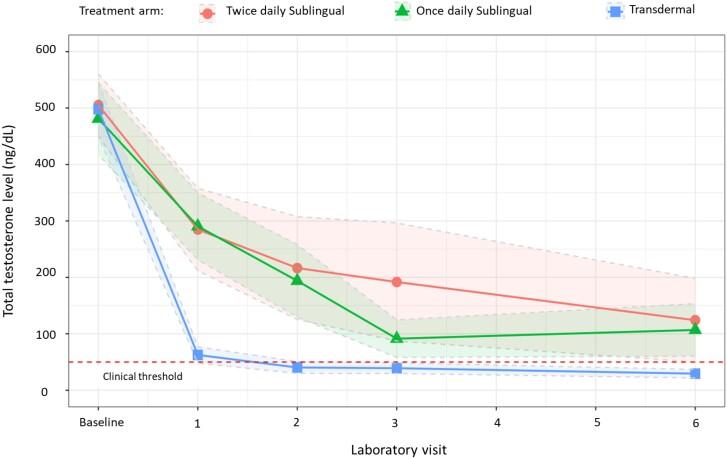
Transdermal 17-beta estradiol resulted in more rapid suppression of total testosterone, lower estrone levels, with no differences in estradiol levels when compared to once-daily and twice-daily sublingual estradiol. Moreover, there was no difference in the mean estradiol dose between the once-daily and twice-daily sublingual 17-beta estradiol group.
CONCLUSION
Continuous exposure with transdermal 17-beta estradiol suppressed testosterone production more effectively and with lower overall estradiol doses relative to once or twice daily sublingual estradiol. Most transgender women achieved cisgender women testosterone levels within 2 months on 1 or 2 0.1 mg/24 hours estradiol patches. Given no difference between once- or twice-daily sublingual estradiol, pulsed 17-beta estradiol likely provides no benefit for testosterone suppression.
背景
对于跨性别女性而言,性别肯定激素疗法(GAHT)的一个目标是使用雌二醇抑制内源性睾酮的产生。然而,不同雌二醇给药方案和给药途径对睾酮抑制的影响尚不清楚。这是第一项比较不同GAHT方案以确定最佳雌二醇给药途径和剂量的开放标签随机试验。
目的
评估采用脉冲式(每日一次或两次舌下含服17-β雌二醇)和持续性(经皮17-β雌二醇)GAHT时,1个月和6个月内睾酮抑制水平<50 ng/dL的情况。
方法
本研究在一家成人门诊跨性别诊所进行。39名开始接受GAHT的跨性别女性被随机分配接受每日一次舌下含服、每日两次舌下含服或经皮17-β雌二醇治疗。所有参与者均接受螺内酯作为抗雄激素药物。剂量每月调整一次,以实现总睾酮抑制水平<50 ng/dL。
结果
与每日一次和每日两次舌下含服雌二醇相比,经皮17-β雌二醇能更迅速地抑制总睾酮,降低雌酮水平,而雌二醇水平无差异。此外,每日一次和每日两次舌下含服17-β雌二醇组之间的平均雌二醇剂量无差异。
结论
与每日一次或两次舌下含服雌二醇相比,持续经皮给予17-β雌二醇能更有效地抑制睾酮产生,且总体雌二醇剂量更低。大多数跨性别女性在使用1或2片0.1 mg/24小时的雌二醇贴片后,在2个月内达到了顺性别女性的睾酮水平。鉴于每日一次和每日两次舌下含服雌二醇之间无差异,脉冲式17-β雌二醇可能对睾酮抑制无益处。



 Zotero 插件