Department of Psychiatry, Graduate School of Medicine, Chiba University, 1-8-1 Inohana, Chuo-ku, Chiba, 260-8670, Japan.
Department of Psychiatry, International University of Health and Welfare Narita Hospital, 852, Hatakeda, Narita, 286-8520, Japan.
Sci Rep. 2024 Jul 15;14(1):16264. doi: 10.1038/s41598-024-67101-x.
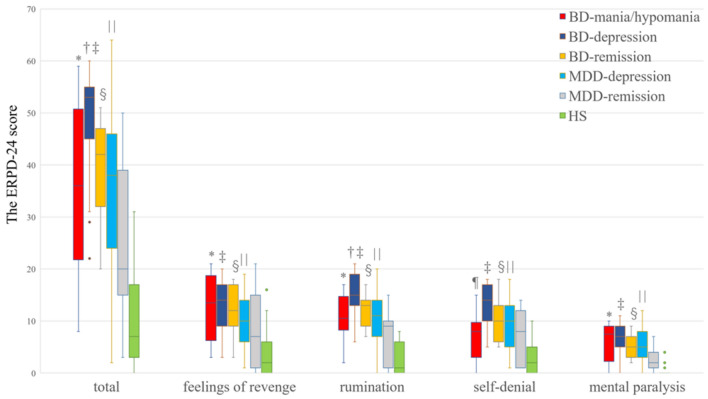
Patients with bipolar disorder (BD) and major depressive disorder (MDD) experience psychological distress associated with daily events that do not meet the threshold for traumatic experiences, referred to as event-related psychological distress (ERPD). Recently, we developed an assessment tool for ERPD, the ERPD-24. This tool considers four factors of ERPD: feelings of revenge, rumination, self-denial, and mental paralysis. We conducted a cross-sectional study between March 2021 and October 2022 to identify the differences and clinical features of ERPD among patients with MDD and BD and healthy subjects who did not experience traumatic events. Specifically, we assessed ERPD using the ERPD-24 and anxiety-related symptoms with the State-Trait Anxiety Inventory, Liebowitz Social Anxiety Scale, and anxious-depressive attack. Regarding the ERPD-24 scores among the groups, as the data did not rigorously follow the test of normality, the Kruskal-Wallis test was used to compare the differences among the groups, followed by the Dunn-Bonferroni adjusted post-hoc test. Non-remitted MDD patients and BD patients, regardless of remission/non-remission, presented more severe ERPD than healthy subjects. This study also demonstrated the relationships between all anxiety-related symptoms, including social phobia and anxious-depressive attack and ERPD, in both BD and MDD patients and in healthy subjects. In conclusion, patients with non-remitted MDD and with BD regardless of remission/non-remission experience severe ERPD related to anxiety-related symptoms.
双相情感障碍(BD)和重度抑郁症(MDD)患者会经历与日常事件相关的心理困扰,但这些事件未达到创伤经历的阈值,我们称之为与事件相关的心理困扰(ERPD)。最近,我们开发了一种用于评估 ERPD 的工具,即 ERPD-24。该工具考虑了 ERPD 的四个因素:报复感、反刍思维、自我否定和精神麻痹。我们于 2021 年 3 月至 2022 年 10 月进行了一项横断面研究,以确定 MDD 和 BD 患者与未经历创伤事件的健康受试者之间 ERPD 的差异和临床特征。具体来说,我们使用 ERPD-24 评估 ERPD,并使用状态特质焦虑量表、利博维茨社交焦虑量表和焦虑抑郁发作评估焦虑相关症状。关于各组的 ERPD-24 评分,由于数据未严格遵循正态性检验,因此我们使用 Kruskal-Wallis 检验比较组间差异,然后进行 Dunn-Bonferroni 调整后的事后检验。未缓解的 MDD 患者和 BD 患者,无论缓解/未缓解,其 ERPD 均比健康受试者更为严重。这项研究还表明,BD 和 MDD 患者以及健康受试者的所有焦虑相关症状,包括社交恐惧症和焦虑抑郁发作,与 ERPD 之间均存在关系。总之,未缓解的 MDD 患者和无论缓解/未缓解的 BD 患者都经历着与焦虑相关症状有关的严重 ERPD。