Pichler Lorenz, Kiss Gyula, Sator Thomas, Schuller Andrea, Kandathil Sam A, Hofbauer Marcus, Koch Thomas, Hirtler Lena, Tiefenboeck Thomas
Department of Orthopaedics and Trauma Surgery Medical University of Vienna Vienna Austria.
Center for Musculoskeletal Surgery Charité - University Medicine Berlin Berlin Germany.
J Exp Orthop. 2024 Jul 24;11(3):e12110. doi: 10.1002/jeo2.12110. eCollection 2024 Jul.
The purpose of this study was to compare the biomechanical properties of a latest generation all-suture anchor repair device (ASARD) for meniscal repair with that of a latest generation PEEK-cage anchor repair device (PCARD) in an experimental setting using cadaveric menisci.
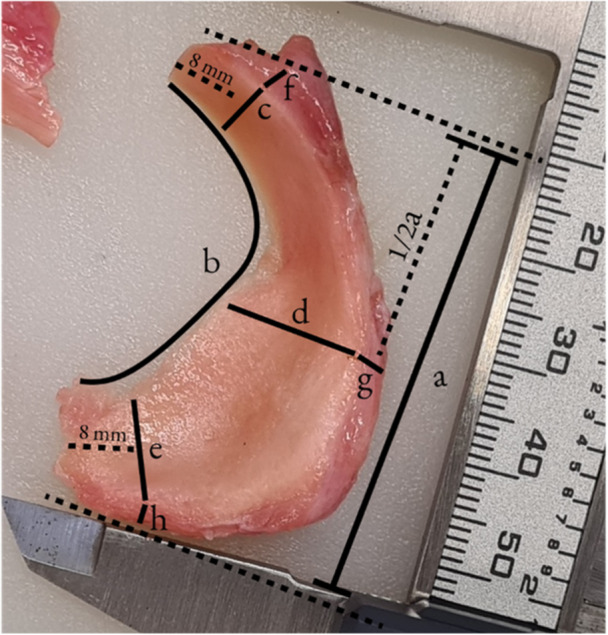
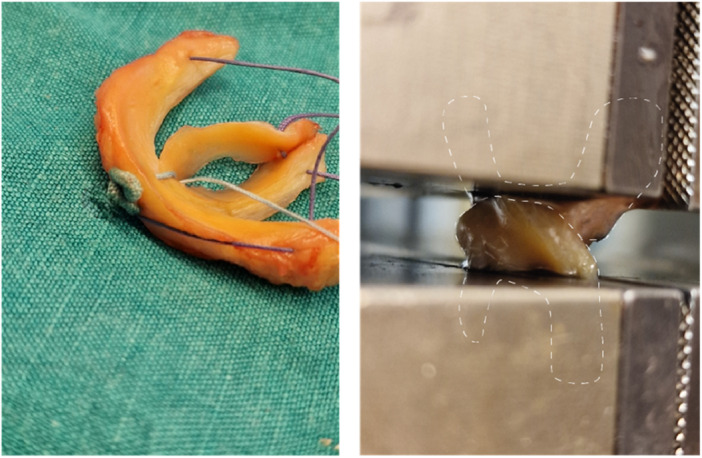
Twenty-six menisci were obtained from the knees of fresh body donors. Artificially created meniscal lesions were treated randomly, using a single stitch with either an ASARD or a PCARD. Cyclic biomechanical testing, utilising a universal material testing machine and following an established protocol, was carried out and load-to-failure (LTF), displacement, stiffness, and mode-of-failure (MOF) reported.
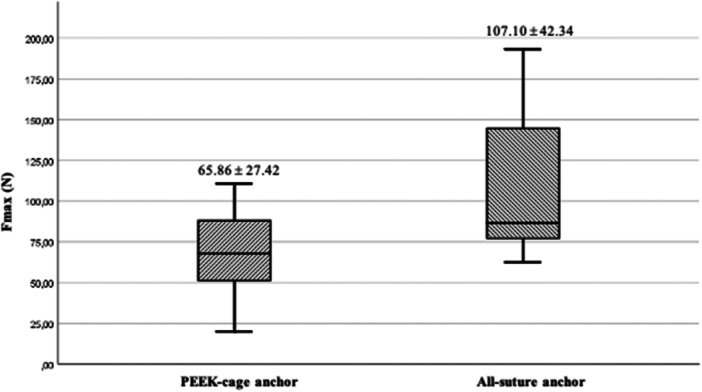
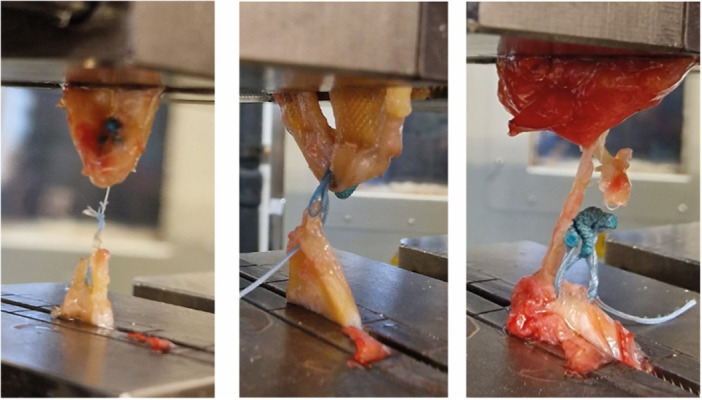
Mean LTF was found to be 61% higher in the ASARD group at 107.10 N (standard deviation [SD], 42.34), compared to 65.86 N (SD, 27.42) in the PCARD group with statistical significance ( = 0.022). The ASARD exhibited a trend towards higher stiffness (10.35 N; SD, 3.92 versus 7.78 N; SD; 3.59) and higher displacement at cycles one, 100, and 499 (1.64, 3.27, and 4.17 mm versus 0.93, 2.19, and 2.83 mm) compared to the PCARD. Cheese wiring was the most common mode-of-failure in both groups (76.9%).
This study demonstrates that an ASARD shows a higher mean LTF than a PCARD when compared in an experimental biomechanical setting.
Level III.
本研究的目的是在使用尸体半月板的实验环境中,比较新一代全缝线锚钉修复装置(ASARD)与新一代聚醚醚酮(PEEK)笼式锚钉修复装置(PCARD)用于半月板修复的生物力学特性。
从新鲜尸体供体的膝关节获取26个半月板。人工制造的半月板损伤随机采用ASARD或PCARD单针缝合进行治疗。使用万能材料试验机并按照既定方案进行循环生物力学测试,记录并报告失效载荷(LTF)、位移、刚度和失效模式(MOF)。
ASARD组的平均LTF为107.10 N(标准差[SD],42.34),比PCARD组的65.86 N(SD,27.42)高61%,具有统计学意义(P = 0.022)。与PCARD相比,ASARD在第1、100和499次循环时表现出更高的刚度趋势(10.35 N;SD,3.92对7.78 N;SD,3.59)和更高的位移(1.64、3.27和4.17 mm对0.93、2.19和2.83 mm)。两组中最常见的失效模式均为奶酪状撕裂(76.9%)。
本研究表明,在实验生物力学环境中比较时,ASARD的平均LTF高于PCARD。
III级。