Jaiswal Ram Mohan, Tiwari Aseem Kumar, Singla Ashina, Jain Ashish, Vohra Rajaat, Kakkar Munish, Suravajhala Prashanth
Mahatma Gandhi Medical College & Hospital, Jaipur, Rajasthan, India.
The Medicity, Sector-38, Gurgaon, Haryana, India.
Hematol Transfus Cell Ther. 2024 Oct-Dec;46(4):455-461. doi: 10.1016/j.htct.2024.03.003. Epub 2024 Apr 29.
COVID-19 convalescent plasma is one of the experimental therapies used widely in moderately sick COVID-19 patients. However, there are a few risks involved in plasma transfusion; notably, transfusion-related acute lung injury (TRALI) caused by antibodies against human leukocyte antigens (HLA). This study was designed to assess the prevalence of anti-HLA antibodies in convalescent plasma donors using the single antigen bead method.
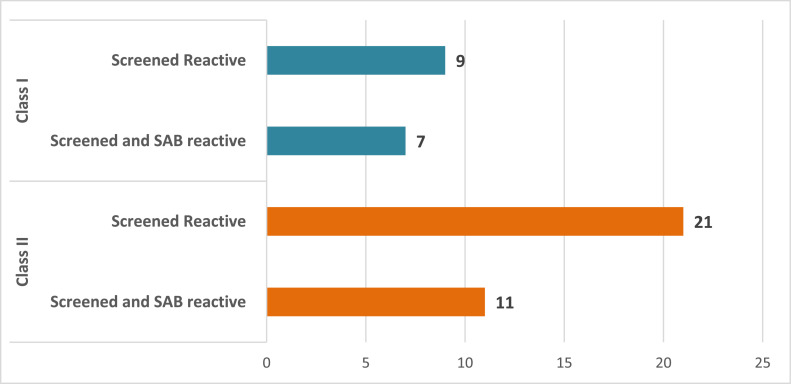
This was a hospital-based observational study of consecutive plasma donors. A total of 252 samples were screened for anti-HLA Class I and Class II antibodies using the microbead assay with the identification of anti-HLA Ab in positive samples being performed using a single antigen bead assay. Luminex-based normalized background cutoff ratios of 10.8 for Class I and 6.9 for Class II and mean fluorescence intensity cutoffs of 2500 for Class I and 1500 for Class II were used for screening and the single bead assay, respectively.
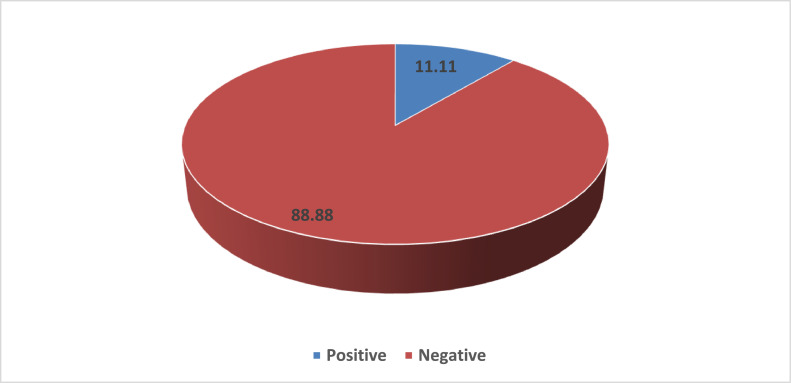
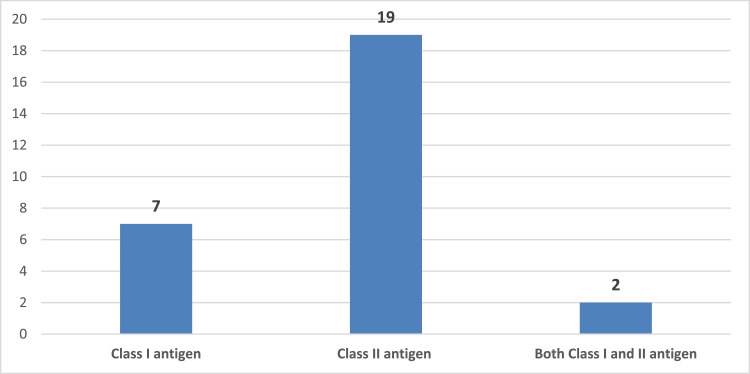
Of 252 screened samples, 28 (11.1 %) were positive for Class I, Class II or both Class I and Class II anti-HLA antibodies in donors with no history of a previous immunizing event. Moreover, 20/252 (7.9%) donors without any history of prior immunization had specific anti-HLA antibodies of Class I or Class II or both by the single bead assay.
The high prevalence of anti-HLA antibodies in our cohort of donors raises an urgent and immediate need for anti-HLA antibody screening in all convalescent plasma donors for safe therapy of COVID-19 patients.
新冠康复者血浆是广泛用于中度新冠患者的实验性疗法之一。然而,血浆输注存在一些风险;特别是由抗人类白细胞抗原(HLA)抗体引起的输血相关急性肺损伤(TRALI)。本研究旨在使用单抗原珠法评估康复血浆捐献者中抗HLA抗体的流行率。
这是一项基于医院的对连续血浆捐献者的观察性研究。使用微珠分析法对总共252份样本进行抗HLA I类和II类抗体筛查,阳性样本中抗HLA抗体的鉴定采用单抗原珠分析法。基于Luminex的I类标准化背景截断比值为10.8,II类为6.9,I类平均荧光强度截断值为2500,II类为1500,分别用于筛查和单珠分析法。
在252份筛查样本中,28份(11.1%)在无既往免疫事件史的捐献者中I类、II类或I类和II类抗HLA抗体均呈阳性。此外,在252名无任何既往免疫史的捐献者中,有20名(7.9%)通过单珠分析法检测出I类或II类或两者均有特异性抗HLA抗体。
我们的捐献者队列中抗HLA抗体的高流行率凸显了对所有新冠康复者血浆捐献者进行抗HLA抗体筛查的迫切需求,以安全治疗新冠患者。