
MAPK 信号通路调控 RFNG 的磷酸化及其核转位抑制奥沙利铂诱导的细胞凋亡和铁死亡。
MAPK Signaling-Mediated RFNG Phosphorylation and Nuclear Translocation Restrain Oxaliplatin-Induced Apoptosis and Ferroptosis.
机构信息
Molecular Diagnosis and Gene Testing Center, The First Affiliated Hospital, Sun Yat-sen University, Guangzhou, Guangdong, 510080, China.
Department of Gastrointestinal Surgery, The First Affiliated Hospital, Sun Yat-sen University, Guangzhou, Guangdong, 510080, China.
出版信息
Adv Sci (Weinh). 2024 Oct;11(38):e2402795. doi: 10.1002/advs.202402795. Epub 2024 Aug 9.
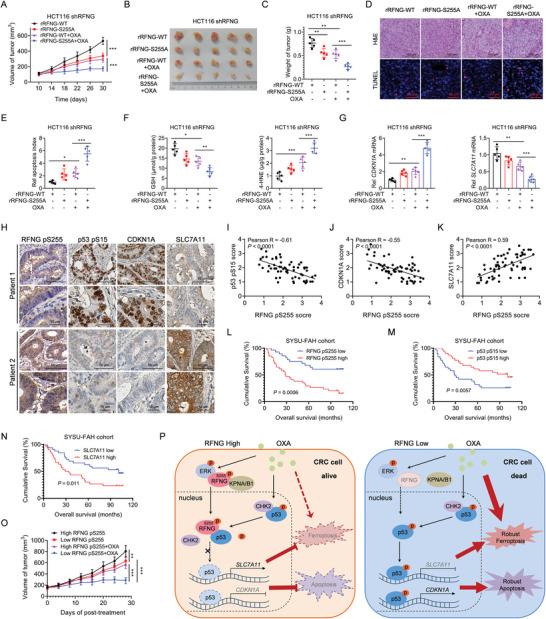
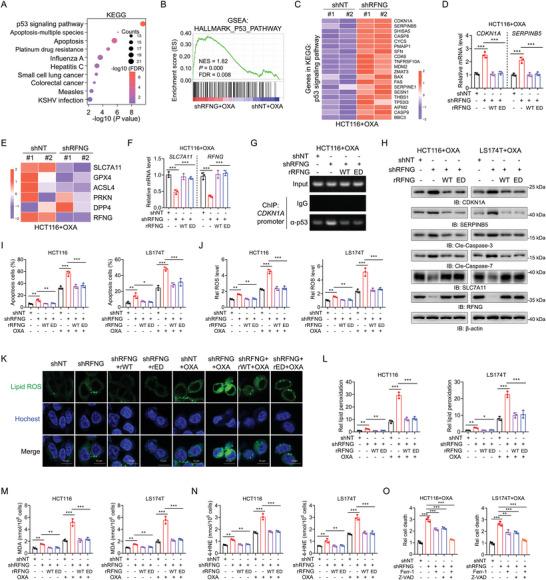
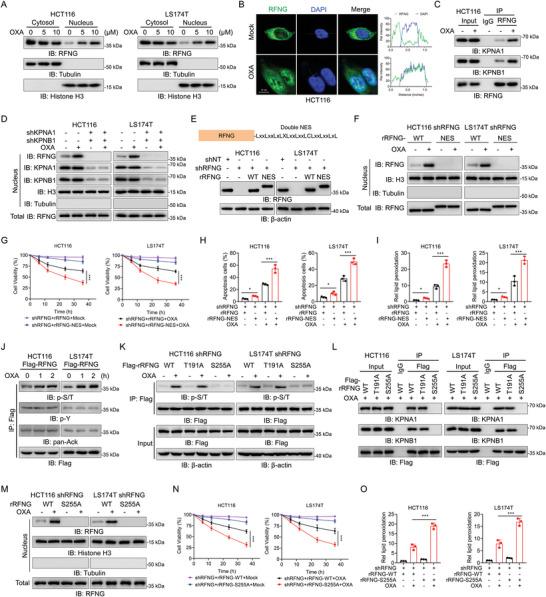
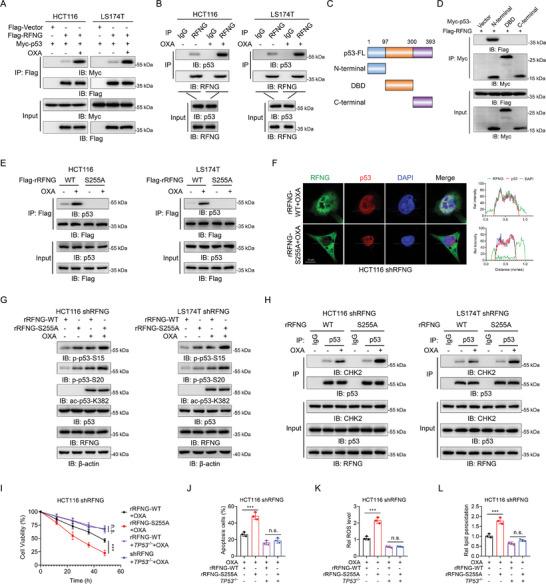
Chemotherapy resistance remains a major challenge in the treatment of colorectal cancer (CRC). Therefore, it is crucial to develop novel strategies to sensitize cancer cells to chemotherapy. Here, the fringe family is screened to determine their contribution to chemotherapy resistance in CRC. It is found that RFNG depletion significantly sensitizes cancer cells to oxaliplatin treatment. Mechanistically, chemotherapy-activated MAPK signaling induces ERK to phosphorylate RFNG Ser255 residue. Phosphorylated RFNG S255 (pS255) interacts with the nuclear importin proteins KPNA1/importin-α1 and KPNB1/importin-β1, leading to its translocation into the nucleus where it targets p53 and inhibits its phosphorylation by competitively inhibiting the binding of CHK2 to p53. Consequently, the expression of CDKN1A is decreased and that of SLC7A11 is increased, leading to the inhibition of apoptosis and ferroptosis. In contrast, phosphor-deficient RFNG S225A mutant showed increased apoptosis and ferroptosis, and exhibited a notable response to oxaliplatin chemotherapy both in vitro and in vivo. It is further revealed that patients with low RFNG pS255 exhibited significant sensitivity to oxaliplatin in a patient-derived xenograft (PDX) model. These findings highlight the crosstalk between the MAPK and p53 signaling pathways through RFNG, which mediates oxaliplatin resistance in CRC. Additionally, this study provides guidance for oxaliplatin treatment of CRC patients.
化疗耐药仍然是结直肠癌(CRC)治疗的主要挑战。因此,开发新的策略使癌细胞对化疗敏感至关重要。在这里,筛选了 fringe 家族以确定它们对 CRC 化疗耐药的贡献。结果发现,RFNG 耗竭可显著增强癌细胞对奥沙利铂治疗的敏感性。从机制上讲,化疗激活的 MAPK 信号诱导 ERK 磷酸化 RFNG Ser255 残基。磷酸化的 RFNG S255(pS255)与核输入蛋白 KPNA1/importin-α1 和 KPNB1/importin-β1 相互作用,导致其易位到细胞核,在细胞核中它靶向 p53 并通过竞争性抑制 CHK2 与 p53 的结合来抑制其磷酸化。结果,CDKN1A 的表达减少,SLC7A11 的表达增加,导致细胞凋亡和铁死亡抑制。相比之下,磷酸化缺陷的 RFNG S225A 突变体表现出增加的细胞凋亡和铁死亡,并在体外和体内对奥沙利铂化疗表现出显著的反应。进一步揭示,在患者来源的异种移植(PDX)模型中,低 RFNG pS255 的患者对奥沙利铂表现出显著的敏感性。这些发现强调了 MAPK 和 p53 信号通路通过 RFNG 的相互作用,介导了 CRC 中的奥沙利铂耐药性。此外,本研究为 CRC 患者的奥沙利铂治疗提供了指导。



 Zotero 插件