J Clin Invest. 2024 Aug 15;134(16):e183396. doi: 10.1172/JCI183396.
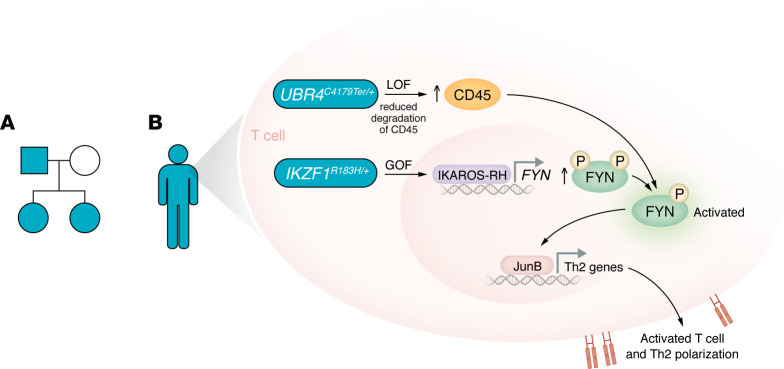
Autoimmune diseases are commonly associated with a polygenic inheritance pattern. In rare instances, causal monogenic variants have been identified. The study by Liu et al. in this issue of the JCI provides an example of monogenic variants occurring in patients with IgG4-related disease (IgG4-RD). The authors investigated a familial cluster of IgG4-RD that consisted of an affected father and two daughters; the mother was unaffected. Genome sequencing of this quad identified a variant in IKZF1 (encoding IKAROS) and another variant in UBR4 (encoding E3 ubiquitin ligase). Both variants were present in the father and both daughters but absent in the unaffected mother. Using multidimensional profiling of immune cells and functional experiments in primary cells, the authors determined a molecular pathway contributing to T cell activation in IgG4-RD. Importantly, the characterization of these variants provides insights into pathogenic mechanisms in IgG4-RD and, potentially, other autoimmune diseases.
自身免疫性疾病通常与多基因遗传模式相关。在极少数情况下,已确定了因果单基因变异。刘等人在本期《临床检查杂志》上的研究为 IgG4 相关疾病(IgG4-RD)患者中发生的单基因变异提供了一个例子。作者研究了一个 IgG4-RD 的家族性聚集,其中包括一个受影响的父亲和两个女儿;母亲没有受到影响。对这个四口之家的基因组测序发现了 IKZF1(编码 IKAROS)中的一个变异和 UBR4(编码 E3 泛素连接酶)中的另一个变异。这两个变异都存在于父亲和两个女儿中,但不存在于未受影响的母亲中。通过对免疫细胞的多维分析和原代细胞的功能实验,作者确定了一个导致 IgG4-RD 中 T 细胞激活的分子途径。重要的是,这些变异的特征为 IgG4-RD 及其他自身免疫性疾病的发病机制提供了深入了解。