Department of Chemical Engineering, Columbia University, New York, New York, USA.
Department of Chemical Engineering, Columbia University, New York, New York, USA.
J Biol Chem. 2024 Sep;300(9):107703. doi: 10.1016/j.jbc.2024.107703. Epub 2024 Aug 22.
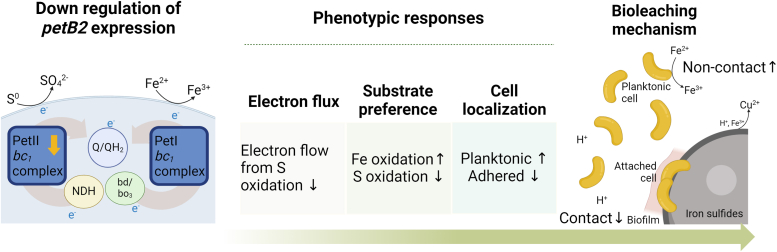
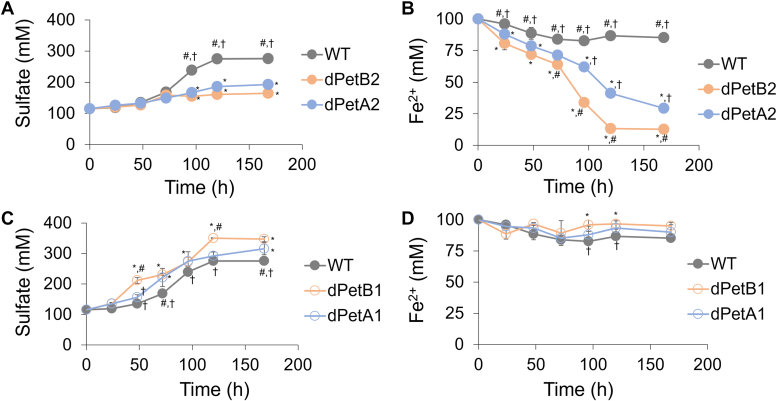
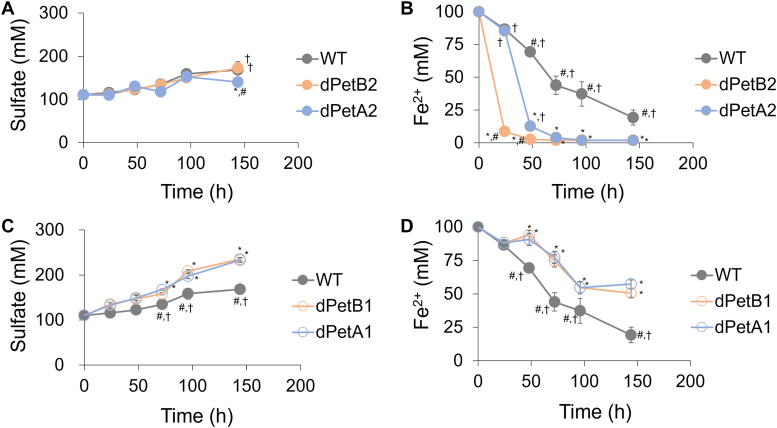
Acidithiobacillus ferrooxidans is an acidophilic chemolithoautotroph that plays an important role in biogeochemical iron and sulfur cycling and is a member of the consortia used in industrial hydrometallurgical processing of copper. Metal sulfide bioleaching is catalyzed by the regeneration of ferric iron; however, bioleaching of chalcopyrite, the dominant unmined form of copper on Earth, is inhibited by surface passivation. Here, we report the implementation of CRISPR interference (CRISPRi) using the catalytically inactive Cas12a (dCas12a) in A. ferrooxidans to knock down the expression of genes in the petI and petII operons. These operons encode bc complex proteins and knockdown of these genes enabled the manipulation (enhancement or repression) of iron oxidation. The petB2 gene knockdown strain enhanced iron oxidation, leading to enhanced pyrite and chalcopyrite oxidation, which correlated with reduced biofilm formation and decreased surface passivation of the minerals. These findings highlight the utility of CRISPRi/dCas12a technology for engineering A. ferrooxidans while unveiling a new strategy to manipulate and improve bioleaching efficiency.
嗜酸氧化亚铁硫杆菌是一种嗜酸化化学自养生物,在生物地球化学铁和硫循环中起着重要作用,也是用于工业湿法冶金处理铜的联合体的成员。金属硫化物的生物浸出是由三价铁的再生催化的;然而,地球上主要未开采形式的黄铜矿的生物浸出受到表面钝化的抑制。在这里,我们报告了使用无催化活性的 Cas12a(dCas12a)在 A. ferrooxidans 中实施 CRISPR 干扰(CRISPRi),以敲低 petI 和 petII 操纵子中的基因表达。这些操纵子编码 bc 复合物蛋白,敲低这些基因可操纵(增强或抑制)铁氧化。petB2 基因敲低菌株增强了铁氧化,导致黄铁矿和黄铜矿氧化增强,这与生物膜形成减少和矿物表面钝化减少相关。这些发现突出了 CRISPRi/dCas12a 技术在工程化 A. ferrooxidans 方面的实用性,同时揭示了一种操纵和提高生物浸出效率的新策略。