
脂肪酸代谢通过调节维 A 酸受体信号通路限制 Th9 细胞分化和抗肿瘤免疫。
Fatty acid metabolism constrains Th9 cell differentiation and antitumor immunity via the modulation of retinoic acid receptor signaling.
机构信息
Department of Frontier Research and Development, Laboratory of Medical Omics Research, Kazusa DNA Research Institute, 2-6-7 Kazusa Kamatari, Kisarazu, Chiba, 292-0818, Japan.
Department of Tumor Microenvironment, Faculty of Medicine, Dentistry and Pharmaceutical Sciences, Okayama University, 2-5-1, Shikata-cho, Kita-ku, Okayama, 700-8558, Japan.
出版信息
Cell Mol Immunol. 2024 Nov;21(11):1266-1281. doi: 10.1038/s41423-024-01209-y. Epub 2024 Aug 26.
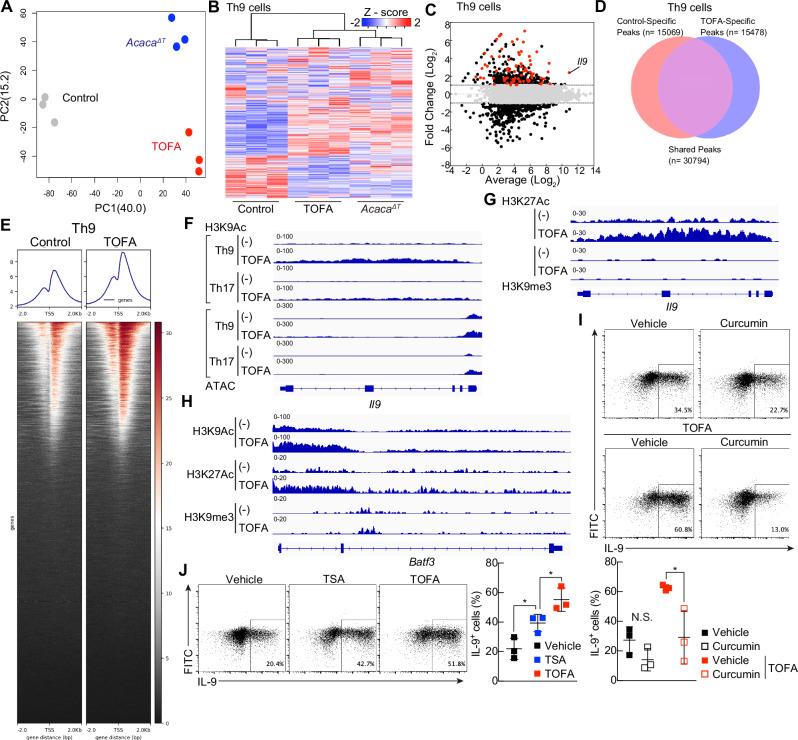
T helper 9 (Th9) cells are interleukin 9 (IL-9)-producing cells that have diverse functions ranging from antitumor immune responses to allergic inflammation. Th9 cells differentiate from naïve CD4 T cells in the presence of IL-4 and transforming growth factor-beta (TGF-β); however, our understanding of the molecular basis of their differentiation remains incomplete. Previously, we reported that the differentiation of another subset of TGF-β-driven T helper cells, Th17 cells, is highly dependent on de novo lipid biosynthesis. On the basis of these findings, we hypothesized that lipid metabolism may also be important for Th9 cell differentiation. We therefore investigated the differentiation and function of mouse and human Th9 cells in vitro under conditions of pharmacologically or genetically induced deficiency of the intracellular fatty acid content and in vivo in mice genetically deficient in acetyl-CoA carboxylase 1 (ACC1), an important enzyme for fatty acid biosynthesis. Both the inhibition of de novo fatty acid biosynthesis and the deprivation of environmental lipids augmented differentiation and IL-9 production in mouse and human Th9 cells. Mechanistic studies revealed that the increase in Th9 cell differentiation was mediated by the retinoic acid receptor and the TGF-β-SMAD signaling pathways. Upon adoptive transfer, ACC1-inhibited Th9 cells suppressed tumor growth in murine models of melanoma and adenocarcinoma. Together, our findings highlight a novel role of fatty acid metabolism in controlling the differentiation and in vivo functions of Th9 cells.
辅助性 T 细胞 9(Th9)细胞是产生白细胞介素 9(IL-9)的细胞,其功能多样,从抗肿瘤免疫反应到过敏炎症。Th9 细胞在 IL-4 和转化生长因子-β(TGF-β)的存在下从幼稚 CD4 T 细胞分化而来;然而,我们对其分化的分子基础的理解仍不完整。先前,我们报道了另一类 TGF-β驱动的辅助性 T 细胞,Th17 细胞的分化高度依赖于从头脂质生物合成。基于这些发现,我们假设脂质代谢对 Th9 细胞分化也可能很重要。因此,我们研究了在药理学或基因诱导的细胞内脂肪酸含量缺乏的条件下,体外培养的小鼠和人 Th9 细胞的分化和功能,以及在乙酰辅酶 A 羧化酶 1(ACC1)基因缺失的小鼠体内的分化和功能,ACC1 是脂肪酸生物合成的重要酶。从头脂肪酸生物合成的抑制和环境脂质的剥夺均增强了小鼠和人 Th9 细胞的分化和 IL-9 产生。机制研究表明,Th9 细胞分化的增加是由视黄酸受体和 TGF-β-SMAD 信号通路介导的。在过继转移中,ACC1 抑制的 Th9 细胞抑制了黑色素瘤和腺癌小鼠模型中的肿瘤生长。总之,我们的研究结果强调了脂肪酸代谢在控制 Th9 细胞分化和体内功能中的新作用。




 Zotero 插件