Peng Xia, Ni Hui-Qin, Liu Yong-Mei, Zhu Jin-Ling, Bai Yu-Ting
Department of Respiratory and Critical Care Medicine, Yancheng First Hospital Affiliated to Nanjing University School of Medicine, Yancheng 224006, Jiangsu Province, China.
Department of Neurology, Yancheng First Hospital Affiliated to Nanjing University School of Medicine, Yancheng 224006, Jiangsu Province, China.
World J Clin Cases. 2024 Aug 26;12(24):5549-5557. doi: 10.12998/wjcc.v12.i24.5549.
Patients with stroke frequently experience pulmonary dysfunction.
To explore the effects of information-motivation-behavioral (IMB) skills model-based nursing care on pulmonary function, blood gas indices, complication rates, and quality of life (QoL) in stroke patients with pulmonary dysfunction.
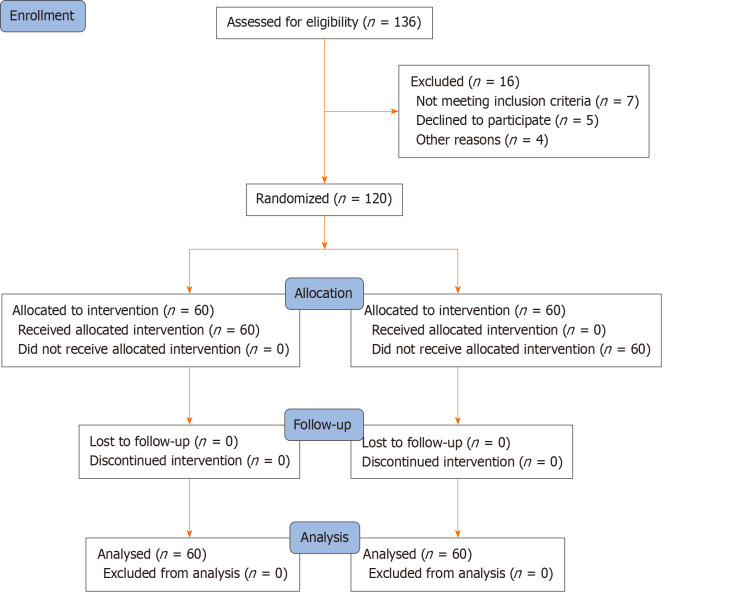
We conducted a controlled study involving 120 stroke patients with pulmonary dysfunction. The control group received routine care, whereas the intervention group received IMB-model-based nursing care. Various parameters including pulmonary function, blood gas indices, complication rates, and QoL were assessed before and after the intervention.
Baseline data of the control and intervention groups were comparable. Post-intervention, the IMB model-based care group showed significant improvements in pulmonary function indicators, forced expiratory volume in 1 sec, forced vital capacity, and peak expiratory flow compared with the control group. Blood gas indices, such as arterial oxygen pressure and arterial oxygen saturation, increased significantly, and arterial carbon dioxide partial. pressure decreased significantly in the IMB model-based care group compared with the control group. The intervention group also had a lower complication rate (6.67% 23.33%) and higher QoL scores across all domains than the control group.
IMB model-based nursing care significantly enhanced pulmonary function, improved blood gas indices, reduced complication rates, and improved the QoL of stroke patients with pulmonary dysfunction. Further research is needed to validate these results and to assess the long-term efficacy and broader applicability of the model.
中风患者经常出现肺功能障碍。
探讨基于信息 - 动机 - 行为(IMB)技能模型的护理对中风合并肺功能障碍患者肺功能、血气指标、并发症发生率及生活质量(QoL)的影响。
我们进行了一项对照研究,纳入120例中风合并肺功能障碍患者。对照组接受常规护理,而干预组接受基于IMB模型的护理。在干预前后评估包括肺功能、血气指标、并发症发生率和生活质量等各项参数。
对照组和干预组的基线数据具有可比性。干预后,与对照组相比,基于IMB模型的护理组在肺功能指标、第1秒用力呼气量、用力肺活量和呼气峰值流速方面有显著改善。基于IMB模型的护理组的血气指标,如动脉血氧分压和动脉血氧饱和度显著升高,动脉二氧化碳分压显著降低。干预组的并发症发生率也低于对照组(6.67%对23.33%),并且在所有领域的生活质量得分均高于对照组。
基于IMB模型的护理显著增强了中风合并肺功能障碍患者的肺功能,改善了血气指标,降低了并发症发生率,并提高了生活质量。需要进一步研究来验证这些结果,并评估该模型的长期疗效和更广泛的适用性。