Ayafor Christian, Chang Allen C, Patel Akanksha, Abid Umer, Xie Dongming, Sobkowicz Margaret J, Wong Hsi-Wu
Energy Engineering Program, University of Massachusetts Lowell, Lowell, MA-01854, USA.
Department of Plastics Engineering, University of Massachusetts Lowell, Lowell, MA-01854, USA.
ChemSusChem. 2025 Feb 1;18(3):e202400698. doi: 10.1002/cssc.202400698. Epub 2024 Nov 6.
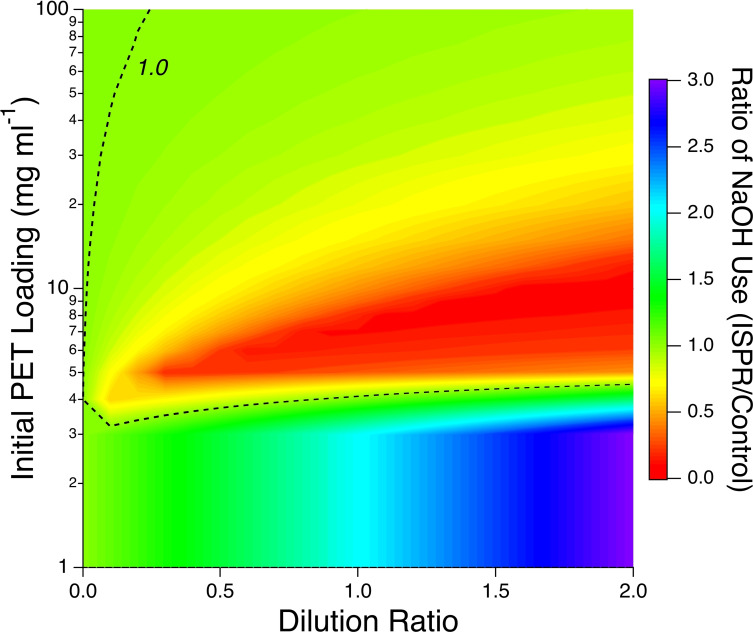
Poly(ethylene terephthalate) (PET) is a common single-use plastic and a major contributor to plastic waste. PET upcycling through enzymatic depolymerization has drawn significant interests, but lack of robust enzymes in acidic environments remains a challenge. This study investigates in-situ product removal (ISPR) of protons and monomers from enzymatic PET depolymerization via a membrane reactor, focusing on the ICCG variant of leaf branch compost cutinase. More than two-fold improvements in overall PET depolymerization and terephthalic acid yields were achieved employing ISPR for an initial PET loading of 10 mg ml . The benefit of ISPR was reduced for a lower initial loading of 1 mg ml due to decreased need for pH stabilization of the enzyme-containing solutions. A back-of-envelop analysis suggests that at a modest dilution ratio, ISPR could help achieve savings on caustic base solutions used for pH control in a bioreactor. Our study provides valuable insights for future ISPR developments for enzymatic PET depolymerization, addressing the pressing need for more sustainable solutions towards plastic recycling and environmental conservation.
聚对苯二甲酸乙二酯(PET)是一种常见的一次性塑料,也是塑料垃圾的主要来源。通过酶促解聚实现PET的升级回收已引起广泛关注,但在酸性环境中缺乏高效的酶仍然是一个挑战。本研究通过膜反应器研究了酶促PET解聚过程中质子和单体的原位产物去除(ISPR),重点关注叶枝堆肥角质酶的ICCG变体。对于初始PET负载量为10 mg/ml的情况,采用ISPR可使PET整体解聚和对苯二甲酸产率提高两倍以上。对于初始负载量为1 mg/ml的较低情况,由于对含酶溶液pH稳定的需求降低,ISPR的益处有所减少。粗略分析表明,在适度的稀释率下,ISPR有助于节省生物反应器中用于pH控制的苛性碱溶液。我们的研究为酶促PET解聚的未来ISPR发展提供了有价值的见解,满足了对更可持续的塑料回收和环境保护解决方案的迫切需求。