State Key Laboratory of Reproductive Medicine and Offspring Health, Center for Clinical Reproductive Medicine, the First Affiliated Hospital of Nanjing Medical University, Nanjing, China.
State Key Laboratory of Reproductive Medicine and Offspring Health, Center for Reproductive Medicine, Institute of Women, Children and Reproductive Health, Shandong University, Jinan, China.
Nat Commun. 2024 Sep 5;15(1):7747. doi: 10.1038/s41467-024-52008-y.
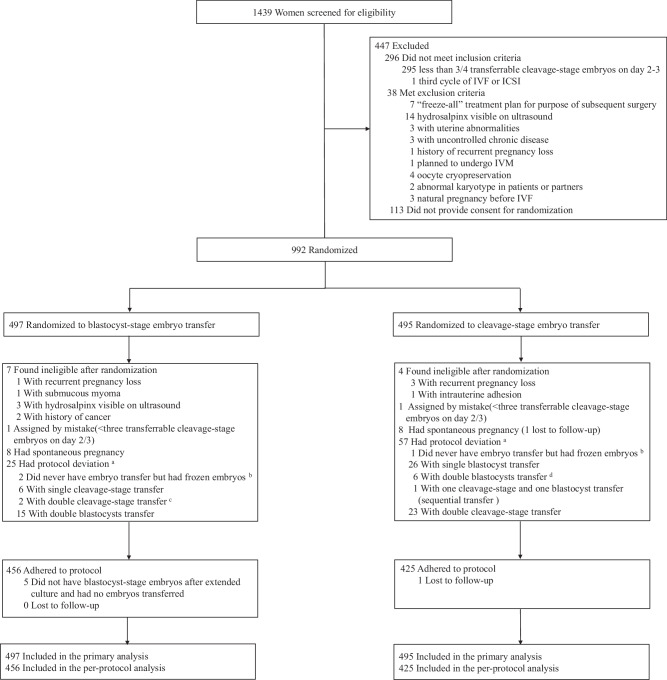
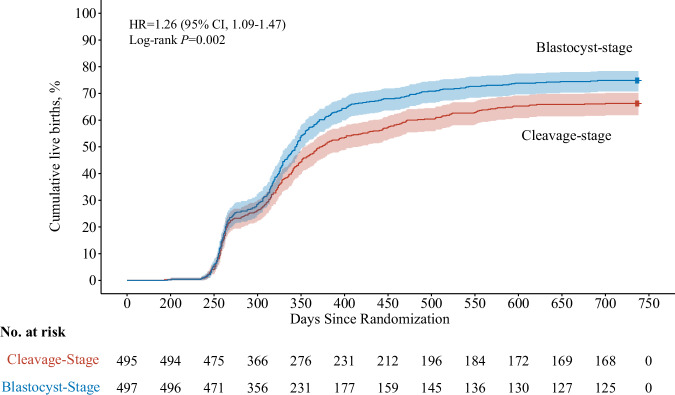
In this multicenter, non-inferiority, randomized trial, we randomly assigned 992 women undergoing in-vitro fertilization (IVF) with a good prognosis (aged 20-40, ≥3 transferrable cleavage-stage embryos) to strategies of blastocyst-stage (n = 497) or cleavage-stage (n = 495) single embryo transfer. Primary outcome was cumulative live-birth rate after up to three transfers. Secondary outcomes were cumulative live-births after all embryo transfers within 1 year of randomization, pregnancy outcomes, obstetric-perinatal complications, and livebirths outcomes. Live-birth rates were 74.8% in blastocyst-stage group versus 66.3% in cleavage-stage group (relative risk 1.13, 95%CI:1.04-1.22; P < 0.001, P = 0.003) (1-year cumulative live birth rates of 75.7% versus 68.9%). Blastocyst transfer increased the risk of spontaneous preterm birth (4.6% vs 2.0%; P = 0.02) and neonatal hospitalization >3 days. Among good prognosis women, a strategy of single blastocyst transfer increases cumulative live-birth rates over single cleavage-stage transfer. Blastocyst transfer resulted in higher preterm birth rates. This information should be used to counsel patients on their choice between cleavage-stage and blastocyst-stage transfer (NCT03152643, https://clinicaltrials.gov/study/NCT03152643 ).
在这项多中心、非劣效性、随机试验中,我们将 992 名预后良好(年龄 20-40 岁,≥3 个可转移的卵裂期胚胎)接受体外受精(IVF)的女性随机分为囊胚期(n=497)或卵裂期(n=495)单胚胎移植策略组。主要结局是最多进行 3 次移植后的累积活产率。次要结局是随机分组后 1 年内所有胚胎移植的累积活产率、妊娠结局、产科围产期并发症和活产结局。囊胚期组的活产率为 74.8%,卵裂期组为 66.3%(相对风险 1.13,95%CI:1.04-1.22;P<0.001,P=0.003)(1 年累积活产率为 75.7%比 68.9%)。囊胚移植增加了自发性早产(4.6%比 2.0%;P=0.02)和新生儿住院>3 天的风险。在预后良好的女性中,单囊胚移植策略比单卵裂期移植策略增加了累积活产率。囊胚移植导致早产率升高。这些信息应用于向患者提供关于卵裂期和囊胚期移植之间选择的咨询(NCT03152643,https://clinicaltrials.gov/study/NCT03152643)。