
如何在内窥镜辅助经椎间孔腰椎体间融合术中设置工作套管:基于 CT 的形态计量分析。
How to Set Working Cannula in Endoscopic-Assisted Transforaminal Lumbar Interbody Fusion: A Morphometric Analysis Based on Computed Tomography.
机构信息
Department of Orthopedic Surgery, The First Affiliated Hospital, Zhejiang University School of Medicine, Hangzhou, China.
Shenzhen Pingle Orthopedics Hospital, Shenzhen, China.
出版信息
Orthop Surg. 2024 Dec;16(12):3006-3013. doi: 10.1111/os.14239. Epub 2024 Sep 10.
OBJECTIVES
There is a high risk of nerve root injury during endoscopic-assisted transforaminal lumbar interbody fusion (Endo-TLIF). This study used computed tomography (CT) imaging to assess the relationship between the exiting nerve root and its surroundings, and the corresponding intervertebral disc. We also measured the approximate position and angle for the placement of the working cannula to reduce the risk of nerve root injury during Endo-TLIF procedures in the Chinese population.
METHODS
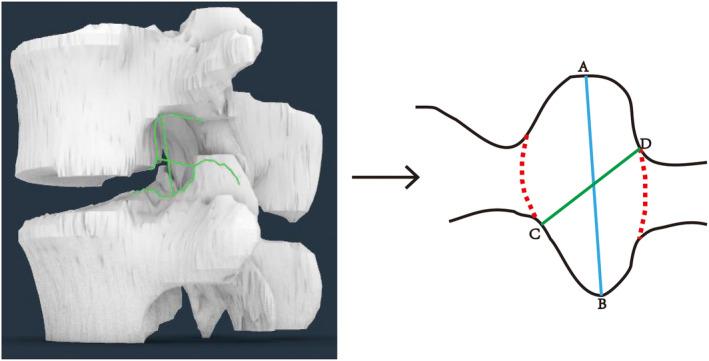
This retrospective study was conducted at our institution between December 2021 and December 2022. A total of 115 patients suffering from low back pain were recruited for the study. For each participant, three-dimensional (3D) vertebral models of the lumbar segments from L3 to S1 were constructed based on their CT images. The nerve root-disc distance, cannula insertion bypass distance and angle, foraminal height and width, exiting nerve root height, and nerve root-pedicle distance were measured. A paired t-test was used to compare measurements between the left and right sides, while inter- and intraobserver reproducibility was assessed using the intraclass correlation coefficient (ICC).
RESULTS
From L3/4 to L5/S1 segments, the ideal cannula insertion distance range was 37.51 ± 4.91-120.38 ± 37.71 mm at L3/4; 42.38 ± 5.29-116.25 ± 27.22 mm at L4/5; and 37.78 ± 4.86-69.26 ± 12.64 mm at L5/S1. The appropriate cannula insertion angle range was 30.86° ± 5.05°-62.59° ± 6.66° at L3/4; 34.30° ± 4.73°-60.88° ± 7.34° at L4/5; and 35.89° ± 4.18°-47.65° ± 7.38° at L5/S1. The height of the intervertebral foramen (IVF) gradually decreased, and the width steadily increased. The exiting nerve root height and the nerve root-pedicle distance slightly decreased caudally.
CONCLUSION
From L3/4 to L5/S1, the range of working cannula insertion distance and angle gradually decreased, and the exiting nerve root height occupying the IVF gradually increased. Our measurement can reduce the risk of nerve root injury caused by inserting the working cannula during Endo-TLIF.
目的
在经皮内镜辅助下经椎间孔腰椎体间融合术(Endo-TLIF)中,存在神经根损伤的高风险。本研究使用计算机断层扫描(CT)成像来评估出神经根与其周围环境和相应椎间盘之间的关系。我们还测量了工作套管放置的近似位置和角度,以降低在中国人群中进行 Endo-TLIF 手术时神经根损伤的风险。
方法
这是一项在我们机构进行的回顾性研究,时间为 2021 年 12 月至 2022 年 12 月。共有 115 名患有腰痛的患者被纳入研究。对于每位参与者,根据其 CT 图像构建了从 L3 到 S1 的腰椎的三维(3D)椎体模型。测量神经根-椎间盘距离、套管插入旁路距离和角度、椎间孔高度和宽度、出神经根高度和神经根-椎弓根距离。使用配对 t 检验比较左右两侧的测量值,使用组内相关系数(ICC)评估观察者内和观察者间的可重复性。
结果
从 L3/4 到 L5/S1 节段,L3/4 处理想的套管插入距离范围为 37.51±4.91-120.38±37.71mm;L4/5 处为 42.38±5.29-116.25±27.22mm;L5/S1 处为 37.78±4.86-69.26±12.64mm。合适的套管插入角度范围为 L3/4 处 30.86°±5.05°-62.59°±6.66°;L4/5 处为 34.30°±4.73°-60.88°±7.34°;L5/S1 处为 35.89°±4.18°-47.65°±7.38°。椎间孔(IVF)的高度逐渐降低,宽度稳定增加。出神经根高度和神经根-椎弓根距离在尾部略减小。
结论
从 L3/4 到 L5/S1,工作套管插入的距离和角度范围逐渐减小,出神经根占据 IVF 的高度逐渐增加。我们的测量可以降低经皮内镜辅助下经椎间孔腰椎体间融合术(Endo-TLIF)中插入工作套管引起神经根损伤的风险。


 Zotero 插件