
人类血清代谢物的遗传易感性与端粒长度存在因果关联:来自全基因组孟德尔随机化和代谢途径分析的见解。
Genetic liability to human serum metabolites is causally linked to telomere length: insights from genome-wide Mendelian randomization and metabolic pathways analysis.
作者信息
Liu Jingwen, Pan Renbing
机构信息
Department of Psychiatry, Longyou People's Hospital Affiliated with Sir Run Run Shaw Hospital, Zhejiang University School of Medicine, Quzhou, China.
Department of Urology, The Quzhou Affiliated Hospital of Wenzhou Medical University, Quzhou People's Hospital, Quzhou, China.
出版信息
Front Nutr. 2024 Aug 26;11:1458442. doi: 10.3389/fnut.2024.1458442. eCollection 2024.
BACKGROUND
Telomere has been recognized as a biomarker of accelerating aging, and telomere length (TL) shortening is closely related to diverse chronic illnesses. Human serum metabolites have demonstrated close correlations with TL maintenance or shortening in observational studies. Nevertheless, little is known about the underlying pathological mechanisms, and Mendelian randomization (MR) analysis of serum metabolites may provide a more comprehensive understanding of the potential biological process.
METHODS
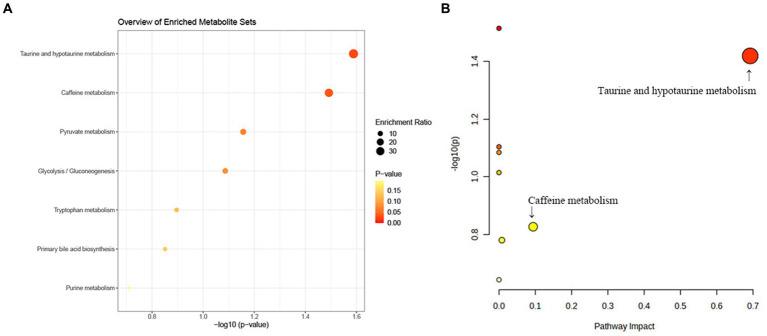
We employed a two-sample MR analysis method to assess the causal links between 486 serum metabolites and TL. We applied the inverse-variance weighted (IVW) approach as our primary analysis, and to assure the stability and robustness of our results, additional analysis methods including the weighted median, MR-Egger, and weighted mode were conducted. MR-Egger intercept test was utilized to detect the pleiotropy. Cochran's Q test was implemented to quantify the extent of heterogeneity. Furthermore, the pathway analysis was conducted to identify potential metabolic pathways.
RESULTS
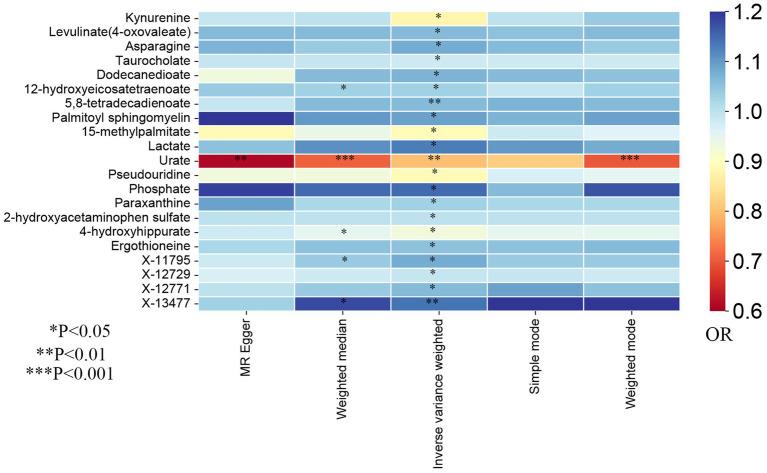
We identified 11 known blood metabolites associated with TL. Among these metabolites, four were lipid (taurocholate, dodecanedioate, 5,8-tetradecadienoate, and 15-methylpalmitate), one amino acid (levulinate (4-oxovaleate)), one carbohydrate (lactate), one nucleotide (pseudouridine), one energy (phosphate), and three xenobiotics (2-hydroxyacetaminophen sulfate, paraxanthine, and ergothioneine). The known protective metabolites included levulinate (4-oxovaleate), dodecanedioate, 5,8-tetradecadienoate, lactate, phosphate, paraxanthine, and ergothioneine. Multiple metabolic pathways have been identified as being implicated in the maintenance of telomere length.
CONCLUSION
Our MR analysis provided suggestive evidence supporting the causal relationships between 11 identified blood metabolites and TL, necessitating further exploration to clarify the mechanisms by which these serum metabolites and metabolic pathways may affect the progression of telomeres.
背景
端粒已被公认为加速衰老的生物标志物,端粒长度(TL)缩短与多种慢性疾病密切相关。在观察性研究中,人类血清代谢物已显示出与TL维持或缩短密切相关。然而,其潜在的病理机制尚不清楚,血清代谢物的孟德尔随机化(MR)分析可能有助于更全面地了解潜在的生物学过程。
方法
我们采用两样本MR分析方法来评估486种血清代谢物与TL之间的因果关系。我们将逆方差加权(IVW)方法作为主要分析方法,并为确保结果的稳定性和稳健性,还进行了包括加权中位数、MR-Egger和加权模式在内的其他分析方法。利用MR-Egger截距检验来检测多效性。采用Cochran's Q检验来量化异质性程度。此外,还进行了通路分析以识别潜在的代谢通路。
结果
我们鉴定出11种与TL相关的已知血液代谢物。在这些代谢物中,4种是脂质(牛磺胆酸盐、十二烷二酸、5,8-十四碳二烯酸和15-甲基棕榈酸),1种氨基酸(乙酰丙酸(4-氧代戊酸)),1种碳水化合物(乳酸),1种核苷酸(假尿苷),1种能量物质(磷酸盐),以及3种外源性物质(硫酸2-羟基对乙酰氨基酚、对甲氧基咖啡因和麦角硫因)。已知的保护性代谢物包括乙酰丙酸(4-氧代戊酸)、十二烷二酸、5,8-十四碳二烯酸、乳酸、磷酸盐、对甲氧基咖啡因和麦角硫因。已确定多种代谢通路与端粒长度的维持有关。
结论
我们的MR分析提供了支持性证据,证明了11种已鉴定的血液代谢物与TL之间的因果关系,需要进一步探索以阐明这些血清代谢物和代谢通路可能影响端粒进展的机制。




 Zotero 插件