Vanderbilt Vaccine Center, Vanderbilt University Medical Center, Nashville, Tennessee, USA.
Department of Pathology, Microbiology and Immunology, Vanderbilt University Medical Center, Nashville, Tennessee, USA.
mBio. 2024 Oct 16;15(10):e0156024. doi: 10.1128/mbio.01560-24. Epub 2024 Sep 12.
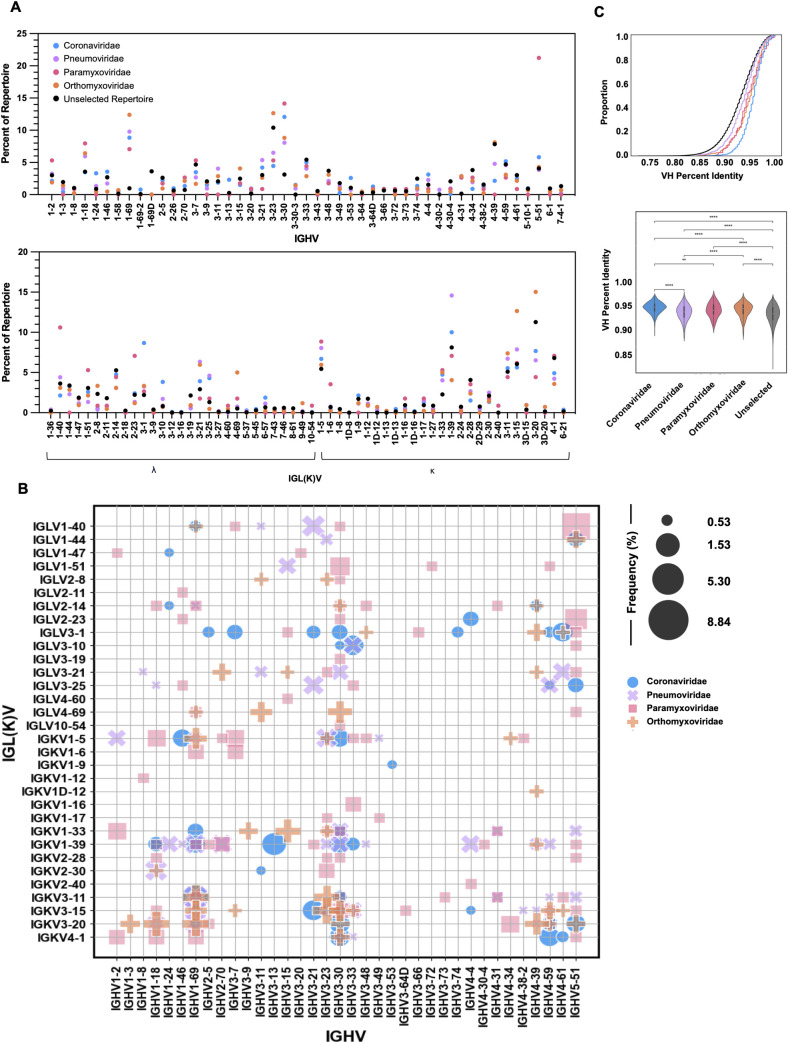
Throughout life, humans experience repeated exposure to viral antigens through infection and vaccination, resulting in the generation of diverse, antigen-specific antibody repertoires. A paramount feature of antibodies that enables their critical contributions in counteracting recurrent and novel pathogens, and consequently fostering their utility as valuable targets for therapeutic and vaccine development, is the exquisite specificity displayed against their target antigens. Yet, there is still limited understanding of the determinants of antibody-antigen specificity, particularly as a function of antibody sequence. In recent years, experimental characterization of antibody repertoires has led to novel insights into fundamental properties of antibody sequences but has been largely decoupled from at-scale antigen specificity analysis. Here, using the LIBRA-seq technology, we generated a large data set mapping antibody sequence to antigen specificity for thousands of B cells, by screening the repertoires of a set of healthy individuals against 20 viral antigens representing diverse pathogens of biomedical significance. Analysis uncovered virus-specific patterns in variable gene usage, gene pairing, somatic hypermutation, as well as the presence of convergent antiviral signatures across multiple individuals, including the presence of public antibody clonotypes. Notably, our results showed that, for B-cell receptors originating from different individuals but leveraging an identical combination of heavy and light chain variable genes, there is a specific CDRH3 identity threshold above which B cells appear to exclusively share the same antigen specificity. This finding provides a quantifiable measure of the relationship between antibody sequence and antigen specificity and further defines experimentally grounded criteria for defining public antibody clonality.IMPORTANCEThe B-cell compartment of the humoral immune system plays a critical role in the generation of antibodies upon new and repeated pathogen exposure. This study provides an unprecedented level of detail on the molecular characteristics of antibody repertoires that are specific to each of the different target pathogens studied here and provides empirical evidence in support of a 70% CDRH3 amino acid identity threshold in pairs of B cells encoded by identical IGHV:IGL(K)V genes, as a means of defining public clonality and therefore predicting B-cell antigen specificity in different individuals. This is of exceptional importance when leveraging public clonality as a method to annotate B-cell receptor data otherwise lacking antigen specificity information. Understanding the fundamental rules of antibody-antigen interactions can lead to transformative new approaches for the development of antibody therapeutics and vaccines against current and emerging viruses.
在整个生命过程中,人类通过感染和接种疫苗反复接触病毒抗原,从而产生多样化的、针对特定抗原的抗体库。抗体的一个最重要特征是,它们能够对抗反复出现和新型病原体,因此它们作为治疗和疫苗开发有价值的靶点具有重要作用,这是因为它们对目标抗原具有极高的特异性。然而,人们对抗体-抗原特异性的决定因素仍然了解有限,特别是作为抗体序列的功能。近年来,对抗体库的实验表征使人们对抗体序列的基本特性有了新的认识,但很大程度上与大规模的抗原特异性分析相分离。在这里,我们使用 LIBRA-seq 技术,通过对一组健康个体的抗体库进行筛选,针对 20 种具有重要生物医学意义的病毒抗原,对数千个 B 细胞的抗体序列与抗原特异性进行了大规模数据映射。分析揭示了病毒特异性的可变基因使用、基因配对、体细胞超突变以及多种个体中存在的趋同抗病毒特征,包括公共抗体克隆型的存在。值得注意的是,我们的结果表明,对于源自不同个体但利用相同重链和轻链可变基因组合的 B 细胞受体,存在一个特定的 CDRH3 身份阈值,超过该阈值,B 细胞似乎只具有相同的抗原特异性。这一发现为抗体序列和抗原特异性之间的关系提供了可量化的衡量标准,并进一步为定义公共抗体克隆性提供了基于实验的标准。
重要性
体液免疫系统的 B 细胞在新的和反复的病原体暴露时产生抗体中起着关键作用。这项研究提供了前所未有的详细信息,说明了针对这里研究的每个不同靶病原体的抗体库的分子特征,并提供了经验证据支持在由相同 IGHV:IGL(K)V 基因编码的 B 细胞对中,70%的 CDRH3 氨基酸身份阈值作为定义公共克隆性并因此预测不同个体中 B 细胞抗原特异性的一种手段。当利用公共克隆性作为一种方法来注释缺乏抗原特异性信息的 B 细胞受体数据时,这一点尤其重要。了解抗体-抗原相互作用的基本规则可以为开发针对当前和新兴病毒的抗体治疗方法和疫苗带来变革性的新方法。