
评估不同生殖病理患者和生育男性精液中已知的铁死亡标志物。
Evaluation of Known Markers of Ferroptosis in Semen of Patients with Different Reproductive Pathologies and Fertile Men.
机构信息
Department of Molecular and Developmental Medicine, University of Siena, 53100 Siena, Italy.
Clinical Pathology Unit, Department of Cellular Therapy, Hematology and Laboratory Medicine, Azienda Ospedaliera-Senese, 53100 Siena, Italy.
出版信息
Cells. 2024 Sep 5;13(17):1490. doi: 10.3390/cells13171490.
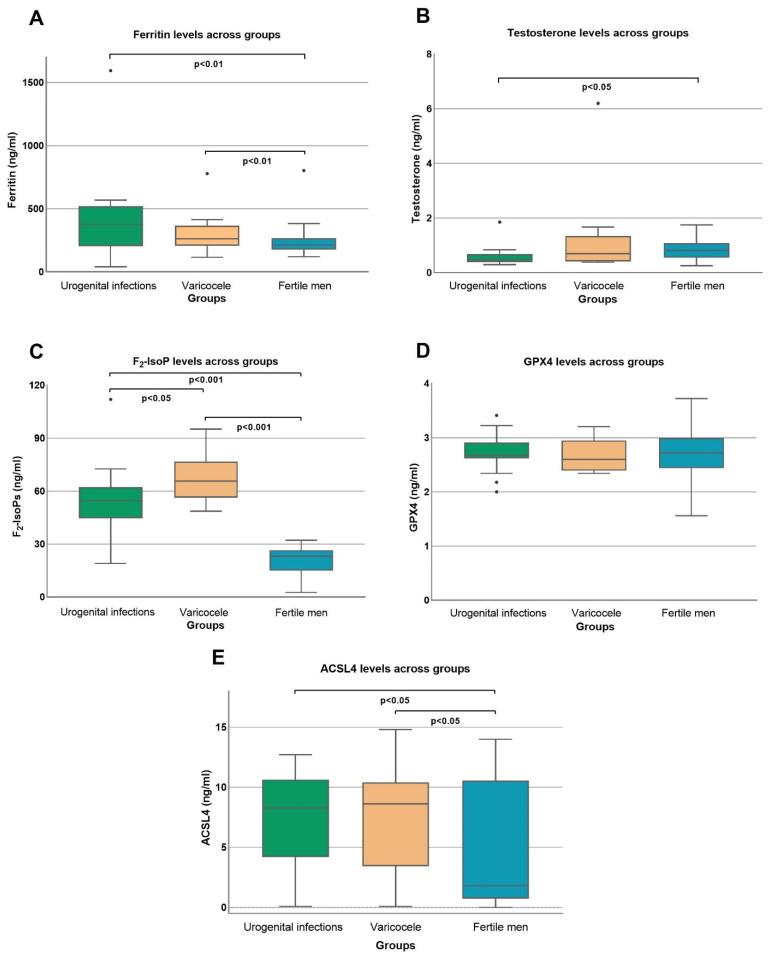
This study aims to investigate the role of ferroptosis, an iron-dependent form of regulated cell death, in male infertility. The motivation behind this research stems from the increasing recognition of oxidative stress and iron metabolism dysregulation as critical factors in male reproductive health. In this study, 28 infertile patients (grouped by the presence of urogenital infections or varicocele) and 19 fertile men were selected. Spermiograms were performed by light microscopy (WHO, 2021). Testosterone, ferritin, transferrin-bound iron, transferrin, and F-isoprostanes (F-IsoPs) were detected in seminal plasma. Glutathione peroxidase 4 (GPX4) and acyl coenzyme A synthetase long chain family member 4 (ACSL4) were also assessed in sperm cells using enzyme-linked immunosorbent assays (ELISA). All the variables were correlated (statistically significant Spearman's rank correlations) in the whole population, and then the comparison between variables of the different groups of men were carried out. Seminal ferritin and transferrin positively correlated with seminal F-IsoPs, which had positive correlations with ACSL4 detected in sperm cells. Ferritin and ACSL4 negatively correlated with the seminal parameters. No correlation was detected for GPX4. Comparing the variables in the three examined groups, elevated levels of ACSL4 were observed in infertile patients with urogenital infections and varicocele; GPX4 levels were similar in the three groups. These results suggested a mechanism of ferroptosis, identified by increased ACSL4 levels and the occurrence of lipid peroxidation. Such events appear to be GPX4-independent in reproductive pathologies such as varicocele and urogenital infections.
本研究旨在探讨铁死亡(一种铁依赖性的细胞死亡形式)在男性不育中的作用。这项研究的动机源于对氧化应激和铁代谢失调作为男性生殖健康关键因素的认识不断增加。本研究选择了 28 名不育患者(按存在泌尿生殖系统感染或精索静脉曲张分组)和 19 名健康男性。采用光学显微镜进行精液分析(WHO,2021 年)。检测精液中的睾酮、铁蛋白、转铁蛋白结合铁、转铁蛋白和 F-异前列烷(F-IsoPs)。使用酶联免疫吸附测定法(ELISA)评估精子细胞中的谷胱甘肽过氧化物酶 4(GPX4)和酰基辅酶 A 合成酶长链家族成员 4(ACSL4)。对所有变量进行了相关性分析(全人群有统计学意义的斯皮尔曼等级相关),然后对不同组别的男性变量进行了比较。精液铁蛋白和转铁蛋白与精液 F-IsoPs 呈正相关,而 F-IsoPs 与精子细胞中检测到的 ACSL4 呈正相关。铁蛋白和 ACSL4 与精液参数呈负相关。GPX4 与其他变量之间无相关性。比较三组患者的变量,发现泌尿生殖系统感染和精索静脉曲张的不育患者中 ACSL4 水平升高;三组患者的 GPX4 水平相似。这些结果提示存在铁死亡机制,表现为 ACSL4 水平升高和脂质过氧化发生。在精索静脉曲张和泌尿生殖系统感染等生殖系统疾病中,这种事件似乎与 GPX4 无关。

 Zotero 插件