Liao Chengcheng, Zeng Lin, Lu Shengjuan, Zheng Shaocu, Guo Baoping, Ke Qing, Wang Mingyue, Sun Jie, Rong Chao, He Sha, Zhong Dani, Huang Mei, Tan Xiaohong, Cen Hong
Department of Hematology/Oncology, Guangxi Medical University Cancer Hospital, Nanning, Guangxi, 530021, China.
State Key Laboratory of Targeting Oncology, Guangxi Medical University, Nanning, Guangxi, 530021, China.
J Cancer. 2024 Sep 9;15(17):5729-5741. doi: 10.7150/jca.99427. eCollection 2024.
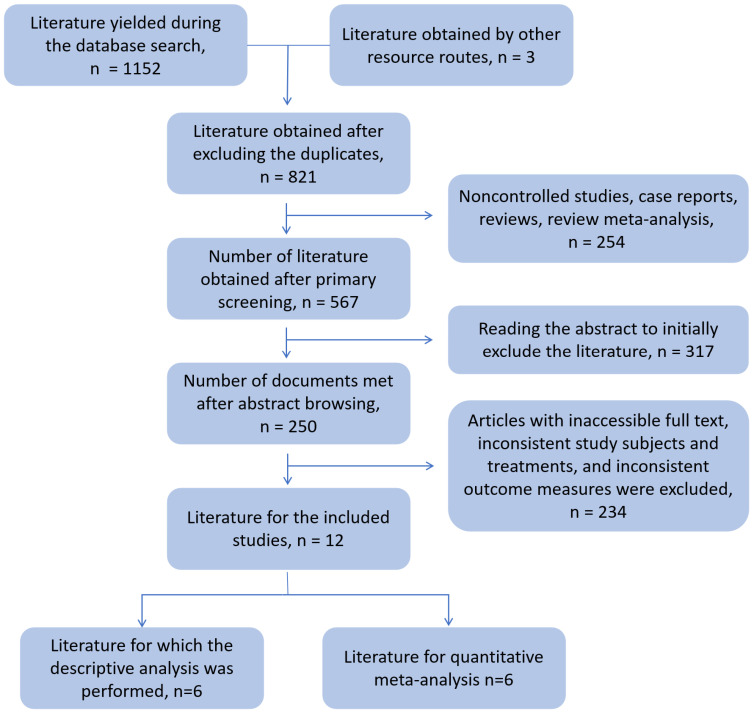
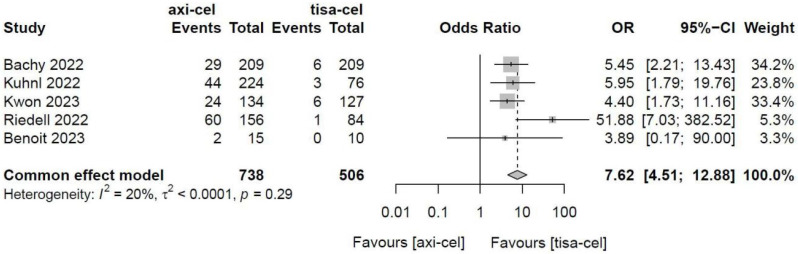
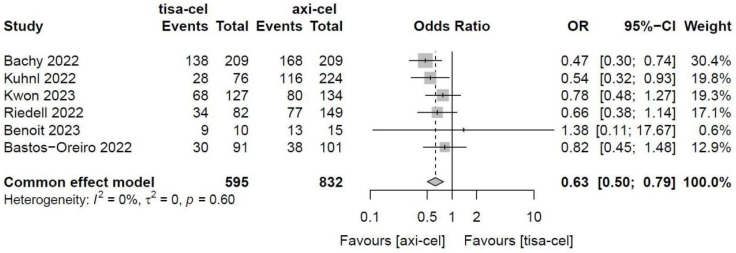
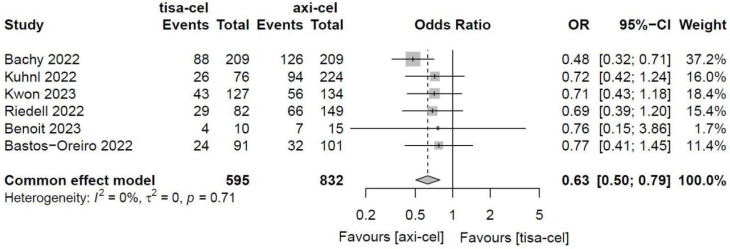
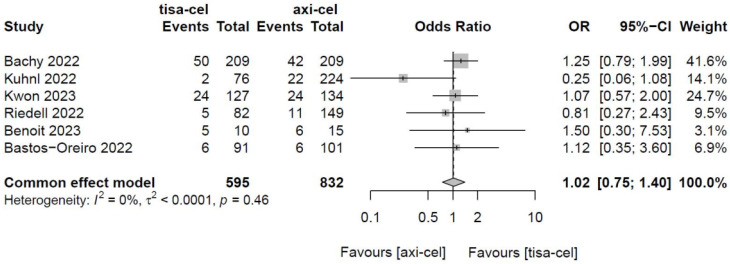
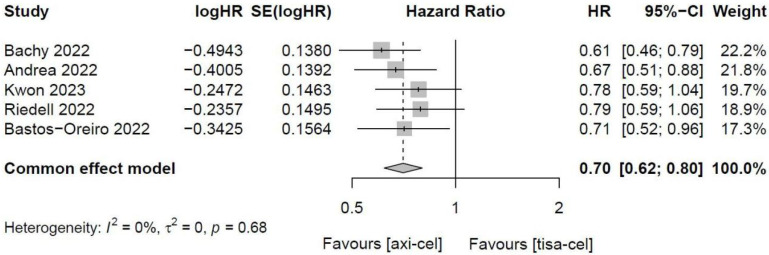
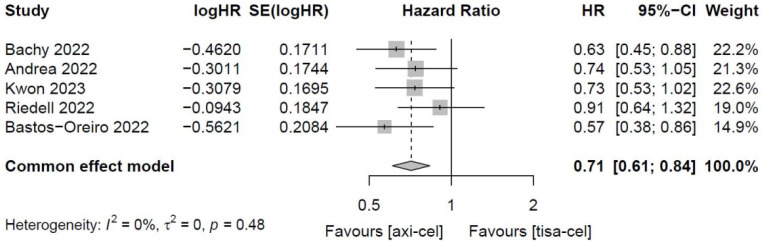
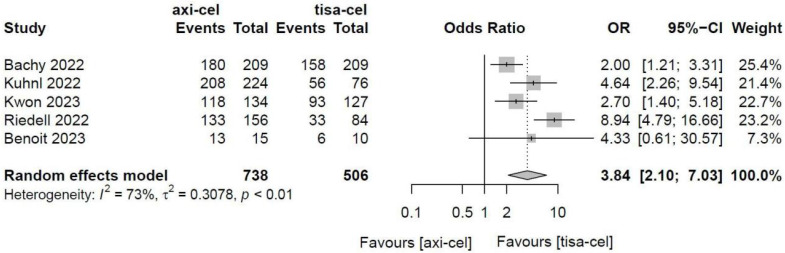
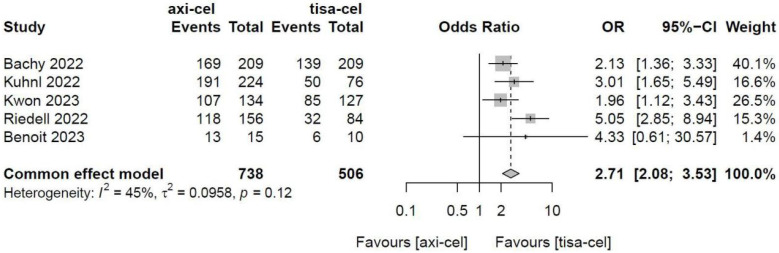
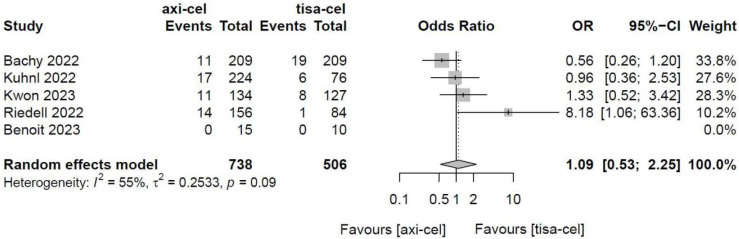
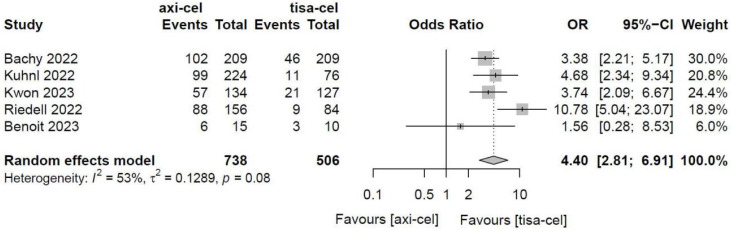
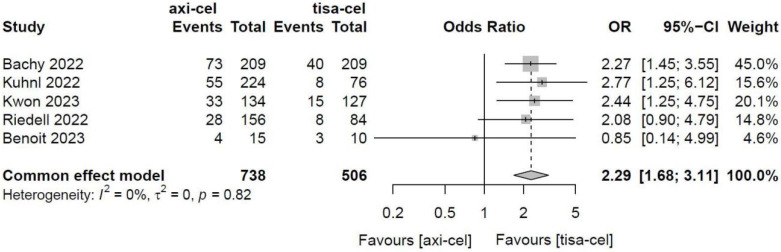
This study aimed to analyze the efficacy and safety of chimeric antigen receptor T-cell (CAR-T) therapy for B-cell lymphoma using published literature data. Literature on CAR-T therapy for B-cell lymphoma was collected by searching common databases. The literature was screened, quality assessed, and data extracted according to the inclusion and exclusion criteria. We performed a quantitative meta-analysis of the efficacy and safety of combined literature data. If the data could not be combined, descriptive analysis was performed. The meta-analysis results indicated that compared with tisagenlecleucel (tisa-cel), axicabtagene ciloleucel (axi-cel) had higher objective response rate (ORR) and complete response rate, with odds ratio (OR) of 0.63 for both sides (95% confidence interval [CI], 0.50-0.79) and statistically significant differences. Partial response rate was lower with axi-cel than with tisa-cel, with an OR of 1.02 for tisa-cel versus axi-cel (95% CI, 0.75-1.40) and no statistically significant difference. Compared with tisa-cel, axi-cel had longer progression-free survival and overall survival, with risk ratios of 0.70 (95% CI, 0.62-0.80) and 0.71 (95% CI, 0.61-0.84) for axi-cel and tisa-cel, respectively. Compared with tisa-cel, axi-cel had higher incidence rates of cytokine release syndrome (CRS) and immune effector cell-related neurotoxicity syndrome (ICANS), with ORs of 3.84 (95% CI, 2.10-7.03) and 4.4 (95% CI, 2.81-6.91), respectively. CAR T-cell therapy is an effective treatment option for relapsed/refractory B-cell lymphoma. Axi-cel has better ORR and survival advantages compared with tisa-cel; however, axi-cel has higher incidence rates of CRS and ICANS compared with tisa-cel.
本研究旨在利用已发表的文献数据,分析嵌合抗原受体T细胞(CAR-T)疗法治疗B细胞淋巴瘤的疗效和安全性。通过检索常见数据库收集关于CAR-T疗法治疗B细胞淋巴瘤的文献。根据纳入和排除标准对文献进行筛选、质量评估并提取数据。我们对合并后的文献数据的疗效和安全性进行了定量荟萃分析。如果数据无法合并,则进行描述性分析。荟萃分析结果表明,与替沙仑赛(tisa-cel)相比,阿基仑赛(axi-cel)具有更高的客观缓解率(ORR)和完全缓解率,双侧比值比(OR)均为0.63(95%置信区间[CI],0.50-0.79),且差异具有统计学意义。阿基仑赛的部分缓解率低于替沙仑赛,替沙仑赛与阿基仑赛相比的OR为1.02(95%CI,0.75-1.40),且无统计学意义。与替沙仑赛相比,阿基仑赛具有更长的无进展生存期和总生存期,阿基仑赛和替沙仑赛的风险比分别为0.70(95%CI,0.62-0.80)和0.71(95%CI,0.61-0.84)。与替沙仑赛相比,阿基仑赛的细胞因子释放综合征(CRS)和免疫效应细胞相关神经毒性综合征(ICANS)的发生率更高,OR分别为3.84(95%CI,2.10-7.03)和4.4(95%CI,2.81-6.91)。CAR T细胞疗法是复发/难治性B细胞淋巴瘤的一种有效治疗选择。与替沙仑赛相比,阿基仑赛具有更好的ORR和生存优势;然而,与替沙仑赛相比,阿基仑赛的CRS和ICANS发生率更高。