Consejo de Investigaciones Científicas y Técnicas (CONICET), Buenos Aires, Argentina.
Instituto y Museo de Ciencias Naturales, Universidad Nacional de San Juan, CIGEOBIO, CONICET, Av. España 400 (N), J5400DNQ, San Juan, San Juan, Argentina.
Sci Rep. 2024 Sep 27;14(1):22071. doi: 10.1038/s41598-024-63196-4.
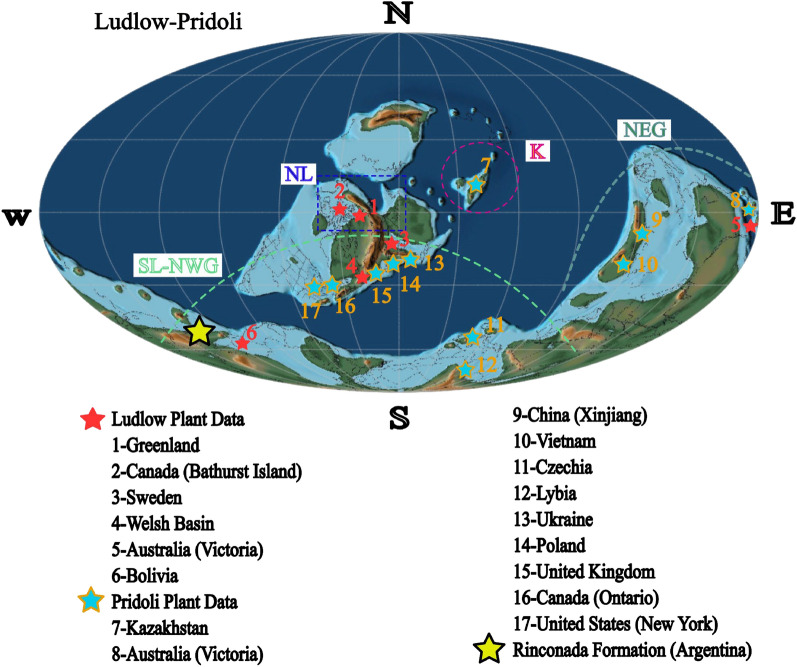
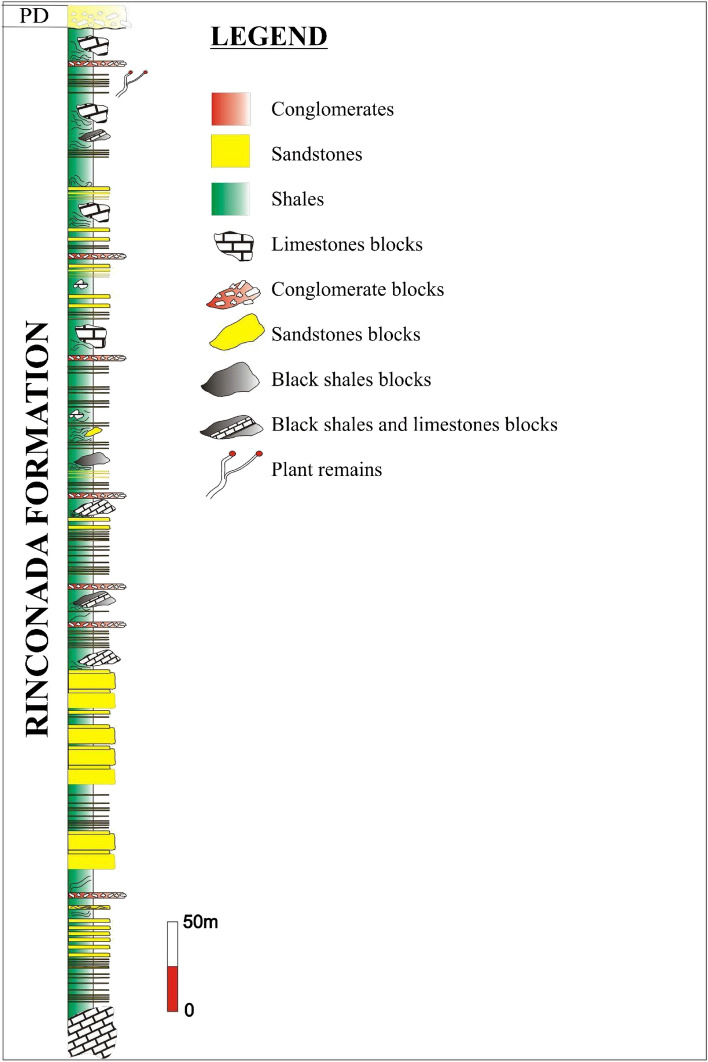
The Silurian-Devonian transition played a crucial role in the development of early terrestrial ecosystems due to the rapid diversification of early vascular plants. However, records of Pridolian plants in western Gondwana are scarce, limited to outcrops located in southern Bolivia. In this contribution, an association of fossil plants housed in the Rinconada Formation is presented. This association corresponds to primitive fossil flora with reproductive structures and sterile axes linked to basal tracheophytes. The fossil assemblage is composed of Aberlemnia caledonica, Caia langii Cooksonia cf. cambrensis, C. paranensis, C. cf. pertoni, Hostinella sp, Cf. Isidrophyton sp, Salopella marcensis, Steganoteca striata, two morphotypes of doubtful taxonomy, and graptolites colonies. The association between flora remains and graptolites, represents a parautochthonous assemblage in an inner marine platform, dominated by gravity flows. This record has paleophytogeographic importance indicating the extension of the northwest Gondwana-southern Laurusia unit to more southern areas of Gondwana. This expansion would have been favored by the post-glacial climatic improvement of the Late Silurian, together with a great radiation capacity and environmental flexibility of the flora. Furthermore, the biochron is extended of three taxa (A. caledonica, C. paranensis and Cf. Isidrophyton sp) first known from the Lochkovian, to the Pridoli.
志留纪-泥盆纪过渡期在早期陆地生态系统的发展中起着至关重要的作用,这主要是由于早期维管植物的快速多样化。然而,冈瓦纳西部的普里多利亚植物记录却很少,仅限于位于玻利维亚南部的露头。在本研究中,展示了里科纳达组中保存的一组化石植物。该组合与原始化石植物群相对应,具有生殖结构和与基生维管束相关的不育轴。化石组合由 Aberlemnia caledonica、Caia langii Cooksonia cf. cambrensis、C. paranensis、C. cf. pertoni、Hostinella sp、Cf. Isidrophyton sp、Salopella marcensis、Steganoteca striata、两种分类群不确定的形态类型和笔石类组成。植物群遗骸与笔石类的组合代表了内海台地的原地组合,以重力流为主。这一记录具有古植物地理重要性,表明西北冈瓦纳-南劳伦西亚单元延伸到冈瓦纳更南部地区。这种扩张可能得益于晚志留世的后冰川期气候改善,以及植物群强大的辐射能力和环境灵活性。此外,三个分类群(A. caledonica、C. paranensis 和 Cf. Isidrophyton sp)的生物年代得到了扩展,它们最初被认为是从洛赫科夫阶到普里多利阶的。