Guo Zhi-Peng, Liao Dan, Chen Lei, Wang Cong, Qu Miao, Lv Xue-Yu, Fang Ji-Liang, Liu Chun-Hong
Beijing Hospital of Traditional Chinese Medicine, Capital Medical University, Beijing 100010, China.
Department of Radiology, Guizhou Provincial People's Hospital, Guiyang 550002, China.
Brain Sci. 2024 Sep 21;14(9):945. doi: 10.3390/brainsci14090945.
Transcutaneous auricular vagus nerve stimulation (taVNS) is effective in regulating mood and high-level cognition in patients with major depressive disorder (MDD). This study aimed to investigate the efficacy of taVNS treatment in patients with MDD and an altered brain topological organization of functional networks.
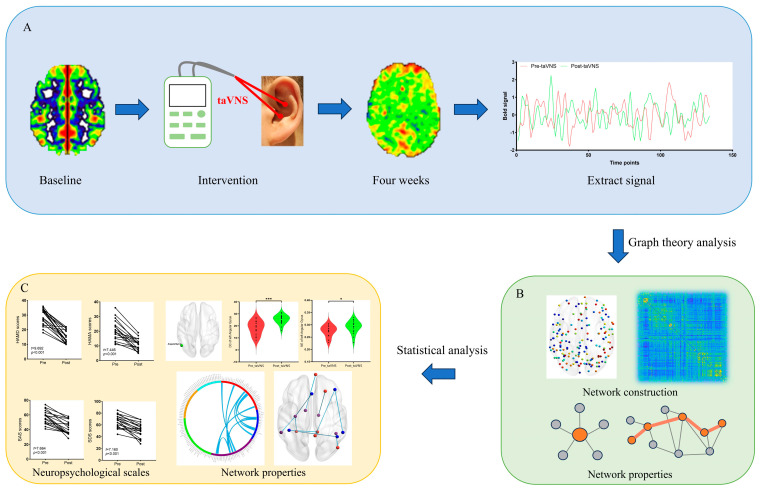
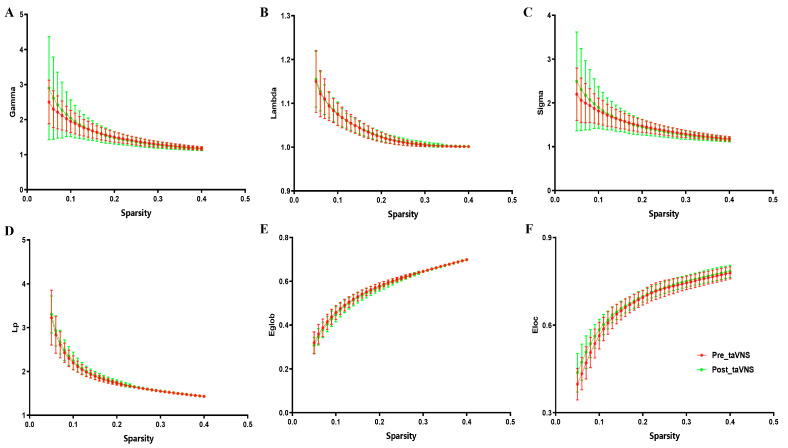
Nineteen patients with MDD were enrolled in this study. Patients with MDD underwent 4 weeks of taVNS treatments; resting-state functional magnetic resonance imaging (rs-fMRI) data of the patients were collected before and after taVNS treatment. The graph theory method and network-based statistics (NBS) analysis were used to detect abnormal topological organizations of functional networks in patients with MDD before and after taVNS treatment. A correlation analysis was performed to characterize the relationship between altered network properties and neuropsychological scores.
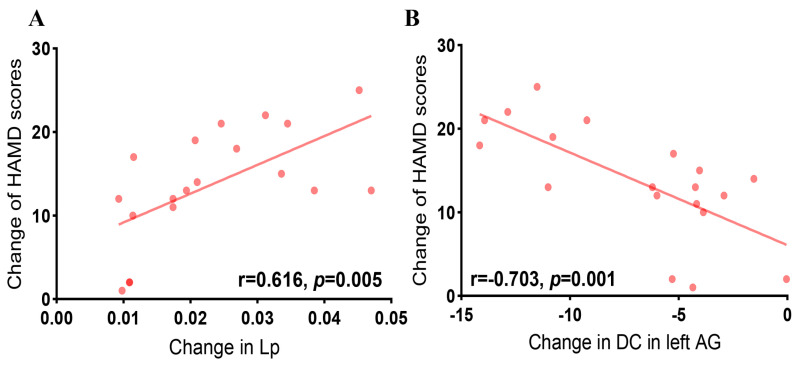
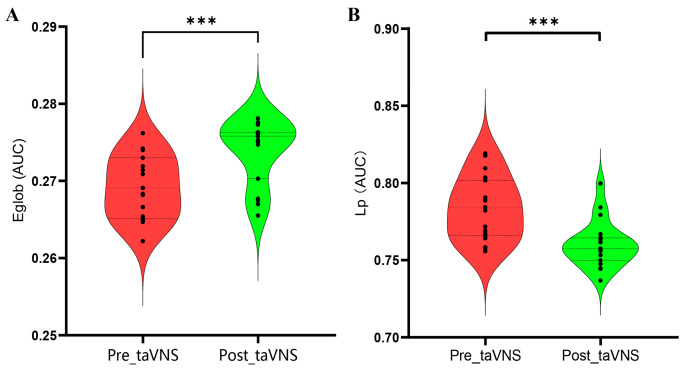
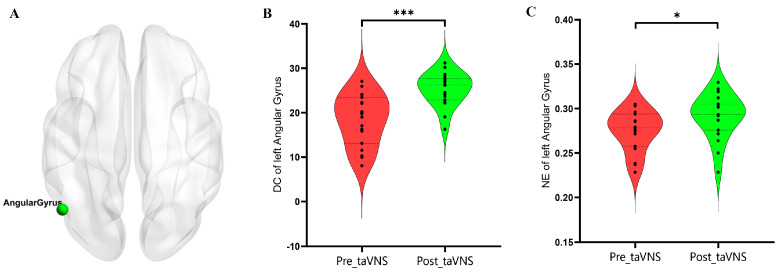
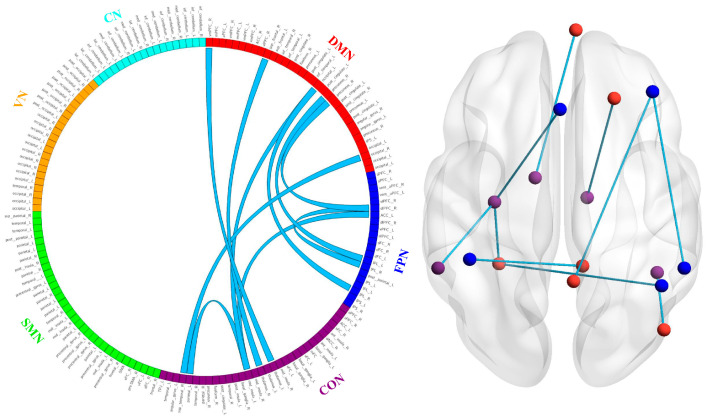
After 4 weeks of taVNS treatment, patients with MDD had increased global efficiency and decreased characteristic path length (Lp). Additionally, patients with MDD exhibited increased nodal efficiency (NE) and degree centrality (DC) in the left angular gyrus. NBS results showed that patients with MDD exhibited reduced connectivity between default mode network (DMN)-frontoparietal network (FPN), DMN-cingulo-opercular network (CON), and FPN-CON. Furthermore, changes in Lp and DC were correlated with changes in Hamilton depression scores.
These findings demonstrated that taVNS may be an effective method for reducing the severity of depressive symptoms in patients with MDD, mainly through modulating the brain's topological organization. Our study may offer insights into the underlying neural mechanism of taVNS treatment in patients with MDD.
经皮耳迷走神经刺激(taVNS)在调节重度抑郁症(MDD)患者的情绪和高级认知方面有效。本研究旨在探讨taVNS治疗对MDD患者及功能网络脑拓扑组织改变的疗效。
19例MDD患者纳入本研究。MDD患者接受4周的taVNS治疗;在taVNS治疗前后收集患者的静息态功能磁共振成像(rs-fMRI)数据。采用图论方法和基于网络的统计(NBS)分析来检测MDD患者在taVNS治疗前后功能网络的异常拓扑组织。进行相关性分析以表征网络属性改变与神经心理学评分之间的关系。
经过4周的taVNS治疗后,MDD患者的全局效率增加,特征路径长度(Lp)降低。此外,MDD患者左侧角回的节点效率(NE)和度中心性(DC)增加。NBS结果显示,MDD患者在默认模式网络(DMN)-额顶网络(FPN)、DMN-扣带- opercular网络(CON)和FPN-CON之间的连接性降低。此外,Lp和DC的变化与汉密尔顿抑郁评分的变化相关。
这些发现表明,taVNS可能是减轻MDD患者抑郁症状严重程度的有效方法,主要是通过调节大脑的拓扑组织。我们的研究可能为taVNS治疗MDD患者的潜在神经机制提供见解。