Department of Pediatrics, The Affiliated Hospital of Jiangsu University, 438 Jiefang Road, Zhenjiang, 212001, China.
International Genome Center, Jiangsu University, 301 Xuefu Road, Zhenjiang, 212013, China.
Redox Biol. 2024 Nov;77:103370. doi: 10.1016/j.redox.2024.103370. Epub 2024 Sep 24.
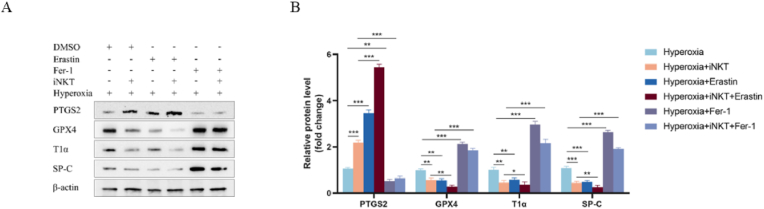
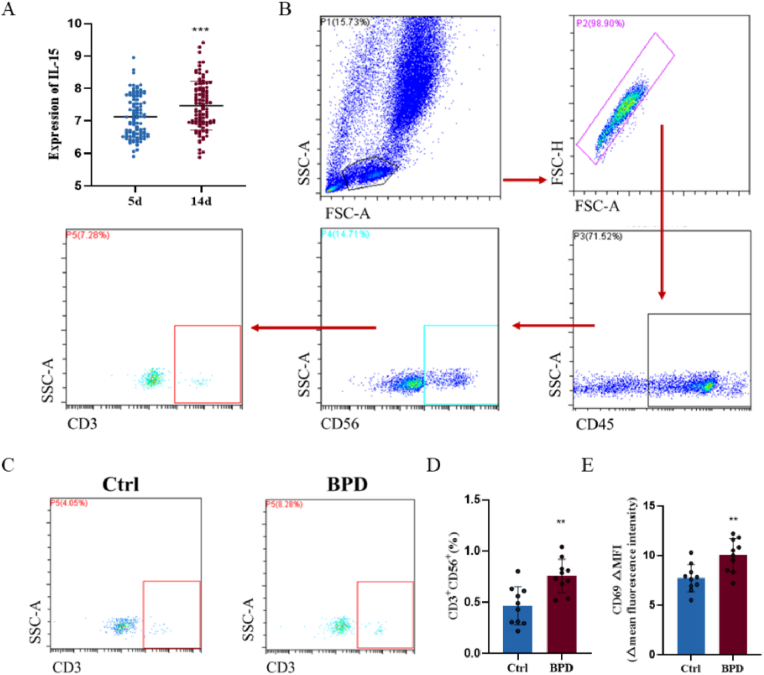
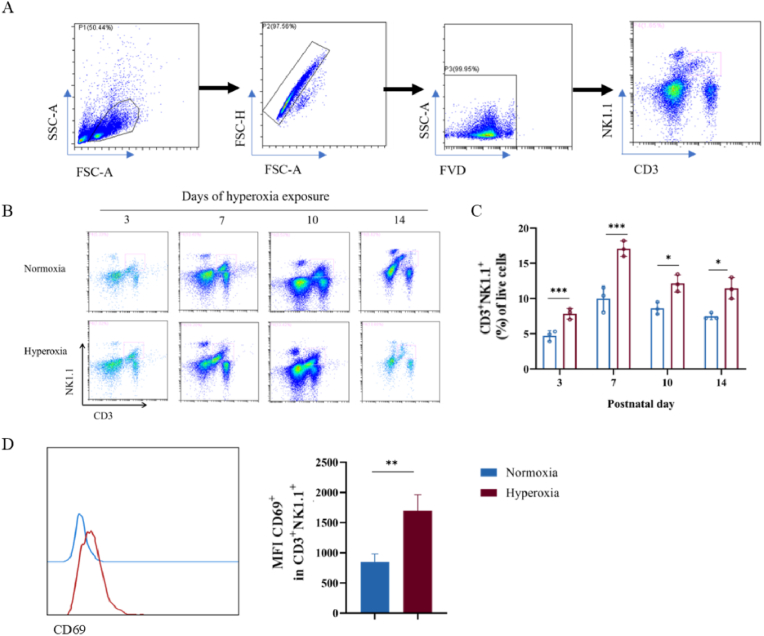
Bronchopulmonary dysplasia (BPD) is a severe lung disease in preterm infants, the abnormal proliferate and differentiate ability of type II epithelial cells (AEC II) is the key to the pathological basis of BPD. Mechanisms regarding abnormal AEC II in BPD remain unclear. The present work investigated the role and mechanisms of invariant natural killer T (iNKT) cells in lung disorder in BPD using public datasets, clinical samples, a hyperoxia-induced BPD mouse model and AEC II-iNKT cells transwell co-culture system. Firstly, we found that the NKT cells development factor IL-15 increased over time in patients with BPD in public databases, and clinically collected peripheral blood NKT cells in patients with BPD were increased. Subsequently, the percentage of iNKT cells increased in hyperoxia group compared with normoxia group, with the highest at P7, accompanied by increased activation with abnormal lung development. The administration of anti-CD1d neutralizing antibody to inhibit iNKT cells could alleviate the abnormal lung development of hyperoxia group mice, while α-GalCer administration could aggravate lung injury in hyperoxia group mice, and adoptive transfer of iNKT cells could aggravate the abnormal lung development in hyperoxia group mice. In addition, to further verify the role of iNKT cells on AEC II, AEC II-iNKT cells co-culture system was established. The presence of iNKT cells could aggravate the abnormal expression of SP-C and T1α under hyperoxia. Meanwhile, RNA-seq analysis showed that ferroptosis-related genes were highly expressed in AEC II co-cultured with iNKT cells under hyperoxia. We further validated the effect of the presence of iNKT cells under hyperoxia environment on AEC II ferroptosis levels, suggested that iNKT cells promote AEC II ferroptosis under hyperoxia, accompanied by decreased expression of SP-C and T1α. Our study found that the recruitment of iNKT cells in the lung may be an important cause of alveolarization disorder in BPD.
支气管肺发育不良(BPD)是一种严重的早产儿肺部疾病,II 型上皮细胞(AEC II)异常增殖和分化能力是 BPD 病理基础的关键。BPD 中异常 AEC II 的发生机制尚不清楚。本研究利用公共数据集、临床样本、高氧诱导的 BPD 小鼠模型和 AEC II-iNKT 细胞 Transwell 共培养系统,探讨了固有自然杀伤 T(iNKT)细胞在 BPD 肺部疾病中的作用和机制。首先,我们在公共数据库中发现,BPD 患者的 NKT 细胞发育因子 IL-15 随时间推移而增加,且临床采集的 BPD 患者外周血 NKT 细胞也增加。随后,与常氧组相比,高氧组中 iNKT 细胞的比例增加,在 P7 时达到最高,同时伴有异常肺发育的激活。用抗 CD1d 中和抗体抑制 iNKT 细胞可减轻高氧组小鼠的异常肺发育,而 α-GalCer 给药可加重高氧组小鼠的肺损伤,过继转移 iNKT 细胞可加重高氧组小鼠的异常肺发育。此外,为了进一步验证 iNKT 细胞对 AEC II 的作用,建立了 AEC II-iNKT 细胞共培养系统。在高氧条件下,iNKT 细胞的存在可加重 SP-C 和 T1α 的异常表达。同时,RNA-seq 分析显示,在高氧共培养条件下,AEC II 中与铁死亡相关的基因高度表达。我们进一步验证了在高氧环境下 iNKT 细胞存在对 AEC II 铁死亡水平的影响,表明 iNKT 细胞在高氧条件下促进 AEC II 铁死亡,同时 SP-C 和 T1α 的表达降低。本研究发现,肺内 iNKT 细胞的募集可能是 BPD 肺泡化障碍的重要原因。