Nguyen Duy Duc, Pham Binh Van, Tran Manh Dai, Nguyen Thanh Duy, Thai An Duc, Le Ky Van, Kim Vu Van, Nguyen Hung Xuan
Hanoi Medical University.
Department of Abdominal Surgery 1, Vietnam National Cancer Hospital.
Ann Med Surg (Lond). 2024 Sep 4;86(10):5739-5743. doi: 10.1097/MS9.0000000000002500. eCollection 2024 Oct.
Surgery for esophageal squamous-cell carcinoma (ESCC) presents many potential challenges owing to malignant lymph node metastasis, complex procedures and severe postoperative complications. The appropriate lymphadenectomy for ESCC remains controversial. This study aims to evaluate the characteristics of lymph node metastasis and postoperative complications in patients with ESCC undergoing minimally invasive esophagectomy and extended two-field lymph node dissection.
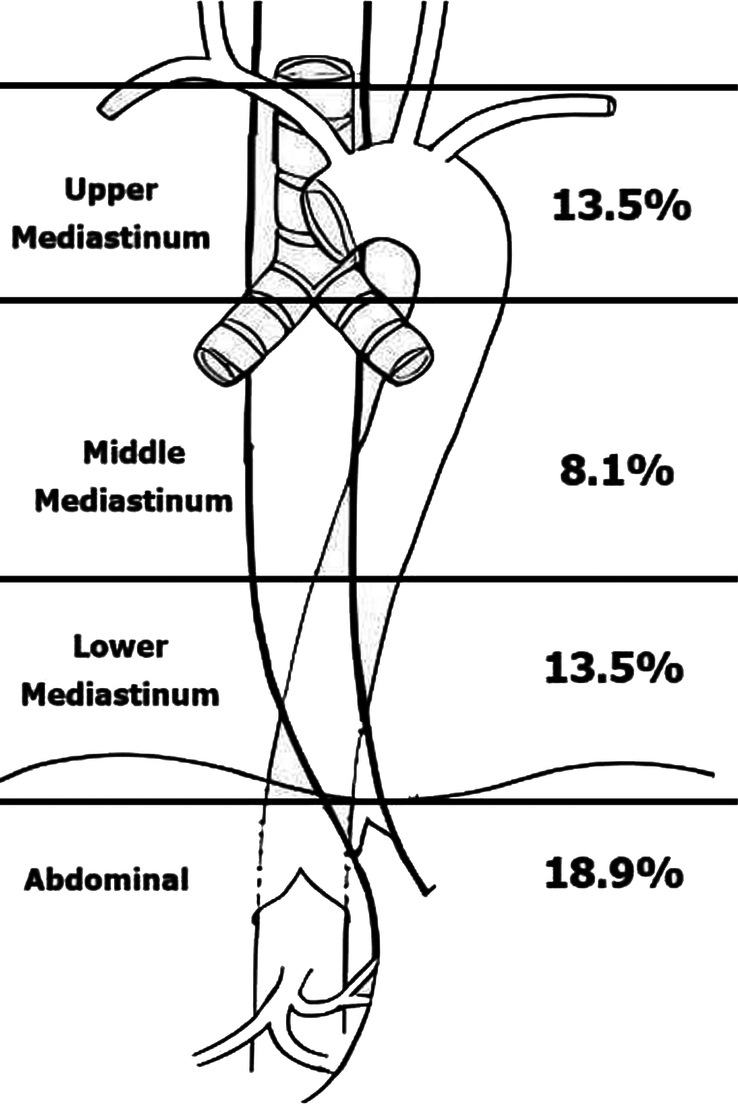
This prospective, single-center, cross-sectional study was conducted from October 2022 to May 2024. All patients with ESCC who underwent minimally invasive esophagectomy and extended two-field lymph node dissection were selected for this study. Postoperative lymph nodes were divided into upper thoracic, middle thoracic, lower thoracic and abdominal lymph node groups.
Seventy-four patients with ESCC, including 49 patients who underwent upfront surgery and 25 patients who received preoperative chemoradiotherapy, were selected. The rate of lymph node metastasis in all patients was 39.2%, with 13.6% of patients having upper thoracic metastasis. The factors affecting the rate of lymph node metastasis included preoperative chemoradiotherapy, tumor stage, poor differentiation, lymphovascular/perineural invasion, and tumor size greater than 2 cm, all of which were significantly different (<0.05). Common postoperative complications included pneumonia (25.7%), recurrent laryngeal nerve (RLN) palsy (10.8%) and anastomotic leak (4.1%). There were no cases required conversion to open surgery, nor any deaths within 90 days postoperatively.
Lymph node metastasis in esophageal squamous-cell carcinoma has a high incidence, occurs in the early stages, and is widely distributed in all regions of the mediastinum and abdomen. Minimally invasive esophagectomy and extended two-field lymph node dissection are feasible and safe, with low complication rates.
由于恶性淋巴结转移、手术操作复杂以及术后严重并发症,食管鳞状细胞癌(ESCC)手术面临诸多潜在挑战。ESCC合适的淋巴结清扫范围仍存在争议。本研究旨在评估接受微创食管切除术和扩大两野淋巴结清扫术的ESCC患者的淋巴结转移特征及术后并发症。
本前瞻性、单中心横断面研究于2022年10月至2024年5月进行。选取所有接受微创食管切除术和扩大两野淋巴结清扫术的ESCC患者。术后淋巴结分为胸上段、胸中段、胸下段和腹部淋巴结组。
选取了74例ESCC患者,其中49例接受了 upfront 手术,25例接受了术前放化疗。所有患者的淋巴结转移率为39.2%,胸上段转移患者占13.6%。影响淋巴结转移率的因素包括术前放化疗、肿瘤分期、低分化、淋巴管/神经周围侵犯以及肿瘤大小大于2 cm,所有这些因素均有显著差异(<0.05)。常见的术后并发症包括肺炎(25.7%)、喉返神经(RLN)麻痹(10.8%)和吻合口漏(