
非酒精性脂肪性肝病与肌肉减少症之间的因果关系:一项双向孟德尔随机化研究
Causal relationship between non-alcoholic fatty liver disease and sarcopenia: a bidirectional Mendelian randomization study.
作者信息
Chen Meng, Liu Jili, Xia Xin, Wang Yarong, Zheng Hongying
机构信息
Department of Geriatrics and Special Needs Medicine, General Hospital of Ningxia Medical University, Yinchuan, China.
Department of Geriatrics, The First Hospital, Shanxi Medical University, Taiyuan, China.
出版信息
Front Med (Lausanne). 2024 Sep 18;11:1422499. doi: 10.3389/fmed.2024.1422499. eCollection 2024.
INTRODUCTION
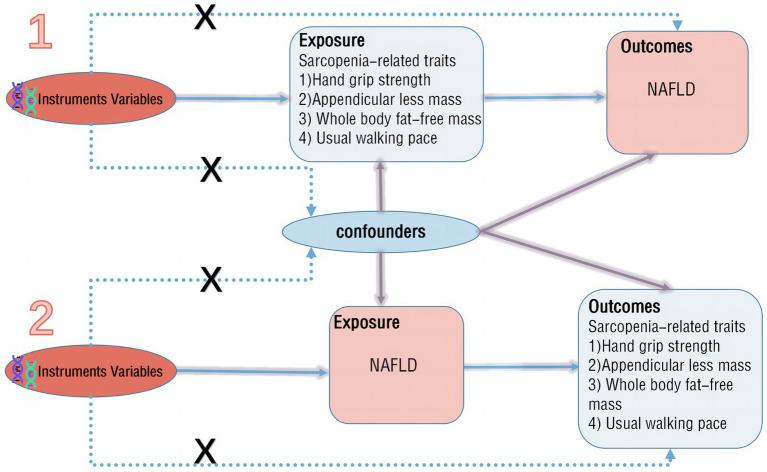
A correlation between non-alcoholic fatty liver disease and sarcopenia is demonstrated, but the causality remains unclear. Our study aims to clarify the point of genetics between non-alcoholic fatty liver disease (NAFLD) and sarcopenia at the level of gene prediction through two-sample Mendelian randomization (MR) analysis.
METHODS
The study employed the two-sample MR approach to investigate the bi-directional causality between NAFLD and sarcopenia. Published summary statistics were used to obtain instrumental variables (IVs) at the genome-wide significance level.
RESULTS
IVW analysis showed that the risk of NAFLD was reduced when walking pace was increased (OR = 0.435, 95%CI 0.240-0.789, = 0.006); Increasing appendicular lean mass (ALM) decreased the risk of NAFLD (OR = 0.906, 95%CI 0.838-0.980, = 0.014); Those older than 60 were more likely to suffer from NAFLD if they had low grip strength (OR = 1.411, 95%CI 1.087-1.830, = 0.0012). In the reverse MR study, weight median analysis showed that NAFLD caused a decrease in ALM (OR = 0.953, 95%CI 0.957-0.994, = 0.001); whereas NAFLD showed no correlation with usual walking pace or grip strength (all with > 0.05). MR-Egger regression analysis showed that there was no horizontal pleiotropy in the SNPs (all with > 0.05).
CONCLUSION
The characteristics related to sarcopenia (usual walking pace, appendicular lean mass and low hand grip strength) may play a causal role in the development of nonalcoholic fatty liver disease, although the underlying mechanisms need to be further investigated. The presence of specific single nucleotide polymorphisms (SNPs) such as rs3747207, rs429358, and rs73001065 has been identified in the PNPLA3, APOE, and MAU2 proteins. These genetic markers represent potential targets for future interventions aimed at addressing, managing, or mitigating the risk of NAFLD.
引言
非酒精性脂肪性肝病与肌肉减少症之间存在相关性,但因果关系仍不明确。我们的研究旨在通过两样本孟德尔随机化(MR)分析,在基因预测层面阐明非酒精性脂肪性肝病(NAFLD)与肌肉减少症之间的遗传学问题。
方法
本研究采用两样本MR方法来研究NAFLD与肌肉减少症之间的双向因果关系。利用已发表的汇总统计数据,在全基因组显著性水平上获取工具变量(IVs)。
结果
IVW分析表明,步行速度加快时NAFLD风险降低(OR = 0.435,95%CI 0.240 - 0.789,P = 0.006);四肢瘦体重(ALM)增加可降低NAFLD风险(OR = 0.906,95%CI 0.838 - 0.980,P = 0.014);60岁以上人群若握力低,则更易患NAFLD(OR = 1.411,95%CI 1.087 - 1.830,P = 0.0012)。在反向MR研究中,体重中位数分析表明,NAFLD会导致ALM降低(OR = 0.953,95%CI 0.957 - 0.994,P = 0.001);而NAFLD与通常步行速度或握力无相关性(所有P>0.05)。MR-Egger回归分析表明,单核苷酸多态性(SNP)不存在水平多效性(所有P>0.05)。
结论
与肌肉减少症相关的特征(通常步行速度、四肢瘦体重和低握力)可能在非酒精性脂肪性肝病的发生发展中起因果作用,尽管其潜在机制仍需进一步研究。已在PNPLA3、APOE和MAU2蛋白中鉴定出特定单核苷酸多态性(SNP),如rs3747207、rs429358和rs73001065。这些遗传标记代表了未来旨在解决、管理或降低NAFLD风险的干预措施的潜在靶点。



 Zotero 插件