
通过半理性酶工程提高色氨酸2-单加氧酶的热稳定性:一种减少实验研究的策略性设计。
Enhancement of tryptophan 2-monooxygenase thermostability by semi-rational enzyme engineering: a strategic design to minimize experimental investigation.
作者信息
Kongjaroon Sirus, Lawan Narin, Trisrivirat Duangthip, Chaiyen Pimchai
机构信息
School of Biomolecular Science and Engineering, Vidyasirimedhi Institute of Science and Technology (VISTEC) Wangchan Valley Rayong 21210 Thailand
Department of Chemistry, Faculty of Science, Chiang Mai University Chiang Mai 50200 Thailand.
出版信息
RSC Chem Biol. 2024 Jul 27;5(10):989-1001. doi: 10.1039/d4cb00102h. eCollection 2024 Oct 2.
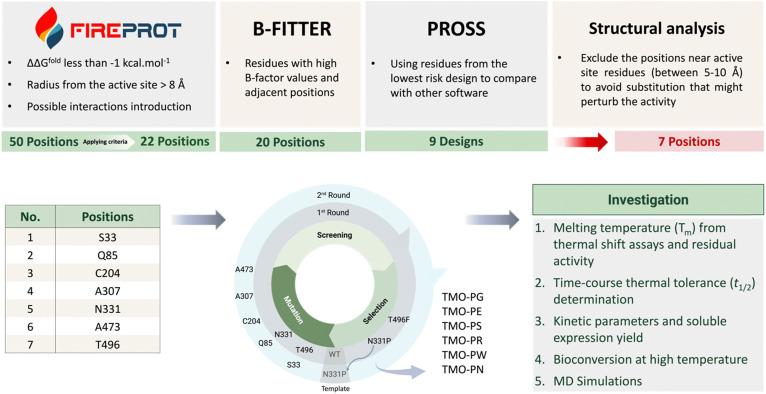
Tryptophan 2-monooxygenase (TMO) is an FAD-bound flavoenzyme which catalyzes the oxidative decarboxylation of l-tryptophan to produce indole-3-acetamide (IAM) and carbon dioxide. The reaction of TMO is the first step of indole-3-acetic acid (IAA) biosynthesis. Although TMO is of interest for mechanistic studies and synthetic biology applications, the enzyme has low thermostability and soluble expression yield. Herein, we employed a combined approach of rational design using computational tools with site-saturation mutagenesis to screen for TMO variants with significantly improved thermostability properties and soluble protein expression. The engineered TMO variants, TMO-PWS and TMO-PWSNR, possess melting temperatures ( ) of 65 °C, 17 °C higher than that of the wild-type enzyme (TMO-WT). At 50 °C, the stabilities ( ) of TMO-PWS and TMO-PWSNR were 85-fold and 92.4-fold higher, while their soluble expression yields were 1.4-fold and 2.1-fold greater than TMO-WT, respectively. Remarkably, the kinetic parameters of these variants were similar to those of the wild-type enzymes, illustrating that they are promising candidates for future studies. Molecular dynamic simulations of the wild-type and thermostable TMO variants identified key interactions for enhancing these improvements in the biophysical properties of the TMO variants. The introduced mutations contributed to hydrogen bond formation and an increase in the regional hydrophobicity, thereby, strengthening the TMO structure.
色氨酸2-单加氧酶(TMO)是一种结合黄素腺嘌呤二核苷酸(FAD)的黄素酶,它催化L-色氨酸的氧化脱羧反应,生成吲哚-3-乙酰胺(IAM)和二氧化碳。TMO的反应是吲哚-3-乙酸(IAA)生物合成的第一步。尽管TMO在机理研究和合成生物学应用方面备受关注,但该酶的热稳定性和可溶性表达产量较低。在此,我们采用了一种结合方法,即使用计算工具进行理性设计并结合位点饱和诱变,以筛选出热稳定性和可溶性蛋白表达显著提高的TMO变体。工程改造的TMO变体TMO-PWS和TMO-PWSNR的解链温度( )为65℃,比野生型酶(TMO-WT)高17℃。在50℃时,TMO-PWS和TMO-PWSNR的稳定性( )分别比TMO-WT高85倍和92.4倍,而它们的可溶性表达产量分别比TMO-WT高1.4倍和2.1倍。值得注意的是,这些变体的动力学参数与野生型酶相似,这表明它们是未来研究的有潜力的候选对象。野生型和热稳定的TMO变体的分子动力学模拟确定了增强TMO变体生物物理性质这些改善的关键相互作用。引入的突变有助于形成氢键并增加局部疏水性,从而加强了TMO的结构。




 Zotero 插件