Mücke Bruna Eduarda Darolt, Rossignatti Beatriz Cotting, Abegão Luis Miguel Gomes, Barbosa Martin Schwellberger, Mello Hugo José Nogueira Pedroza Dias
Physics of Materials Group, Institute of Physics, Federal University of Goiás, Samambaia Campus, Goiânia 74001-970, GO, Brazil.
Photonics Group, Physics Institute, Federal University of Goiás, Samambaia Campus, Goiânia 74001-970, GO, Brazil.
Polymers (Basel). 2024 Oct 1;16(19):2789. doi: 10.3390/polym16192789.
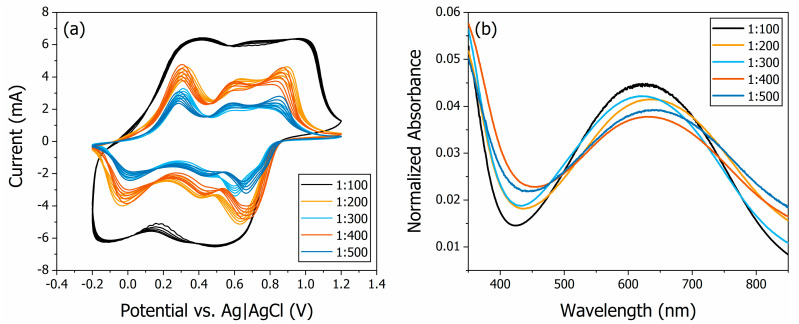
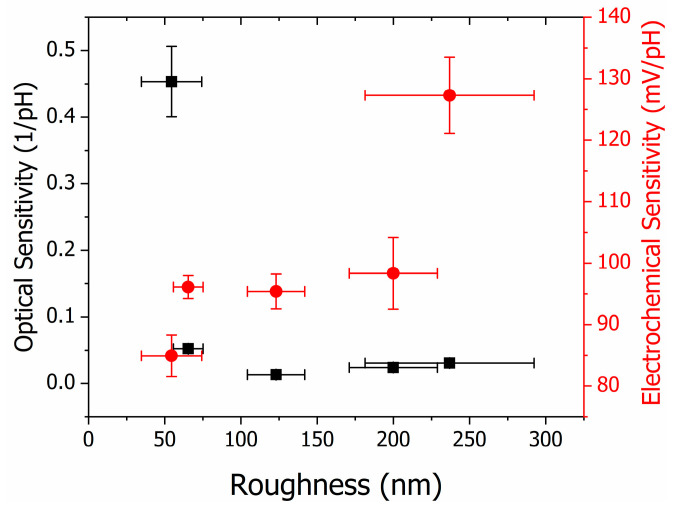
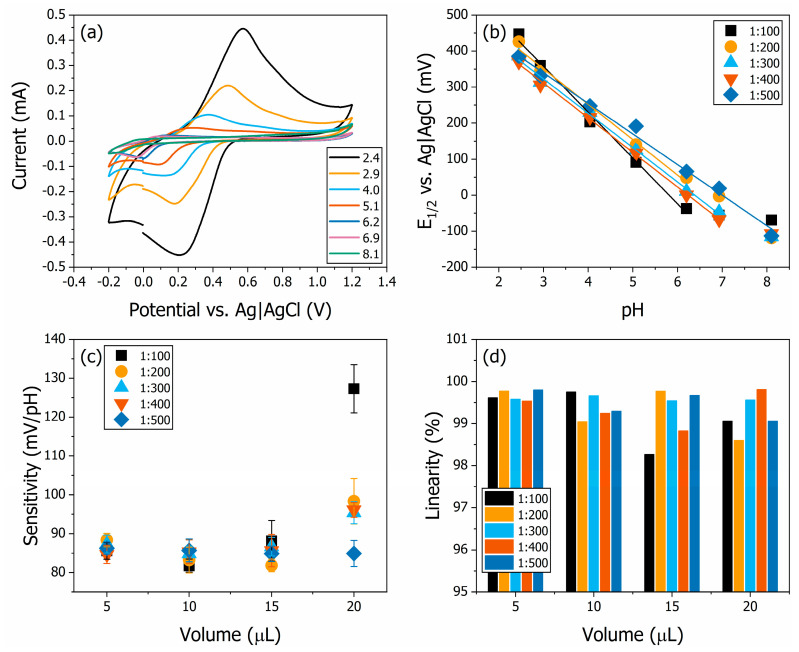
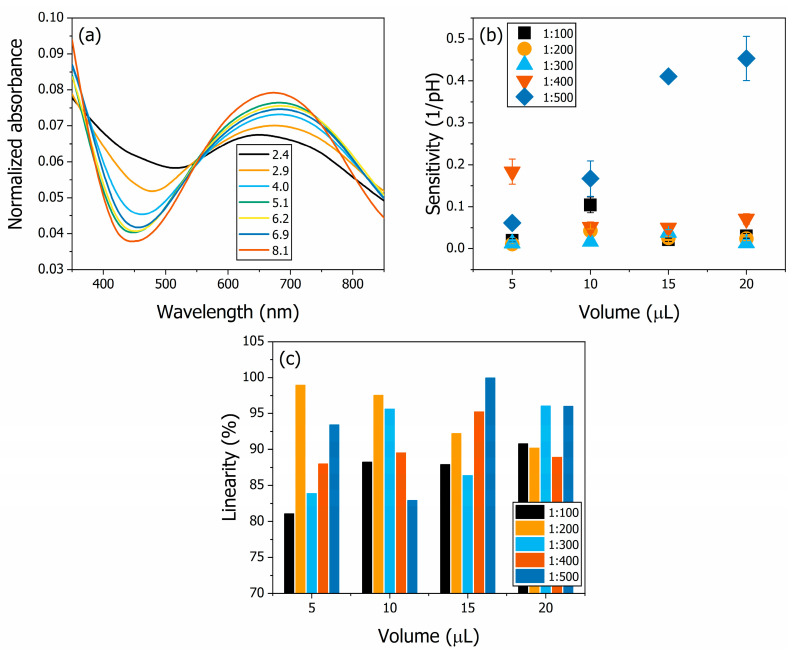
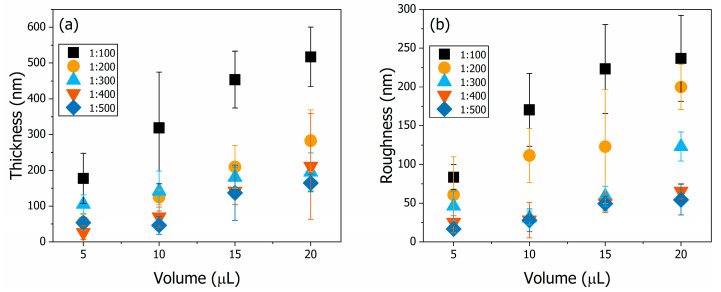
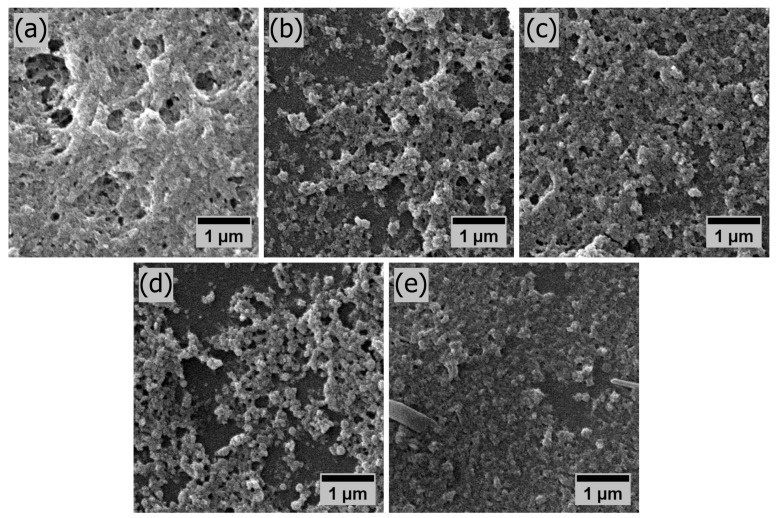
Conducting polymers used in chemical sensors are attractive because of their ability to confer reversible properties controlled by the doping/de-doping process. Polyaniline (PANI) is one of the most prominent materials used due to its ease of synthesis, tailored properties, and higher stability. Here, PANI thin films deposited by the drop-casting method on fluorine-doped tin oxide (FTO) substrates were used in electrochemical and optical sensors for pH measurement. The response of the devices was correlated with the deposition parameters; namely, the volume of deposition solution dropped on the substrate and the concentration of the solution, which was determined by the weight ratio of polymer to solvent. The characterisation of the samples aimed to determine the structure-property relationship of the films and showed that the chemical properties, oxidation states, and protonation level are similar for all samples, as concluded from the cyclic voltammetry and UV-VIS spectroscopic analysis. The sensing performance of the PANI film is correlated with its relative physical properties, thickness, and surface roughness. The highest electrochemical sensitivity obtained was 127.3 ± 6.2 mV/pH, twice the Nernst limit-the highest pH sensitivity reported to our knowledge-from the thicker and rougher sample. The highest optical sensitivity, 0.45 ± 0.05 1/pH, was obtained from a less rough sample, which is desirable as it reduces light scattering and sample oxidation. The results presented demonstrate the importance of understanding the structure-property relationship of materials for optimised sensors and their potential applications where high-sensitivity pH measurement is required.
用于化学传感器的导电聚合物因其具有通过掺杂/去掺杂过程控制的可逆特性而颇具吸引力。聚苯胺(PANI)是最突出的材料之一,因其易于合成、性能可定制且稳定性更高。在此,通过滴铸法沉积在氟掺杂氧化锡(FTO)基板上的聚苯胺薄膜被用于电化学和光学pH测量传感器。器件的响应与沉积参数相关;即滴落在基板上的沉积溶液体积和溶液浓度,溶液浓度由聚合物与溶剂的重量比确定。对样品的表征旨在确定薄膜的结构-性能关系,循环伏安法和紫外-可见光谱分析表明,所有样品的化学性质、氧化态和质子化水平相似。聚苯胺薄膜的传感性能与其相对物理性质、厚度和表面粗糙度相关。从较厚且较粗糙的样品中获得的最高电化学灵敏度为127.3±6.2 mV/pH,是能斯特极限的两倍——据我们所知,这是报道的最高pH灵敏度。从粗糙度较小的样品中获得了最高光学灵敏度,为0.45±0.05 1/pH,这是理想的,因为它减少了光散射和样品氧化。所呈现的结果证明了理解材料的结构-性能关系对于优化传感器及其在需要高灵敏度pH测量的潜在应用中的重要性。