Perelman School of Medicine at the University of Pennsylvania, 3400 Civic Center Blvd, South Pavilion, 1st Floor, Philadelphia, PA, 19104, USA.
Corporal Michael J. Crescenz Veterans Affairs Medical Center, Philadelphia, PA, USA.
Adv Ther. 2024 Dec;41(12):4418-4432. doi: 10.1007/s12325-024-02992-w. Epub 2024 Oct 19.
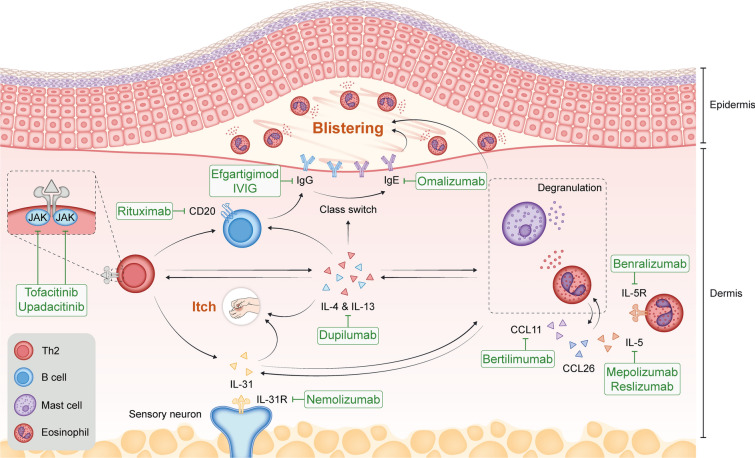
Bullous pemphigoid (BP) is an autoimmune blistering disease that most often affects elderly individuals and has a significant negative impact on quality of life. The disease is characterized primarily by autoantibodies to hemidesmosomal proteins BP180 and/or BP230, and an inflammatory reaction with notable features of type 2 inflammation, including elevated serum IgE, increased numbers of eosinophils in lesions and peripheral blood, and elevated expression of type 2 cytokines and chemokines in skin lesions. In this review, we present what is known about BP pathophysiology, including the role of type 2 inflammation, and discuss how findings from studies of biologics targeting type 2 immune mediators have helped to clarify the biological mechanisms driving BP pathophysiology. Future studies of these targeted therapies and others in development will help to further elucidate the mechanisms underlying BP pathophysiology and potentially provide better treatment options for patients.
大疱性类天疱疮(BP)是一种自身免疫性水疱病,主要影响老年人,对生活质量有重大负面影响。该疾病主要表现为针对桥粒蛋白 BP180 和/或 BP230 的自身抗体,以及以 2 型炎症为特征的炎症反应,包括血清 IgE 升高、皮损和外周血中嗜酸性粒细胞增多,以及皮损中 2 型细胞因子和趋化因子表达升高。在这篇综述中,我们介绍了已知的 BP 发病机制,包括 2 型炎症的作用,并讨论了靶向 2 型免疫调节剂的生物制剂研究结果如何有助于阐明驱动 BP 发病机制的生物学机制。未来对这些靶向治疗药物和其他正在开发的药物的研究将有助于进一步阐明 BP 发病机制的机制,并为患者提供更好的治疗选择。