Pfeil-Gardiner Olivia, Rosa Higor Vinícius Dias, Riedel Dietmar, Chen Yu Seby, Lörks Dominique, Kükelhan Pirmin, Linck Martin, Müller Heiko, Van Petegem Filip, Murphy Bonnie J
Redox and Metalloprotein Research Group, Max Planck Institute of Biophysics, Frankfurt, Germany.
Mattei Lab, Structural and Computational Biology Unit, EMBL Heidelberg, Heidelberg, Germany.
Nat Methods. 2024 Dec;21(12):2299-2306. doi: 10.1038/s41592-024-02482-5. Epub 2024 Oct 24.
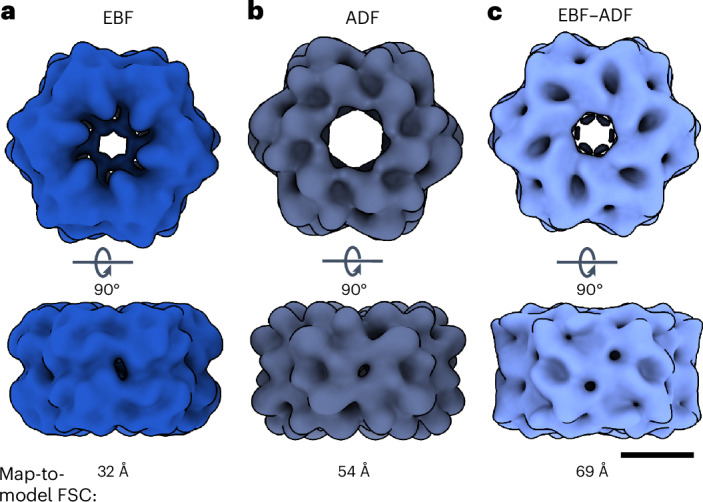
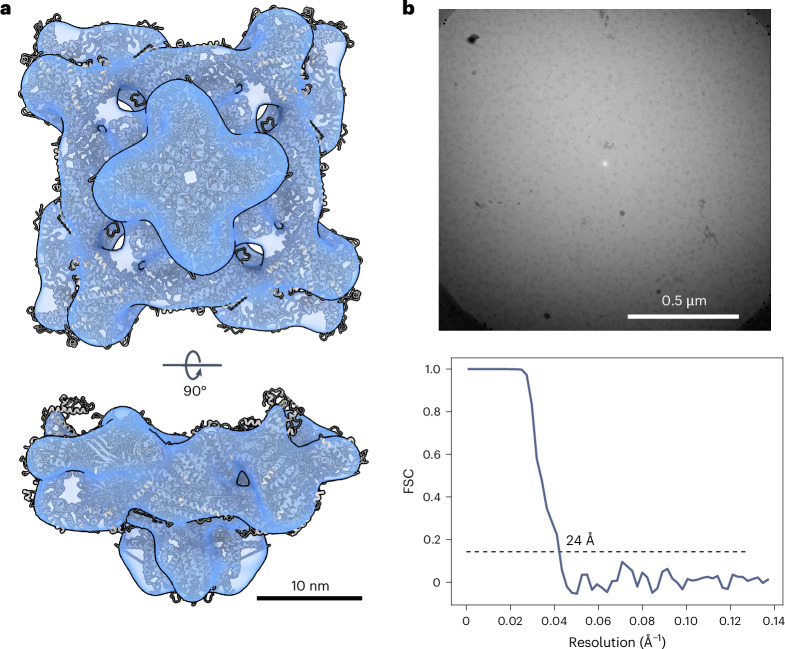
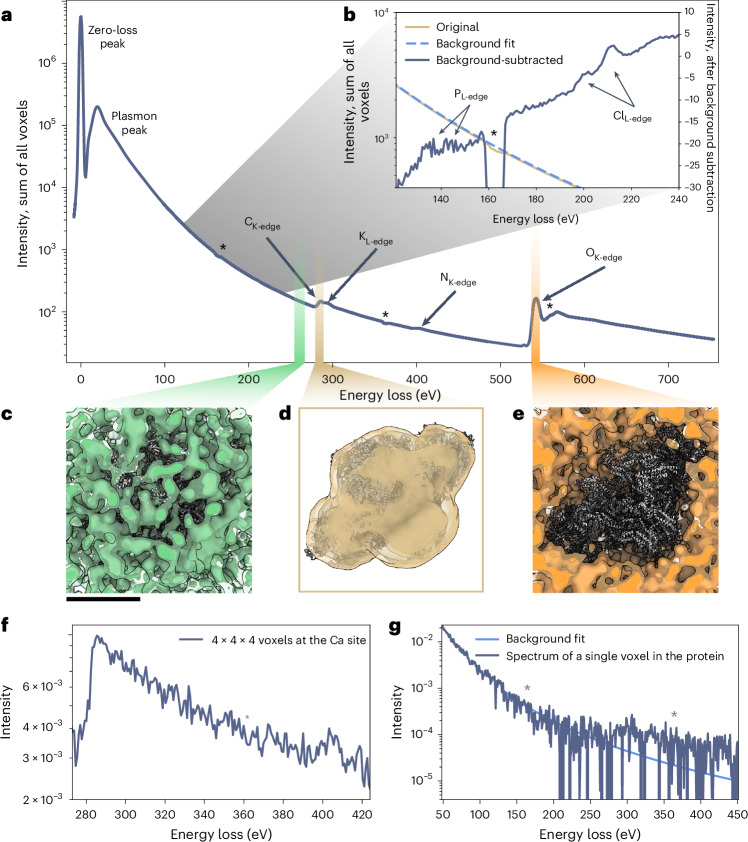
For macromolecular structures determined by cryogenic electron microscopy, no technique currently exists for mapping elements to defined locations, leading to errors in the assignment of metals and other ions, cofactors, substrates, inhibitors and lipids that play essential roles in activity and regulation. Elemental mapping in the electron microscope is well established for dose-tolerant samples but is challenging for biological samples, especially in a cryo-preserved state. Here we combine electron energy-loss spectroscopy with single-particle image processing to allow elemental mapping in cryo-preserved macromolecular complexes. Proof-of-principle data show that our method, reconstructed electron energy-loss (REEL) analysis, allows a three-dimensional reconstruction of electron energy-loss spectroscopy data, such that a high total electron dose is accumulated across many copies of a complex. Working with two test samples, we demonstrate that we can reliably localize abundant elements. We discuss the current limitations of the method and potential future developments.
对于通过低温电子显微镜确定的大分子结构,目前不存在将元素映射到特定位置的技术,这导致在金属和其他离子、辅因子、底物、抑制剂以及在活性和调节中起关键作用的脂质的归属上出现错误。电子显微镜中的元素映射对于耐剂量样本已经很成熟,但对于生物样本具有挑战性,尤其是在冷冻保存状态下。在这里,我们将电子能量损失谱与单颗粒图像处理相结合,以实现对冷冻保存的大分子复合物进行元素映射。原理验证数据表明,我们的方法,即重建电子能量损失(REEL)分析,能够对电子能量损失谱数据进行三维重建,从而在复合物的多个拷贝上累积高总电子剂量。通过处理两个测试样本,我们证明能够可靠地定位丰富元素。我们讨论了该方法当前的局限性以及潜在的未来发展。