Lee Soon Kyu, Nam Soon Woo, Han Ji Won, Kwon Jung Hyun
Division of Gastroenterology and Hepatology, Department of Internal Medicine, Incheon St. Mary's Hospital, College of Medicine, The Catholic University of Korea, Seoul 06591, Republic of Korea.
Division of Gastroenterology and Hepatology, Department of Internal Medicine, Seoul St. Mary's Hospital, College of Medicine, The Catholic University of Korea, Seoul 06591, Republic of Korea.
Cancers (Basel). 2024 Oct 21;16(20):3543. doi: 10.3390/cancers16203543.
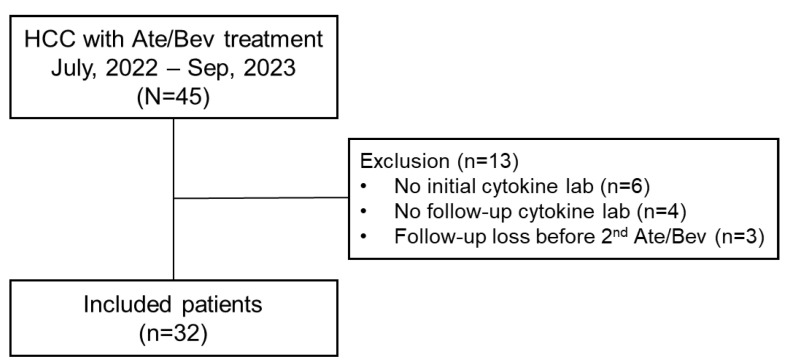
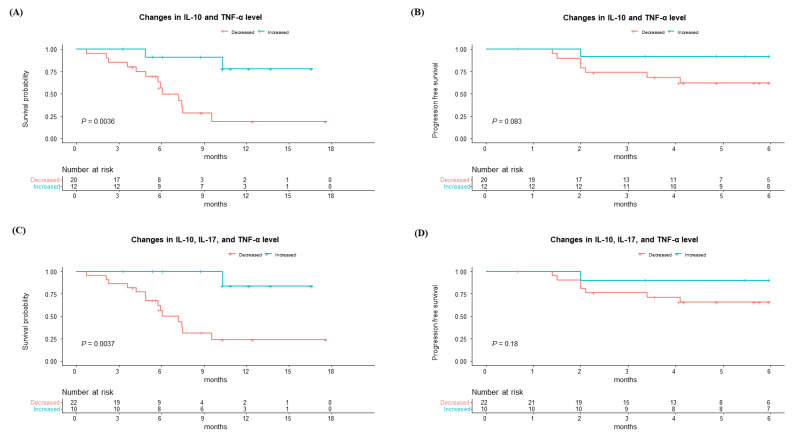
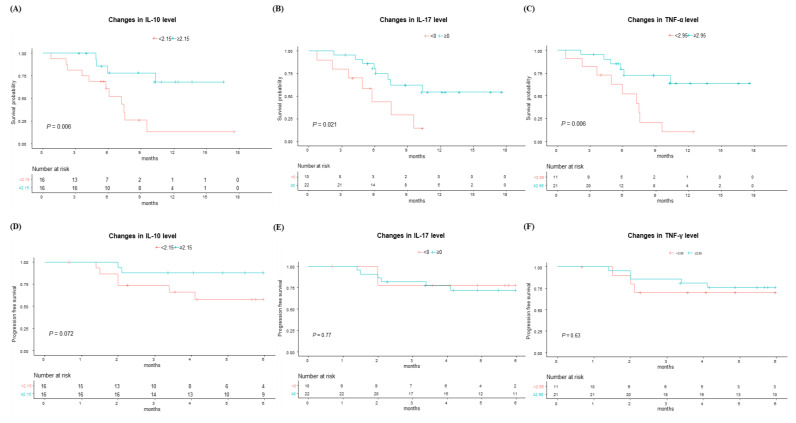
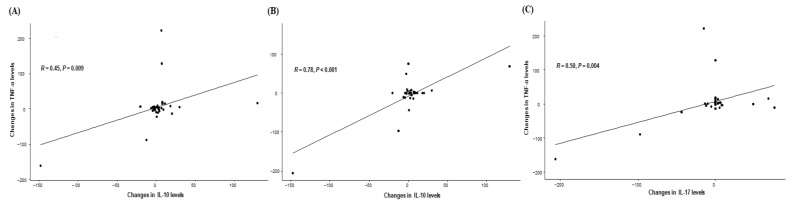
: Reliable biomarkers for predicting outcomes in hepatocellular carcinoma (HCC) treated with atezolizumab plus bevacizumab (Ate/Bev) are still lacking. Cytokines, which play a crucial role in immune regulation and HCC progression, have potential as predictive markers, but data supporting their use are limited. This study aimed to evaluate the impact of early changes in cytokine levels on the clinical outcomes of advanced HCC patients. : We prospectively enrolled 32 advanced HCC patients, collecting blood samples before the first and second Ate/Bev treatments. These samples were analyzed for IL-2, IL-6, IL-10, IL-12, IL-17, IFN-γ, and TNF-α levels to assess changes post-treatment. The primary outcome was overall survival, with a secondary focus on progression-free survival (PFS) at 6 months. : The mean age of the participants was 64.2 years, with the majority being male (93.8%). Patients showing increased IL-10, IL-17, and TNF-α levels had significantly better survival ( < 0.05) and marginally improved PFS compared to those with decreased cytokine levels. Interestingly, a positive correlation was noted between changes in IL-10 and TNF-α levels ( = 0.009). Furthermore, a multivariable analysis revealed that increased levels of IL-10 and TNF-α were significant predictors of enhanced survival (hazard ratio, 0.07; 95% confidence interval, 0.01-0.46; = 0.005). : An early increases in IL-10 and TNF-α after Ate/Bev treatment may serve as effective biomarkers for clinical outcomes in advanced HCC patients.
用于预测接受阿替利珠单抗联合贝伐珠单抗(Ate/Bev)治疗的肝细胞癌(HCC)患者预后的可靠生物标志物仍然缺乏。细胞因子在免疫调节和HCC进展中起关键作用,具有作为预测标志物的潜力,但支持其应用的数据有限。本研究旨在评估细胞因子水平早期变化对晚期HCC患者临床预后的影响。我们前瞻性招募了32例晚期HCC患者,在首次和第二次Ate/Bev治疗前采集血样。对这些样本进行白细胞介素-2(IL-2)、白细胞介素-6(IL-6)、白细胞介素-10(IL-10)、白细胞介素-12(IL-12)、白细胞介素-17(IL-17)、干扰素-γ(IFN-γ)和肿瘤坏死因子-α(TNF-α)水平分析,以评估治疗后的变化。主要结局是总生存期,次要重点是6个月时的无进展生存期(PFS)。参与者的平均年龄为64.2岁,大多数为男性(93.8%)。与细胞因子水平降低的患者相比,IL-10、IL-17和TNF-α水平升高的患者生存期显著更长(P<0.05),PFS略有改善。有趣的是,IL-10和TNF-α水平的变化之间存在正相关(r=0.009)。此外,多变量分析显示,IL-10和TNF-α水平升高是生存期延长的显著预测因素(风险比,0.07;95%置信区间,0.01-0.46;P=0.005)。Ate/Bev治疗后IL-10和TNF-α的早期升高可能作为晚期HCC患者临床预后的有效生物标志物。