Akbas Turkay
Division of Intensive Medicine, Department of Internal Medicine, School of Medicine, Düzce University, Düzce 81620, Turkey.
J Clin Med. 2024 Oct 10;13(20):6025. doi: 10.3390/jcm13206025.
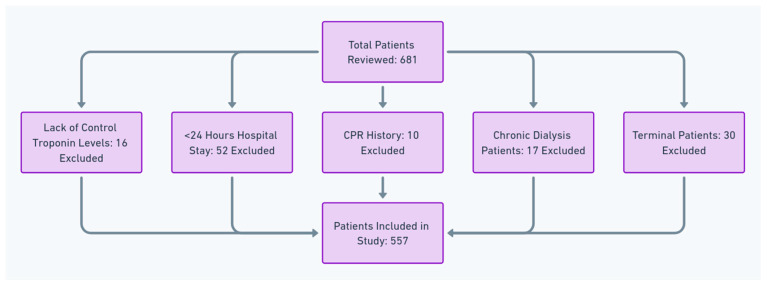
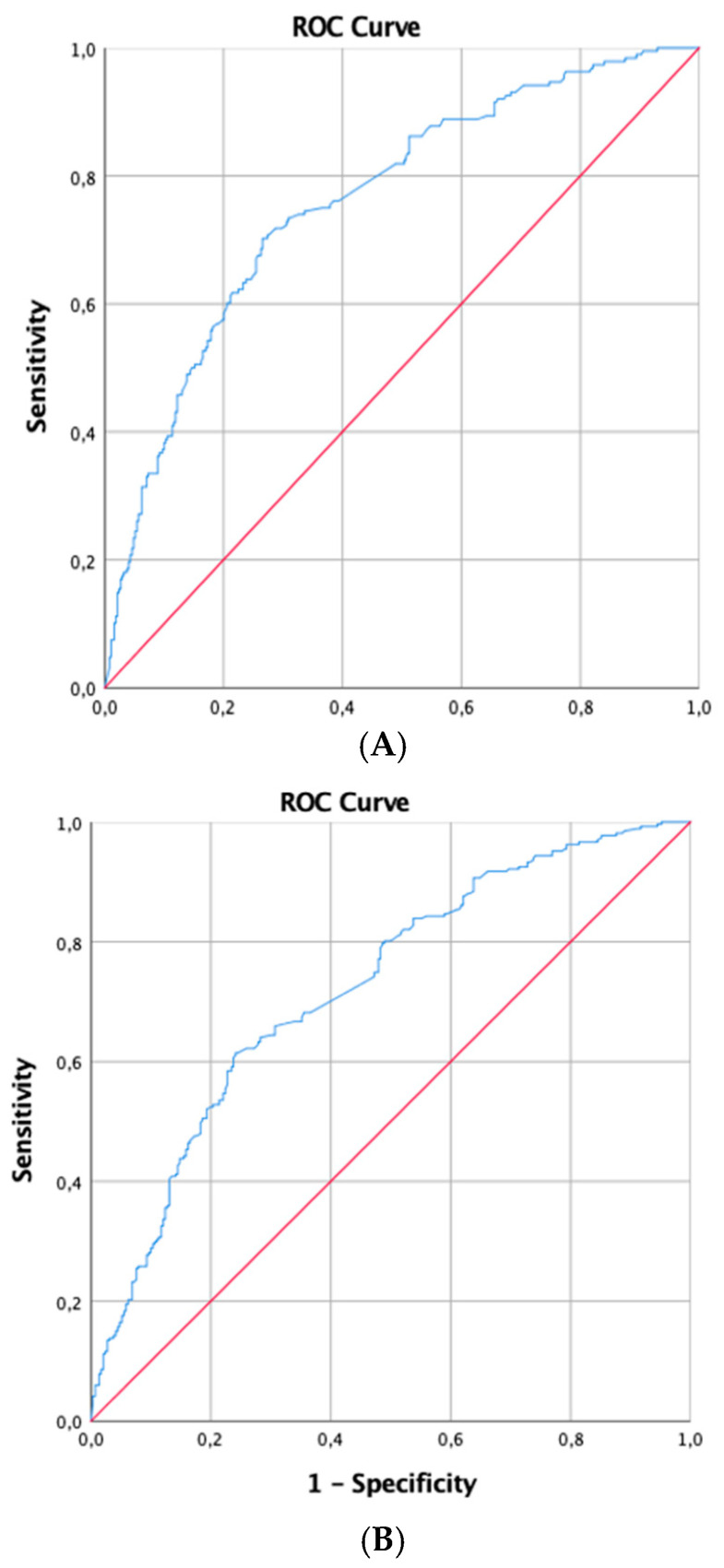
: Cardiac troponin I (TnI) is a specific marker of myocardial damage used in the diagnosis of acute coronary syndrome (ACS). TnI levels can also be elevated in patients without ACS, which is linked to a worse prognosis and mortality. We evaluated the clinical implications and prognostic significance of serum TnI levels in critically ill non-cardiac patients admitted to the intensive care unit (ICU) at a tertiary-level hospital. : A three-year retrospective study including the years 2017-2020 was conducted to evaluate in-hospital mortality during ICU stay and mortality rates at 28 and 90 days, as well as one and two years after admission, in 557 patients admitted to the medical ICU for non-cardiac causes. : TnI levels were elevated in 206 (36.9%) patients. Patients with elevated TnI levels were significantly older and had higher rates of comorbidities, including chronic heart failure, coronary heart disease, and chronic kidney disease ( < 0.05 for all). Patients with elevated TnI levels required more invasive mechanical ventilation, vasopressor infusion, and dialysis in the ICU and experienced more shock within the first 72 h ( = 0.001 for all). High TnI levels were associated with higher Acute Physiological and Chronic Health Evaluation (APACHE) II (27.6 vs. 20.3, = 0.001) and Sequential Organ Failure assessment (8.8 vs. 5.26, = 0.001) scores. Elevated TnI levels were associated with higher mortality rates at 28 days (58.3% vs. 19.4%), 90 days (69.9% vs. 35.0%), one year (78.6% vs. 46.2%), and two years (82.5% vs. 55.6%) ( < 0.001 for all). Univariate logistic regression analysis revealed that high TnI levels were a strong independent predictor of mortality at all time points: (OR = 1.2, 95% CI: 1.108-1.3, < 0.001), (OR = 1.207, 95% CI: 1.095-1.33, = 0.001), (OR = 1.164, 95% CI: 1.059-1.28, = 0.002), and (OR = 1.119, 95% CI: 1.026-1.22, = 0.011). Multivariate analysis revealed that age, albumin level, APACHE II score, and requirements for dialysis and vasopressor use in the ICU were important predictors of mortality across all timeframes, but elevated TnI levels were not. : Elevated TnI levels in critically ill non-cardiac patients are markers of disease severity. While elevated TnI levels were significant predictors of mortality in the univariate analysis, they lost significance in the multivariate model when adjusted for other factors. Patients with elevated TnI levels had higher mortality rates across all timeframes, from 28 days to two years.
心肌肌钙蛋白I(TnI)是用于诊断急性冠状动脉综合征(ACS)的心肌损伤特异性标志物。在无ACS的患者中,TnI水平也可能升高,这与更差的预后和死亡率相关。我们评估了一家三级医院重症监护病房(ICU)收治的重症非心脏疾病患者血清TnI水平的临床意义及预后价值。:进行了一项为期三年(2017年至2020年)的回顾性研究,以评估557例因非心脏原因入住内科ICU患者在ICU住院期间的院内死亡率、28天和90天死亡率以及入院后1年和2年的死亡率。:206例(36.9%)患者TnI水平升高。TnI水平升高的患者年龄显著更大,合并症发生率更高,包括慢性心力衰竭、冠心病和慢性肾病(所有P<0.05)。TnI水平升高的患者在ICU需要更多有创机械通气、血管活性药物输注和透析,且在最初72小时内发生休克的情况更多(所有P = 0.001)。高TnI水平与更高的急性生理与慢性健康状况评分系统(APACHE)II(27.6对20.3,P = 0.001)和序贯器官衰竭评估(8.8对5.26,P = 0.001)评分相关。TnI水平升高与28天(58.3%对19.4%)、90天(69.9%对35.0%)、1年(78.6%对46.2%)和2年(82.5%对55.6%)的更高死亡率相关(所有P<0.001)。单因素逻辑回归分析显示,高TnI水平是所有时间点死亡率的强有力独立预测因素:28天(OR = 1.2,95%CI:1.108 - 1.3,P<0.001)、90天(OR = 1.207,95%CI:1.095 - 1.33,P = 0.001)、1年(OR = 1.164,95%CI:1.059 - 1.28,P = 0.002)和2年(OR =