
后路入路采用 Cerclage 电缆固定治疗移位髋臼骨折的长期临床和影像学结果:一项回顾性队列研究。
The Long-Term Clinical and Radiographic Outcomes of Cerclage Cable Fixation for Displaced Acetabular Fractures Using a Posterior Approach: A Retrospective Cohort Study.
机构信息
Department of Orthopedic Surgery, Toyohashi Municipal Hospital, Toyohashi 441-8570, Aichi, Japan.
出版信息
Medicina (Kaunas). 2024 Oct 10;60(10):1659. doi: 10.3390/medicina60101659.
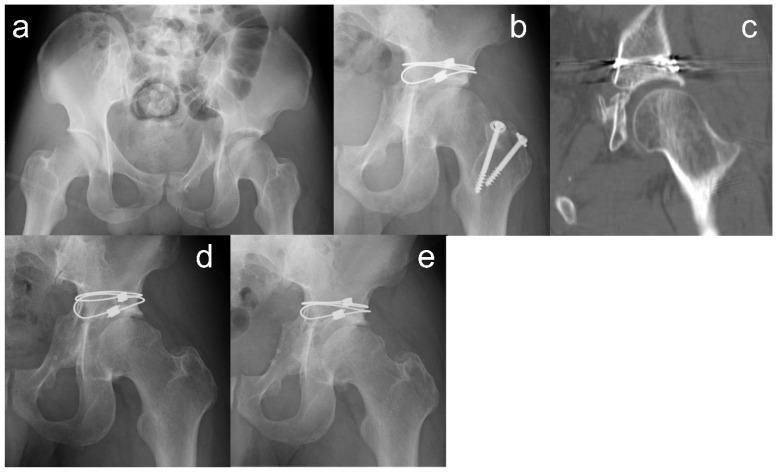
: Cerclage cable fixation with 2 mm multiple-braided cables for displaced acetabular fractures has shown good midterm functional and radiographic outcomes. We retrospectively evaluated the clinical and radiographic outcomes of cerclage cable fixations over ten years. : We extracted data for patients who underwent cerclage cable fixation for acetabular fractures at a single institution from 2007 to 2012. We adopted this procedure for acetabulum fractures with posterior column fractures. Postoperative reduction quality, complications, reoperations, and Japanese Orthopedic Association (JOA) hip objective functional scores were analyzed. Postoperative reduction quality was classified using plain radiography and computed tomography. : We evaluated nine patients with a mean follow-up period of 14.1 ± 2.6 years (range: 10.8-18.1 years). The mean age was 47.1 ± 15.5 years old (range: 28-74 years); the mean injury severity score was 13.6 ± 4.7 (range: 9-22). The most frequent type of fracture was a both-column fracture. Anatomical reduction quality was achieved in five cases. Four patients had hip osteoarthritis at the last follow-up; among them, one patient had worsening hip arthritis > 5 years after surgery, and one patient developed osteoarthritis > 10 years after surgery. Their postoperative reduction quality was worse than their anatomical reduction quality, and both engaged in physical labor. None of the patients underwent revision total hip arthroplasty. The mean JOA hip score was 90.9 ± 7.9 (range: 74-100); seven patients scored >90 at the last follow-up. : Cerclage cable fixation showed satisfactory postoperative reductions and favorable long-term clinical outcomes. Long-term follow-up might be necessary for patients whose postoperative reduction is not anatomical to detect late occurrence of hip osteoarthritis, even if osteoarthritis is not evident during short-term follow-up periods.
: 对于髋臼骨折,采用 2mm 多股编织线进行环扎电缆固定,中期功能和影像学结果良好。我们回顾性评估了单一机构在十年间采用环扎电缆固定治疗髋臼骨折的临床和影像学结果。: 我们提取了 2007 年至 2012 年期间在一家机构接受环扎电缆固定治疗髋臼骨折的患者数据。我们采用这种方法治疗后柱骨折的髋臼骨折。分析了术后复位质量、并发症、再次手术和日本骨科协会(JOA)髋关节客观功能评分。术后复位质量采用 X 线和平扫 CT 进行分类。: 我们评估了 9 例患者,平均随访时间为 14.1 ± 2.6 年(范围:10.8-18.1 年)。平均年龄为 47.1 ± 15.5 岁(范围:28-74 岁);平均损伤严重程度评分为 13.6 ± 4.7(范围:9-22)。最常见的骨折类型为双柱骨折。5 例达到解剖复位质量。4 例患者在末次随访时患有髋关节骨关节炎;其中 1 例患者术后 5 年以上髋关节关节炎加重,1 例患者术后 10 年以上出现骨关节炎。他们的术后复位质量比解剖复位质量差,且均从事体力劳动。所有患者均未接受翻修全髋关节置换术。JOA 髋关节评分为 90.9 ± 7.9(范围:74-100);7 例患者在末次随访时评分 >90。: 环扎电缆固定术后复位满意,长期临床效果良好。对于术后复位不是解剖复位的患者,需要长期随访,以发现晚期髋关节骨关节炎的发生,即使在短期随访期间没有明显的骨关节炎。

 Zotero 插件