Department of Physiology, Centre for Neuroendocrinology, School of Biomedical Sciences, University of Otago, Dunedin 9054, New Zealand.
Endocrinology. 2024 Nov 26;166(1). doi: 10.1210/endocr/bqae152.
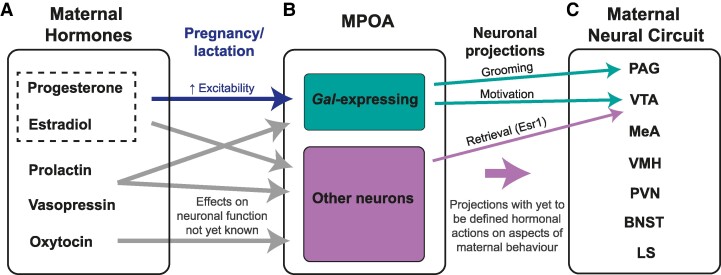
The importance of hormones in mediating a behavioral transition in mammals from a virgin or nonparenting state to parental state was established around 50 years ago. Extensive research has since revealed a highly conserved neural circuit that underlies parental behavior both between sexes and between mammalian species. Within this circuit, hormonal action in the medial preoptic area of the hypothalamus (MPOA) has been shown to be key in timing the onset of parental behavior with the birth of offspring. However, the mechanism underlying how hormones act in the MPOA to facilitate this change in behavior has been unclear. Technical advances in neuroscience, including single cell sequencing, novel transgenic approaches, calcium imaging, and optogenetics, have recently been harnessed to reveal new insights into maternal behavior. This review aims to highlight how the use of these tools has shaped our understanding about which aspects of maternal behavior are regulated by specific hormone activity within the MPOA, how hormone-sensitive MPOA neurons integrate within the wider neural circuit that governs maternal behavior, and how maternal hormones drive changes in MPOA neuronal function during different reproductive states. Finally, we review our current understanding of hormonal modulation of MPOA-mediated paternal behavior in males.
大约 50 年前,人们就已经确立了激素在介导哺乳动物从处女或非育儿状态向育儿状态的行为转变中的重要作用。此后,大量研究揭示了一个高度保守的神经回路,它是两性之间和哺乳动物物种之间亲代行为的基础。在这个回路中,下丘脑内侧视前区(MPOA)的激素作用被证明是控制亲代行为与后代出生时间的关键。然而,激素在 MPOA 中发挥作用以促进这种行为变化的机制尚不清楚。神经科学的技术进步,包括单细胞测序、新型转基因方法、钙成像和光遗传学,最近被用来揭示对母性行为的新见解。这篇综述旨在强调这些工具的使用如何使我们更好地了解特定激素活动如何调节 MPOA 中的哪些方面的母性行为,激素敏感的 MPOA 神经元如何在调节母性行为的更广泛的神经回路中整合,以及母性激素如何在不同的生殖状态下驱动 MPOA 神经元功能的变化。最后,我们回顾了我们目前对雄性中 MPOA 介导的父性行为的激素调节的理解。