Division Heart and Lungs, Laboratory of Experimental Cardiology, University Medical Center Utrecht, Utrecht, The Netherlands.
Julius Center for Health Sciences and Primary Care, University Medical Center Utrecht, Utrecht University, Utrecht, The Netherlands.
PLoS One. 2024 Nov 5;19(11):e0310023. doi: 10.1371/journal.pone.0310023. eCollection 2024.
Left ventricular ejection fraction (EF) is used to categorize heart failure (HF) into phenotypes but this information is often missing in electronic health records or non-HF registries.
We tested the applicability of a simplified version of a multivariable algorithm, that was developed on data of the Swedish Heart Failure Registry to predict EF in patients with HF. We used data from 4,868 patients with HF from the Cardiology Centers of the Netherlands database, an organization of 13 cardiac outpatient clinics that operate between the general practitioner and the hospital cardiologist. The algorithm included 17 demographical and clinical variables. We tested model discrimination, model performance and calculated model sensitivity, specificity, positive and negative predictive values for EF ≥ vs. <50% and EF ≥ vs. <40%. We additionally performed a multivariable multinomial analysis for all three separate HF phenotypes (with reduced, mildly reduced and preserved EF) HFrEF vs. HFmrEF vs. HFpEF. Finally, we internally validated the model by using temporal validation.
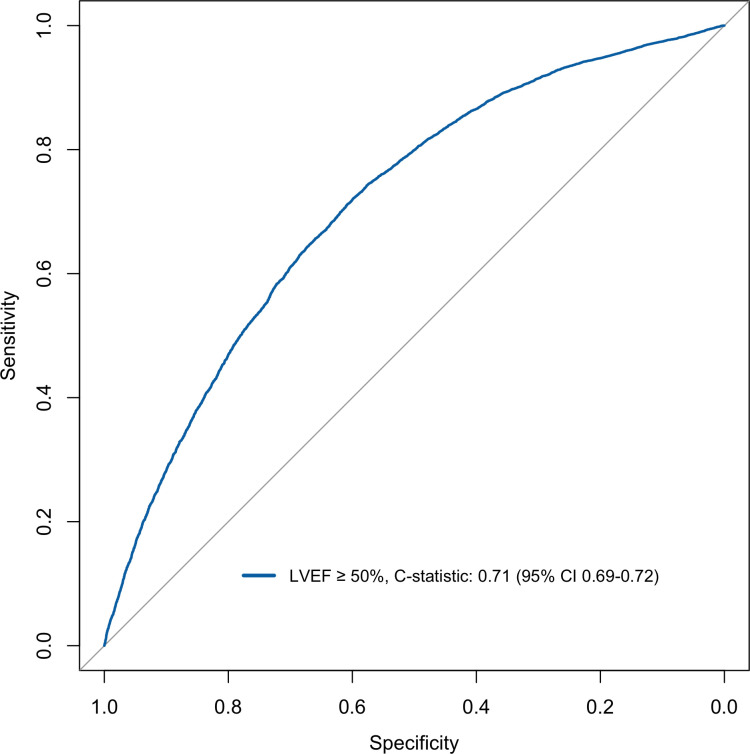
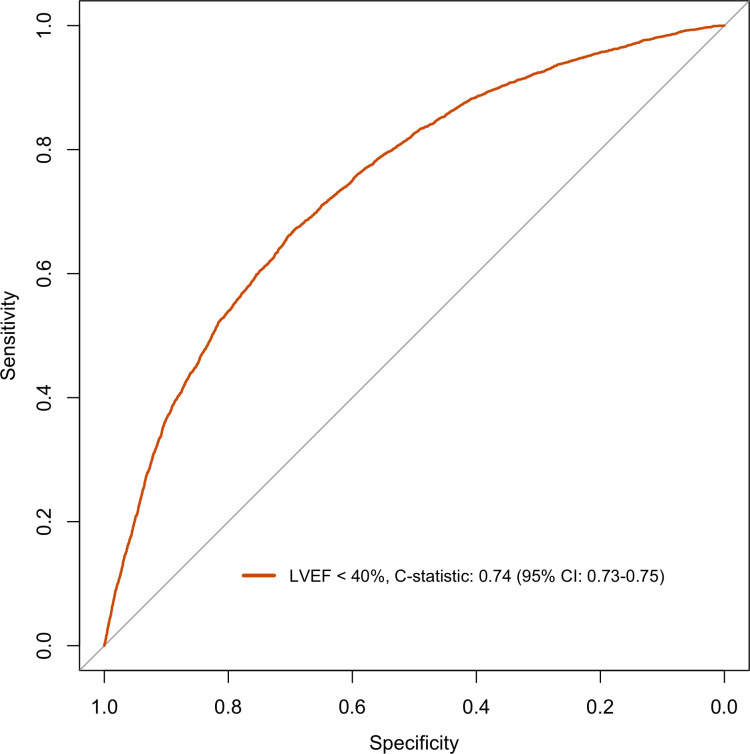
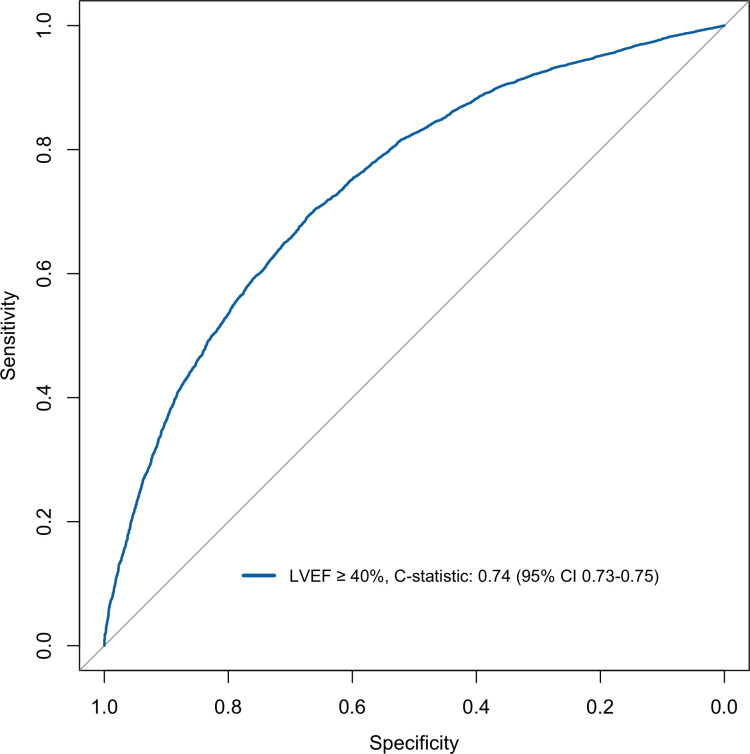
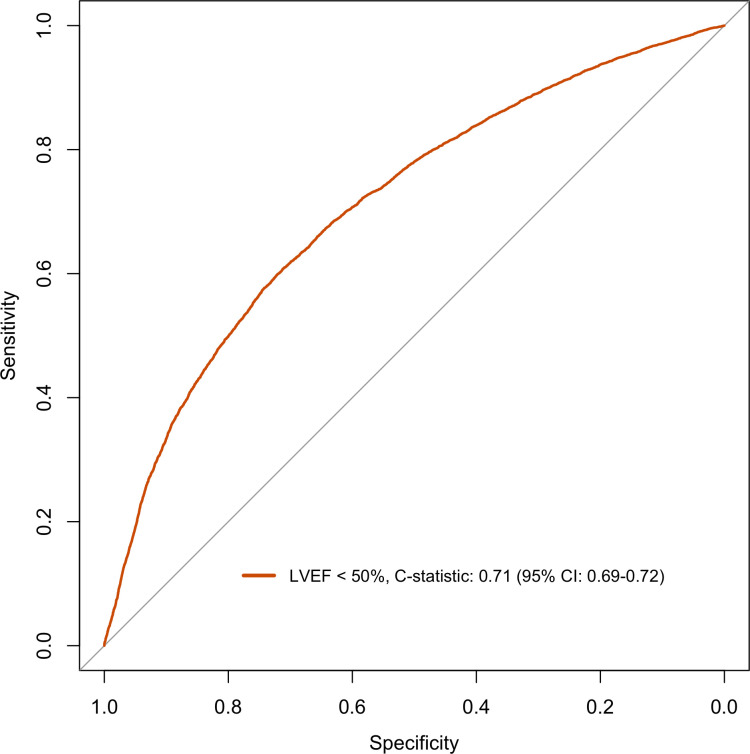
Mean age was 66 ±12 years, 44% of patients were women, 68% had HFpEF, 17% had HFrEF, and 15% had HFmrEF. The C-statistic was of 0.71 for EF ≥/< 50% (95% CI: 0.69-0.72) and of 0.74 (95% CI: 0.73-0.75) for EF ≥/< 40%. The model had the highest sensitivities for EF ≥50% (0.72, 95% CI: 0.63-0.75) and for EF ≥40% (0.70, 95% CI: 0.65-0.71). Similar results were achieved by the multinomial model, but the C-statistics for predicting HFpEF vs HFrEF was lower (0.61, 95% CI 0.58-0.63). The internal validation confirmed good discriminative ability.
A simple algorithm based on routine clinical characteristics can help discern HF phenotypes in non-cardiology datasets and research settings such as research on primary care data, where measurements of EF is often not available.
左心室射血分数(EF)用于将心力衰竭(HF)分为表型,但电子健康记录或非 HF 登记处通常缺少此信息。
我们测试了一种简化的多变量算法的适用性,该算法是在瑞典心力衰竭登记处的数据上开发的,用于预测 HF 患者的 EF。我们使用了来自荷兰心脏病学中心数据库的 4868 名 HF 患者的数据,该数据库是由 13 家心脏门诊组成的组织,在全科医生和医院心脏病专家之间运作。该算法包括 17 个人口统计学和临床变量。我们测试了模型的判别能力、性能,并计算了 EF≥与<50%和 EF≥与<40%的模型灵敏度、特异性、阳性和阴性预测值。我们还对所有三种单独的 HF 表型(射血分数降低、轻度降低和保留)进行了多变量多项分析,即射血分数降低性心力衰竭(HFrEF)与射血分数中间值降低性心力衰竭(HFmrEF)与射血分数保留性心力衰竭(HFpEF)。最后,我们通过使用时间验证来对模型进行内部验证。
平均年龄为 66±12 岁,44%的患者为女性,68%为 HFpEF,17%为 HFrEF,15%为 HFmrEF。EF≥/<50%的 C 统计量为 0.71(95%CI:0.69-0.72),EF≥/<40%的 C 统计量为 0.74(95%CI:0.73-0.75)。对于 EF≥50%(0.72,95%CI:0.63-0.75)和 EF≥40%(0.70,95%CI:0.65-0.71),该模型的灵敏度最高。多变量模型也得到了类似的结果,但预测 HFpEF 与 HFrEF 的 C 统计量较低(0.61,95%CI 0.58-0.63)。内部验证证实了该模型具有良好的判别能力。
基于常规临床特征的简单算法可以帮助在非心脏病学数据集和研究环境中识别 HF 表型,例如在初级保健数据研究中,EF 的测量通常不可用。