
类风湿关节炎和银屑病关节炎患者中抑郁、焦虑与无法实现病情缓解之间的关联。
Association between depression and anxiety and inability to achieve remission in rheumatoid arthritis and psoriatic arthritis.
作者信息
Snoeck Henkemans Selinde V J, Vis Marijn, Koc Gonul Hazal, Luime Jolanda J, Kok Marc R, Tchetverikov Ilja, van der Kooij Sjoerd M, Bijsterbosch Jessica, van der Helm-van Mil Annette H M, de Jong Pascal H P
机构信息
Department of Rheumatology, Erasmus MC, Rotterdam, The Netherlands.
Department of Rheumatology, Maasstad Hospital, Rotterdam, The Netherlands.
出版信息
Rheumatology (Oxford). 2025 May 1;64(5):2411-2421. doi: 10.1093/rheumatology/keae621.
OBJECTIVES
To investigate the association between depression and anxiety and the inability to achieve remission in RA and PsA patients. In addition, the association between depressive and anxiety symptoms and disease activity components was explored.
METHODS
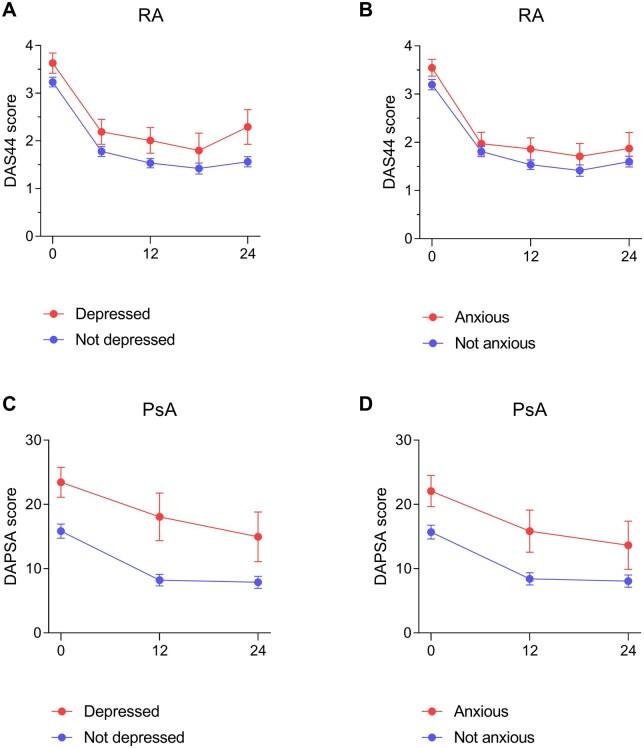
A total of 400 RA and 367 PsA patients from the tREACH and DEPAR were included, respectively. Patients had a possible depression or anxiety disorder if they scored >7 on the Hospital Anxiety and Depression Scale (HADS). Remission was defined as DAS44 <1.6 in RA and DAPSA ≤ 4 in PsA. Mixed models were used to assess the association between depression/anxiety, at any timepoint during 2 years, and remission during 2 years, and to explore which disease activity components are most influenced by depression/anxiety.
RESULTS
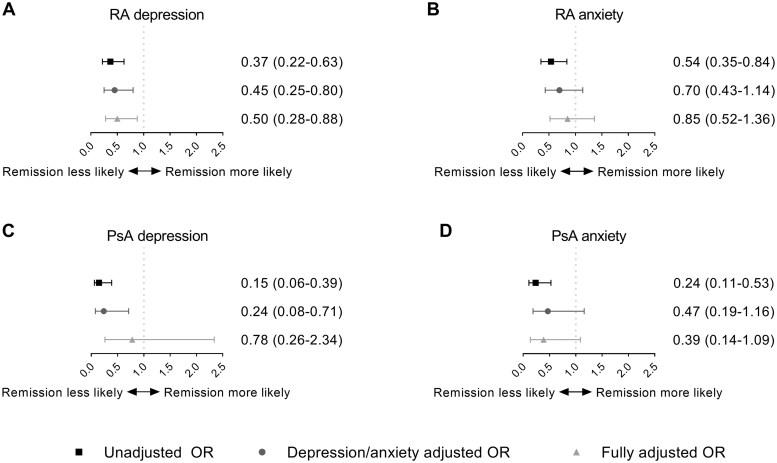
At baseline, 20% of RA patients had a possible depression and 30% a possible anxiety disorder. In PsA this was 18% and 23%. After adjustment for concurrent anxiety symptoms, depression was associated with a lower odds of achieving remission during 2 years of follow-up [OR 0.45 (95%CI 0.25-0.80) for RA and OR 0.24 (95%CI 0.08-0.71) for PsA]. Anxiety was not associated with remission after adjustment for concurrent depression symptoms. The presence of depression/anxiety was associated with higher tender joint count, worse general health, more pain and slightly elevated inflammation markers, but not with more swollen joints in both RA and PsA.
CONCLUSION
The presence of depressive symptoms in RA and PsA patients at baseline or during follow-up was associated with a lower likelihood of achieving remission. Healthcare professionals should, therefore, be aware of symptoms of depression.
目的
研究类风湿关节炎(RA)和银屑病关节炎(PsA)患者中抑郁和焦虑与无法实现病情缓解之间的关联。此外,还探讨了抑郁和焦虑症状与疾病活动成分之间的关联。
方法
分别纳入了来自tREACH和DEPAR研究的400例RA患者和367例PsA患者。如果患者在医院焦虑抑郁量表(HADS)上的得分>7,则可能患有抑郁或焦虑症。缓解的定义为RA患者的疾病活动度评分(DAS44)<1.6,PsA患者的疾病活动度评分(DAPSA)≤4。采用混合模型评估2年内任何时间点的抑郁/焦虑与2年内病情缓解之间的关联,并探讨哪些疾病活动成分受抑郁/焦虑影响最大。
结果
在基线时,20%的RA患者可能患有抑郁症,30%可能患有焦虑症。在PsA患者中,这一比例分别为18%和23%。在对并发焦虑症状进行调整后,抑郁与随访2年内病情缓解的较低几率相关[RA患者的比值比(OR)为0.45(95%置信区间[CI]为0.25 - 0.80),PsA患者的OR为0.24(95%CI为0.08 - 0.71)]。在对并发抑郁症状进行调整后,焦虑与病情缓解无关。抑郁/焦虑的存在与压痛关节计数增加、总体健康状况较差、疼痛更多以及炎症标志物略有升高有关,但在RA和PsA患者中均与肿胀关节增多无关。
结论
RA和PsA患者在基线或随访期间出现抑郁症状与病情缓解的可能性较低有关。因此,医疗保健专业人员应注意抑郁症状。


 Zotero 插件