Sharma Ritika, Rana Dharmender Singh, Awasthi Abhishek, Singh Dilbag, Ibrahim Ahmed A, Umar Ahmad, Baskoutas Sotirios
Department of Environmental Sciences, Central University of Himachal Pradesh, Dharamshala, 176215, HP, India.
Department of Physics, MLSM College Sunder Nagar, Chaterokhri, Mandi, HP, India.
Heliyon. 2024 Oct 11;10(20):e39090. doi: 10.1016/j.heliyon.2024.e39090. eCollection 2024 Oct 30.
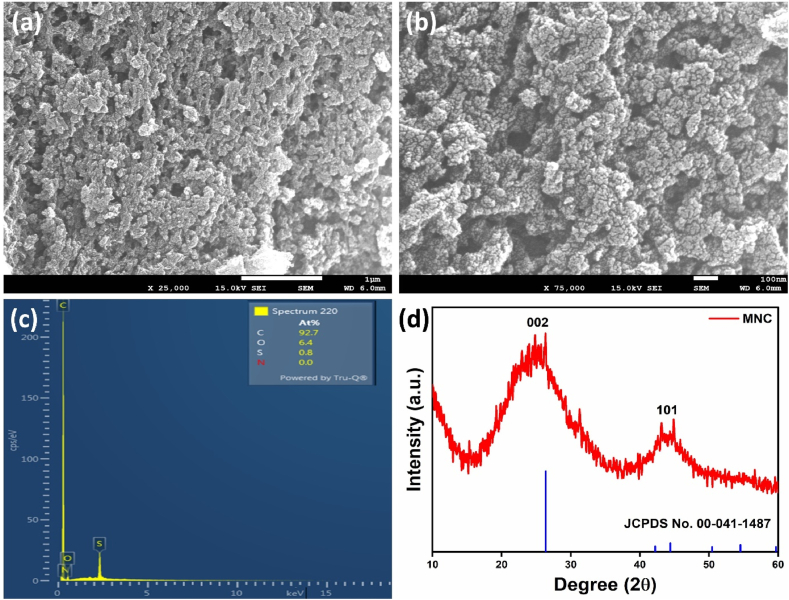
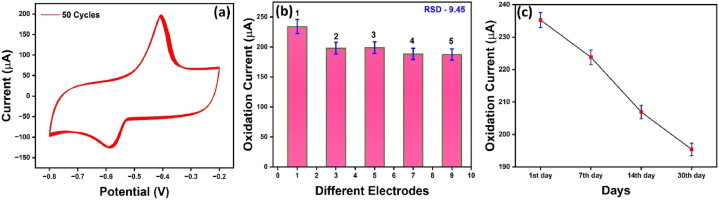
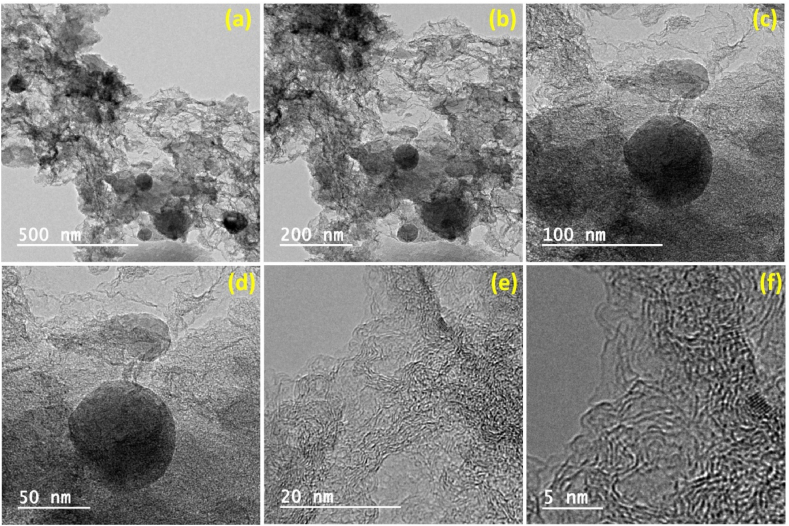
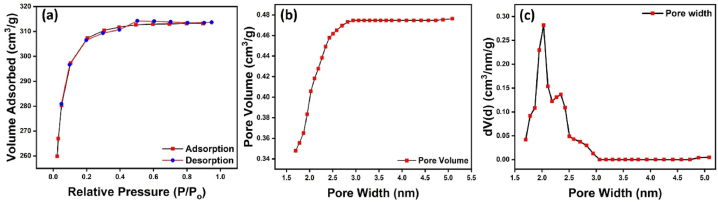
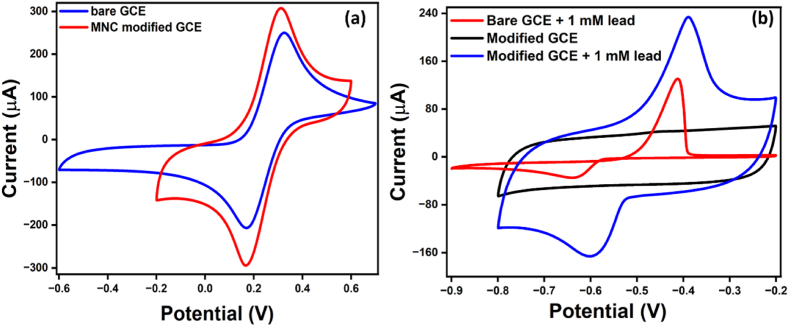
This study has explored the sustainable solution after designing an economical metal-free biomass-derived nanocarbon for the selective sensing of lead. The nitrogen and sulfur-rich mesoporous nanocarbon is designed through a facile hydrothermal-assisted thermal annealing method. The high-temperature treatment gave nanocarbon unique carbon dot decorated layered morphology, while nitrogen and sulfur precursor thiourea and melamine strengthened the nanomaterial stability, sensitivity, and selectivity toward lead metal ions. The high specific surface area of mesoporous nanocarbon viz., 1671.93 m/g with the pore width and pore volume of 2.02 nm and 0.476 cm/g has enhanced the conductivity of as-synthesized sensor, which helps in increasing sensitivity toward lead. The high conductivity was also confirmed through cyclic voltammetry, where an 80 % increment in current was observed in the case of the modified electrode when compared with bare GCE. The differential pulse normal voltammetry and differential pulse anodic stripping voltammetry were performed to calculate the detection limit, where an excellent detection limit of 22 nM was obtained from the DPASV technique. Moreover, the nanomaterial was also tested for detecting lead in tap water. The as-synthesized nanocomposite is highly efficient and selective for the detection of lead. This study will motivate the researchers to engineer sustainable and efficient devices for sensing metal pollutants.
本研究在设计出一种用于选择性检测铅的经济实惠的无金属生物质衍生纳米碳之后,探索了可持续的解决方案。通过简便的水热辅助热退火方法设计出了富含氮和硫的介孔纳米碳。高温处理赋予了纳米碳独特的碳点修饰层状形态,而氮和硫前驱体硫脲和三聚氰胺增强了纳米材料对铅金属离子的稳定性、灵敏度和选择性。介孔纳米碳的高比表面积,即1671.93 m/g,孔径为2.02 nm,孔体积为0.476 cm/g,提高了合成传感器的导电性,这有助于提高对铅的灵敏度。通过循环伏安法也证实了高导电性,与裸玻碳电极相比,修饰电极的电流增加了80%。进行差分脉冲正常伏安法和差分脉冲阳极溶出伏安法以计算检测限,通过差分脉冲阳极溶出伏安法技术获得了22 nM的优异检测限。此外,还对该纳米材料进行了自来水中铅检测的测试。合成的纳米复合材料对铅的检测具有高效性和选择性。这项研究将激励研究人员设计出可持续且高效的金属污染物传感装置。