
基于胰岛素样生长因子-1(IGF-1)的产生,右美托咪定预处理神经元细胞对氧糖剥夺/复氧期间的细胞死亡具有保护作用。
Dexmedetomidine Pretreatment of Neuronal Cells Has Protective Effect Against Cell Death During Oxygen-glucose Deprivation/Reoxygenation, Based on IGF-1 Production.
作者信息
Yamane Yui, Li Xiaojia, Hanafusa Kei, Nakayama Hitoshi, Watanabe Koji, Iwabuchi Kazuhisa, Hayashida Masakazu
出版信息
Juntendo Iji Zasshi. 2024 Sep 11;70(5):360-367. doi: 10.14789/jmj.JMJ23-0037-OA. eCollection 2024.
OBJECTIVE
Insulin-like growth factor 1 (IGF-1) protects neuronal-cell damage by ischemia. Although neuronal cells have been reported to produce IGF-1, the molecular mechanisms remains obscure. Dexmedetomidine (DEX) protects neuronal cells from ischemic damage. We investigated the involvement of IGF-1 in the effect of DEX pretreatment on neuronal ischemic damage using an mouse hippocampal neuron model.
MATERIALS
We used Dexmedetomidine and cryopreserved passaged mouse hippocampal neuronal HT22. Other reagents in this study were analytical grade.
METHODS
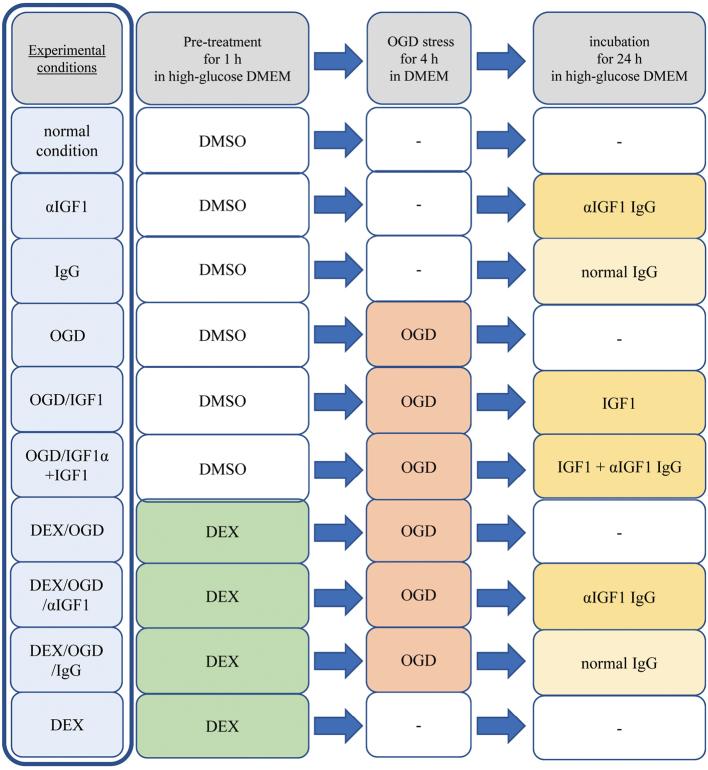
Ischemia-reperfusion was modeled using the oxygen-glucose deprivation/reoxygenation (OGD/R). The effect of DEX was examined by incubating cells in DEX-containing medium for 1 hour prior to OGD/R. The cell damages were evaluated by lactate dehydrogenase (LDH) release. The amount of released IGF-1 were evaluated quantitatively by ELISA. The degree of Akt phosphorylation was evaluated by western blotting.
RESULTS
OGD/R loading promoted LDH release from neuronal cells, while DEX pretreatment suppressed the LDH release. IGF-1 release from them was primed by DEX pretreatment under OGD/R condition, but not under normal conditions. Akt was activated in DEX-pretreated cells following OGD/R loading. IGF-1 neutralizing antibody (IGF-1) eliminated the above effects of DEX pretreatment. However, IGF-1 receptor expression in neuronal cells was not affected by DEX pretreatment prior to OGD/R loading.
CONCLUSIONS
Our results demonstrate that neuronal cells primed with DEX under OGD/R conditions could release IGF-1 and potentially protect themselves via the IGF-1/Akt pathway. Consequently, it appears that neuronal cells activated by DEX have the capacity to self-protect from ischemic damage.
目的
胰岛素样生长因子1(IGF-1)可保护神经元细胞免受缺血损伤。尽管已有报道称神经元细胞可产生IGF-1,但其分子机制仍不清楚。右美托咪定(DEX)可保护神经元细胞免受缺血损伤。我们使用小鼠海马神经元模型研究了IGF-1在DEX预处理对神经元缺血损伤作用中的参与情况。
材料
我们使用了右美托咪定和冻存传代的小鼠海马神经元HT22。本研究中的其他试剂均为分析纯级。
方法
采用氧糖剥夺/复氧(OGD/R)模拟缺血再灌注。在OGD/R之前,将细胞在含DEX的培养基中孵育1小时,以检测DEX的作用。通过乳酸脱氢酶(LDH)释放评估细胞损伤。通过酶联免疫吸附测定法(ELISA)定量评估释放的IGF-1量。通过蛋白质免疫印迹法评估Akt磷酸化程度。
结果
OGD/R处理促进了神经元细胞中LDH的释放,而DEX预处理抑制了LDH的释放。在OGD/R条件下,DEX预处理可引发它们释放IGF-1,但在正常条件下则不会。OGD/R处理后,DEX预处理的细胞中Akt被激活。IGF-1中和抗体消除了DEX预处理的上述作用。然而,OGD/R处理前,DEX预处理对神经元细胞中IGF-1受体表达没有影响。
结论
我们的结果表明,在OGD/R条件下用DEX预处理的神经元细胞可释放IGF-1,并可能通过IGF-1/Akt途径自我保护。因此,DEX激活的神经元细胞似乎有能力自我保护免受缺血损伤。



 Zotero 插件