
血清抗登革热病毒抗体的损耗与抗严重急性呼吸综合征冠状病毒2 IgG水平高以及蚊媒中登革热病毒阳性率低相关——印度泰米尔纳德邦一项全州范围基于社区的整群随机研究的结果
Attrition in serum anti-DENV antibodies correlates with high anti-SARS-CoV-2 IgG levels and low DENV positivity in mosquito vectors-Findings from a state-wide cluster-randomized community-based study in Tamil Nadu, India.
作者信息
Selvavinayagam Sivaprakasam T, Sankar Sathish, Yong Yean K, Anshad Abdul R, Chandramathi Samudi, Somasundaram Anavarathan, Palani Sampath, Kumarasamy Parthipan, Azhaguvel Roshini, Kumar Ajith B, Subramaniam Sudharshini, Malathi Manickam, Vijayalakshmi Venkatachalam, Rajeshkumar Manivannan, Kumaresan Anandhazhvar, Pandey Ramendra P, Muruganandam Nagarajan, Gopalan Natarajan, Kannan Meganathan, Murugesan Amudhan, Balakrishnan Pachamuthu, Byrareddy Siddappa N, Dash Aditya P, Velu Vijayakumar, Larsson Marie, Shankar Esaki M, Raju Sivadoss
机构信息
State Public Health Laboratory, Directorate of Public Health and Preventive Medicine, DMS Campus, Teynampet, Chennai, Tamil Nadu, India.
Department of Microbiology, Saveetha Dental College and Hospitals, Saveetha Institute of Medical and Technical Sciences, Centre for Infectious Diseases, Saveetha University, Chennai, Tamil Nadu, India.
出版信息
PLOS Glob Public Health. 2024 Nov 21;4(11):e0003608. doi: 10.1371/journal.pgph.0003608. eCollection 2024.
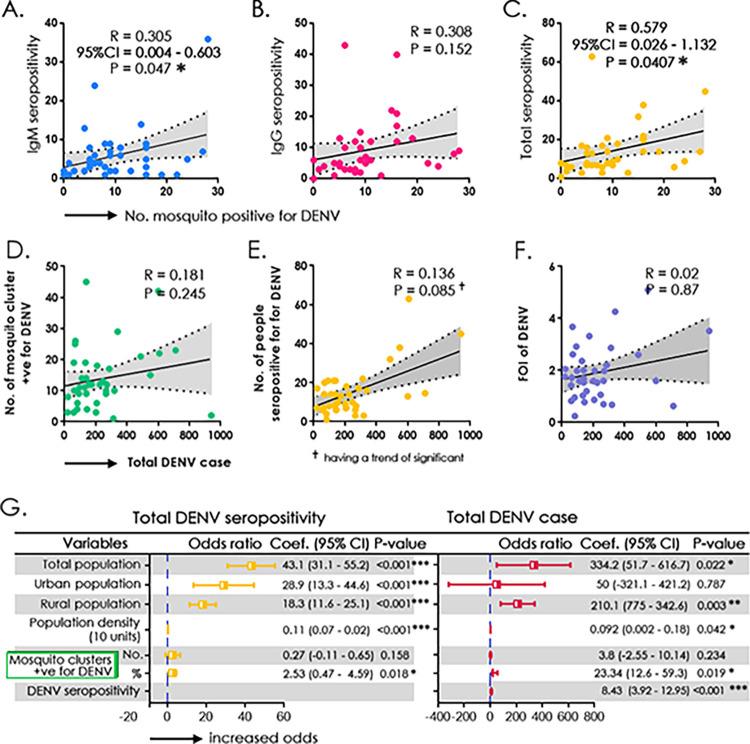
The decline in dengue incidence and/or prevalence during the COVID-19 pandemic (2020-22) appears to be attributed to reduced treatment-seeking rates, under-reporting, misdiagnosis, disrupted health services and reduced exposure to mosquito vectors due to prevailing lockdowns. There is limited scientific data on dengue virus (DENV) disease during the COVID-19 pandemic. Here, we conducted a community-based, cross-sectional, cluster-randomized survey to assess anti-DENV and anti-SARS-CoV-2 seroprevalence, and also estimated the spatial distribution of DENV-positive aedine mosquito vectors during the COVID-19 pandemic across all the 38 districts of Tamil Nadu, India. Using real-time PCR, the prevalence of DENV in mosquito pools during 2021 was analyzed and compared with the previous and following years of vector surveillance, and correlated with anti-DENV IgM and IgG levels in the population. Results implicate that both anti-DENV IgM and IgG seroprevalence and DENV positivity in mosquito pools were reduced across all the districts. A total of 13464 mosquito pools and 5577 human serum samples from 186 clusters were collected. Of these, 3.76% of the mosquito pools were positive for DENV. In the human sera, 4.12% were positive for anti-DENV IgM and 6.4% for anti-DENV IgG. While the anti-SARS-CoV-2 levels significantly correlated with overall DENV seropositivity, COVID-19 vaccination status significantly correlated with anti-DENV IgM levels. The study indicates a profound impact of anti-SARS-CoV-2 levels on DENV-positive mosquito pools and seropositivity. Continuous monitoring of anti-DENV antibody levels, especially with the evolving variants of SARS-CoV-2 and the surge in COVID-19 cases will shed light on the distribution, transmission and therapeutic attributes of DENV infection.
2019-2022年新冠疫情期间登革热发病率和/或流行率的下降似乎归因于就诊率降低、报告不足、误诊、卫生服务中断以及由于普遍实施封锁导致接触蚊媒的机会减少。关于新冠疫情期间登革热病毒(DENV)疾病的科学数据有限。在此,我们开展了一项基于社区的横断面整群随机调查,以评估抗DENV和抗SARS-CoV-2血清阳性率,并估计印度泰米尔纳德邦38个区在新冠疫情期间DENV阳性伊蚊媒介的空间分布。使用实时聚合酶链反应(PCR)分析了2021年蚊虫样本中DENV的流行率,并与之前和之后年份的媒介监测数据进行比较,并与人群中的抗DENV IgM和IgG水平相关联。结果表明,所有区的抗DENV IgM和IgG血清阳性率以及蚊虫样本中的DENV阳性率均有所下降。共收集了来自186个群组的13464份蚊虫样本和5577份人类血清样本。其中,3.76%的蚊虫样本DENV呈阳性。在人类血清中,4.12%的抗DENV IgM呈阳性,6.4%的抗DENV IgG呈阳性。虽然抗SARS-CoV-第2水平与总体DENV血清阳性率显著相关,但新冠疫苗接种状况与抗DENV IgM水平显著相关。该研究表明抗SARS-CoV-2水平对DENV阳性蚊虫样本和血清阳性率有深远影响。持续监测抗DENV抗体水平,尤其是随着SARS-CoV-2变异株的演变和新冠病例的激增,将有助于了解DENV感染的分布、传播和治疗特性。


 Zotero 插件