Barbosa Ribeiro Bruno, Marques João Heitor, Baptista Pedro Manuel, Sousa Paulo J M, Pires Saúl, Menéres Pedro, Barbosa Irene
Department of Ophthalmology, Unidade Local de Saúde Santo António, Porto, Portugal.
School of Medicine and Biomedical Sciences (ICBAS), University of Porto, Porto, Portugal.
Clin Ophthalmol. 2024 Nov 20;18:3313-3320. doi: 10.2147/OPTH.S480704. eCollection 2024.
To study corneal epithelial thickness in patients with Dry Eye Disease (DED), according to symptomatology.
Cross-sectional study in the outpatient clinic of the Ophthalmology Department of a tertiary hospital in Oporto, Portugal. Adult patients with a clinical diagnosis of dry eye disease were eligible for participation. Each patient underwent corneal epithelial thickness mapping with swept-source optical coherence tomography (SS-OCT, Heidelberg Anterion) and automated ocular surface analysis (IDRA Ocular Surface Analyzer SBM Sistemi, Italy). Schirmer's test, tear film osmolarity (by TearLab Osmolarity System) and Dry-Eye Related Questionnaire (OSDI-12) were also evaluated. Patients were classified accordingly the severity of symptoms in the OSDI-12 in group 1 (mild disease) and group 2 (moderate to severe disease).
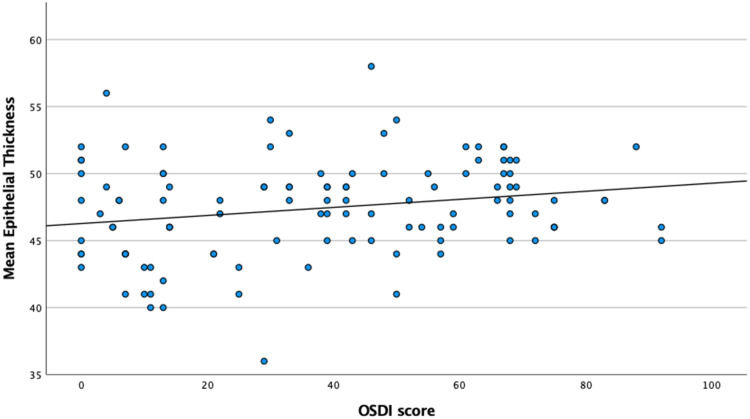
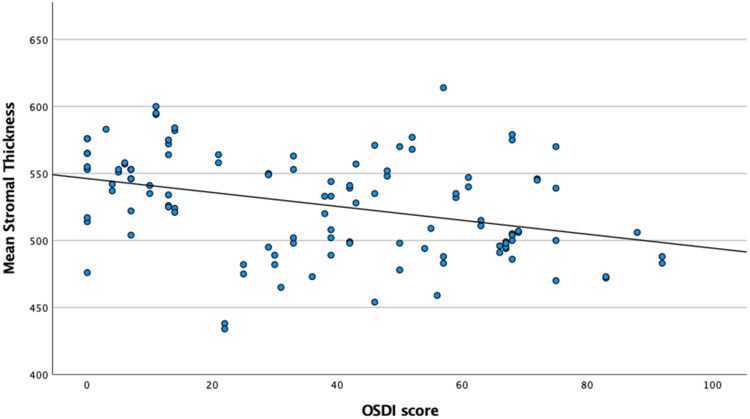
We enrolled 200 eyes (of 100 subjects): 65 in group 1 and 135 in group 2. Median OSDI and Schirmer's test in group 1 was 7 vs 46 points, p<0.001 and 15 vs 11 mm, p=0.007 in group 2. Eyes from group 2 showed higher mean epithelial thickness (48.4 vs 47.1 µm, p=0.027) and lower mean stromal thickness (522.0 vs 546.6 µm, p<0.001) in comparison with group 1. OSDI score was positively correlated with the mean epithelial thickness (r=0.188, p=0.008) and epithelial variability index (r=0.277, p=0.004) and negatively correlated with the mean stromal thickness (r=-0.313, p<0.001). Patients in group 2 showed higher epithelial variability index (4.5 vs 3.2, p<0.001).
Our study suggests that patients with more severe DED symptoms have thicker corneal epithelia and thinner stroma, which may act as a compensatory response. Epithelial variability index is positively correlated with the OSDI score and may reflect DED severity. This is the first study to report stromal thinning in patients with DED, thereby proving novel information regarding the matter. More studies are needed to confirm these results.
根据症状学研究干眼病(DED)患者的角膜上皮厚度。
在葡萄牙波尔图一家三级医院眼科门诊进行的横断面研究。临床诊断为干眼病的成年患者符合参与条件。每位患者均接受扫频光学相干断层扫描(SS - OCT,海德堡Anterion)进行角膜上皮厚度测绘以及自动眼表分析(IDRA眼表分析仪SBM Sistemi,意大利)。还评估了泪液分泌试验、泪膜渗透压(通过TearLab渗透压系统)和干眼相关问卷(OSDI - 12)。根据OSDI - 12中症状的严重程度将患者分为1组(轻度疾病)和2组(中度至重度疾病)。
我们纳入了200只眼(100名受试者):1组65只眼,2组135只眼。1组的OSDI中位数和泪液分泌试验分别为7分对46分,p<0.001;2组分别为15毫米对11毫米,p = 0.007。与1组相比,2组的眼睛显示出更高的平均上皮厚度(48.4对47.1 µm,p = 0.027)和更低的平均基质厚度(522.0对546.6 µm,p<0.001)。OSDI评分与平均上皮厚度(r = 0.188,p = 0.008)和上皮变异指数(r = 0.277,p = 0.004)呈正相关,与平均基质厚度(r = - 0.313,p<0.001)呈负相关。2组患者的上皮变异指数更高(4.5对3.2,p<0.001)。
我们的研究表明,DED症状更严重的患者角膜上皮更厚,基质更薄,这可能是一种代偿反应。上皮变异指数与OSDI评分呈正相关,可能反映DED的严重程度。这是第一项报道DED患者基质变薄的研究,从而提供了关于该问题的新信息。需要更多研究来证实这些结果。